
Horse Care · 19 November 2026
Why Horses Wear Shoes, and Whether Every Horse Needs Them
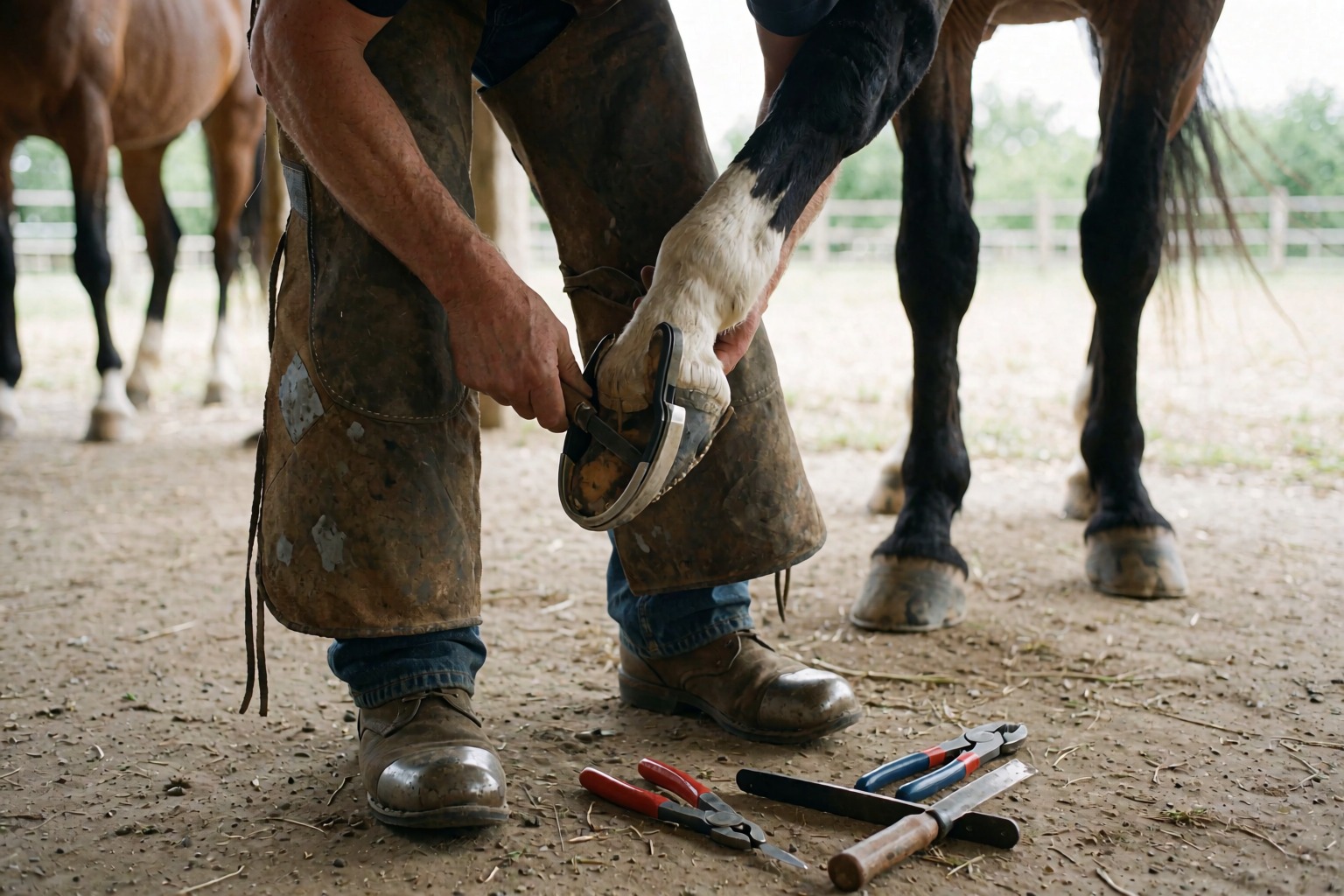
Horses wear shoes to stop the hoof wearing down faster than it can grow back. A horse's hoof wall is made of the same kind of material as a fingernail, built up in layers from the coronary band at the top of the hoof down to the ground. In the wild, that steady growth usually keeps pace with wear, because wild horses cover long distances over soft or mixed ground rather than standing on hard surfaces for hours at a time. A ridden horse, especially one working on roads, stony tracks or hard arenas, often wears its hooves away faster than nature intended. The shoe is simply a layer of protection between the hoof and the ground, taking the wear so the hoof itself doesn't have to.
What does a horseshoe actually do?
A shoe takes the brunt of the wear so the hoof wall stays intact for longer between trims. It also gives the horse grip and support on different surfaces, which matters more than it might sound: a horse cantering on wet grass, standing in a muddy gateway, or working on a hard road surface all need different amounts of traction, and a shoe can be built or adapted for each. In some cases a farrier uses shoeing to ease the load on a particular part of the foot, which matters for a horse recovering from an injury, managing a long-term joint problem, or being treated for a condition like laminitis.
Shoes aren't just flat strips of metal either. There are shoes with studs built in for grip on wet or slippery ground, lighter shoes for horses that don't need much bulk underfoot, and specialist shoes a vet or farrier might prescribe as part of a treatment plan, such as a shoe with a raised heel or extra support built into the sole. The right shoe depends on the individual horse, its job, and the ground it stands on most of the time. There isn't a single correct shoe that suits every horse, the way there isn't a single correct pair of shoes for every person doing every job.
What a shoe doesn't do is make a hoof healthier on its own. The hoof underneath still needs to be the right shape and properly balanced before a shoe goes anywhere near it. Nailing a shoe onto a badly trimmed foot just protects whatever problem is already there rather than fixing it, which is why the trim always comes before the shoe, never the other way round.
Why do some horses go barefoot?
Some horses go barefoot because their hooves are naturally tough enough, and their workload light enough, that the hoof doesn't wear down faster than it grows. A horse living mostly in a field, doing gentle hacking on grass or soft tracks, is a very different proposition to a horse in full work on roads, in an arena several times a week, or competing regularly on firm going. The first horse may never need a shoe in its life. The second often will.
Hoof shape and quality vary a great deal between individual horses, in much the same way nails and skin vary between people. Native breeds and ponies, bred over generations on rough hill or moorland ground, often have naturally harder, more compact feet than horses bred for speed or size on softer pasture. That isn't a rule that holds for every single horse of that type, but it's part of why some yards run entirely barefoot and others shoe almost everything they own.
Going barefoot is also a deliberate choice some owners make for a horse that would normally be shod. It's usually done alongside a careful trimming routine from a farrier experienced in barefoot work, plus a gradual change in surfaces and workload that lets the hoof toughen up over weeks rather than days. It isn't something to switch into overnight. A horse coming out of shoes after years of being shod will typically need time, and sometimes hoof boots for harder ground or longer rides, before its feet catch up with the work being asked of them.
The honest answer to "does my horse need shoes" is that it depends on the individual: the ground they're worked on, how much work they're doing, the natural strength of their hoof, and whether they stay sound and comfortable without shoes on. Most vets and equine welfare charities treat this as a case-by-case decision between an owner, their farrier and, where there's a health question involved, their vet, rather than a blanket rule that applies the same way to every horse.
What does the farrier actually do, and how often?
A farrier trims the hoof back to the correct shape and balance whether or not the horse is being shod. If it is being shod, they then remove the old shoe, trim and assess the foot, and shape and fit a new shoe, either hot (shaped in a forge at high temperature) or cold (shaped without heat), depending on the method and the job. The hoof keeps growing all the time, rather like a fingernail, so even a barefoot horse still needs a regular trim. Left too long, an untrimmed foot grows out of balance, and the wall can crack, chip or split unevenly as it takes the horse's weight at the wrong angle.
A general rule many yards work to is a farrier visit roughly every four to eight weeks, with the exact gap depending on how fast that particular horse's feet grow, the time of year, and whether the horse is shod or barefoot. Growth tends to slow down in winter and speed up again on spring grass, so the same horse might comfortably go a little longer between visits in December than it would in May. A horse with naturally fast-growing feet, or one doing hard work that pulls shoes loose, may need visits nearer the four-week end of that range. Your own farrier, who actually handles your horse's feet on a regular basis, is the right person to set that schedule, rather than a fixed number copied from somewhere else.
Between scheduled visits, an owner's job is mostly about watching and reporting rather than doing anything to the foot themselves. A shoe that's come loose, twisted sideways, or been lost altogether in the field shouldn't wait for the next booked appointment. Neither should a split or crack in the hoof wall that's visibly widening, or a horse that's suddenly short-striding, footy on hard ground, or reluctant to turn in one direction when none of that was true the week before. A quick phone call to the farrier to ask whether it can wait or needs an earlier look costs nothing and often saves a much bigger problem later.
It's also worth knowing what a farrier doesn't do. They aren't vets, and a good farrier will say so themselves if what they're looking at doesn't look like a straightforward shoeing or trimming issue. That boundary matters, because knowing which professional to call, and when, is often the difference between a problem that's sorted in a day and one that drags on because it went to the wrong person first.
When a hoof problem needs a vet, not just a farrier
A farrier deals with trimming, balance and shoeing. A vet is the right call when something looks or feels like pain or illness rather than a straightforward maintenance job. Heat in the hoof that doesn't settle, a strong or bounding digital pulse felt at the back of the fetlock, sudden lameness, a horse reluctant to put any weight on a foot, or swelling above the hoof are all reasons to ring the vet rather than wait for the farrier's next scheduled visit.
Laminitis is the clearest example of why that distinction matters. It's a painful inflammation of the tissues inside the hoof, often linked to diet, weight or an underlying hormonal condition, and it needs prompt veterinary attention rather than just a change of shoeing. A farrier may well be brought in afterwards as part of managing the horse's feet through recovery, sometimes fitting special supportive shoes or pads, but that work happens alongside the vet's treatment plan, never instead of it. Sudden foot pain, unusual heat, or a reluctance to move is always worth a vet call first, because by the time a horse is visibly lame, the underlying problem has usually been building for some time already.
An abscess is another common cause of sudden, severe lameness that can look alarming but often resolves well once found and drained, usually by a vet or in some cases a farrier working with the vet's guidance. The horse can go from sound to barely able to walk on that foot within hours, which understandably worries owners, but a prompt call to get it looked at properly usually sorts it within days.
A good rule for any owner, new or experienced, is simple: routine trimming and shoeing is the farrier's job, and anything that looks like pain, infection or a sudden change in how the horse is moving is the vet's job first. If you're ever unsure which one you're looking at, ring the vet. It's far better to be told it was nothing than to miss something that mattered.
Shoes aren't a badge of a "proper" horse, and bare feet aren't automatically healthier. Both are simply tools for managing the same underlying thing: a hoof that's being asked to cope with a particular workload on particular ground. The right answer for your own horse is whichever one keeps it sound, comfortable and moving well, worked out with a farrier who actually looks at its feet rather than guessed from a general rule someone else follows.