Horse Habits · 16 November 2026
Why Horses Sleep Standing Up, and When They Lie Down Completely
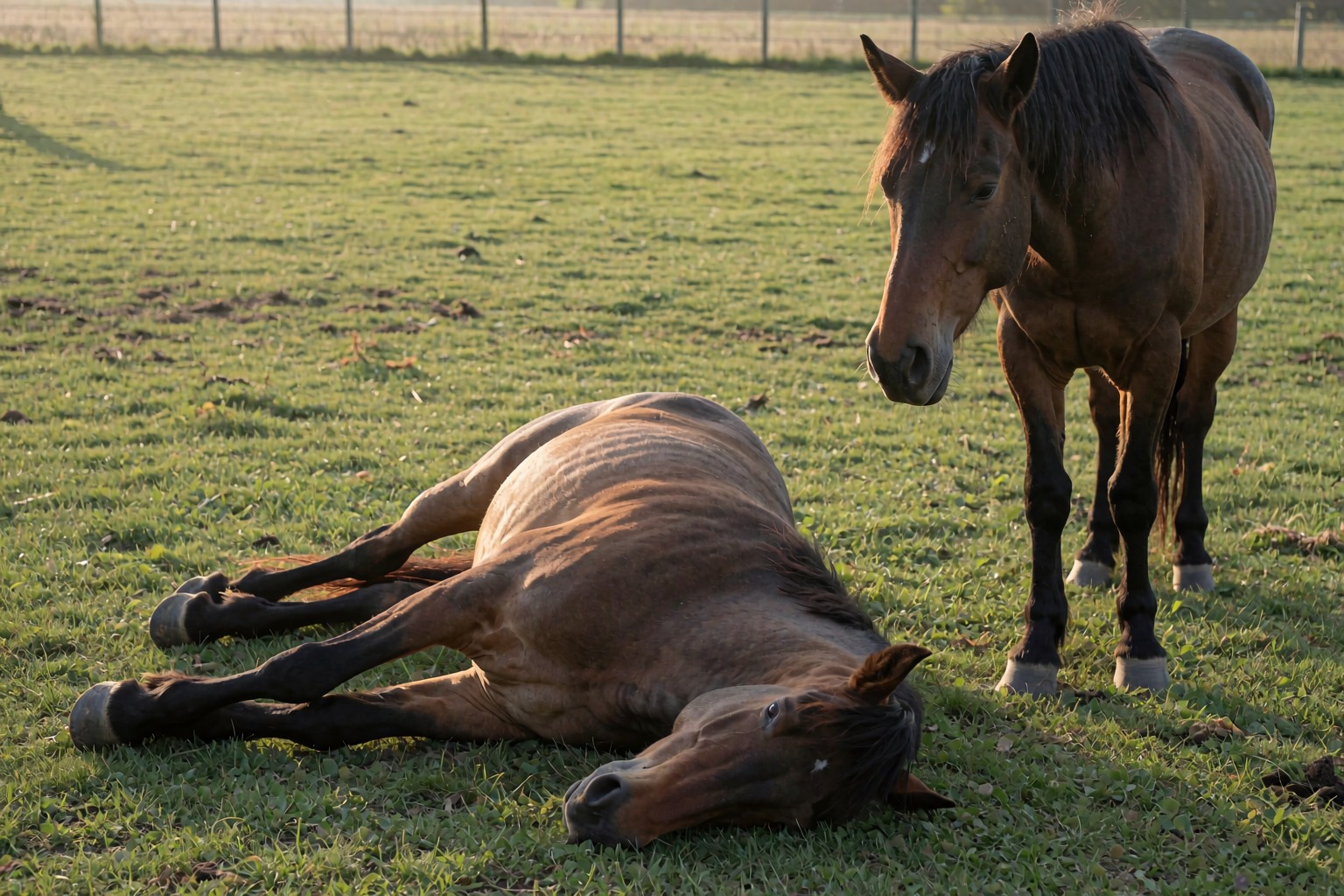
A horse can sleep on its feet because its legs lock into place almost by themselves. A system of tendons and ligaments called the stay apparatus holds the joints steady with barely any muscular effort, which is why you can walk past a paddock at four in the afternoon and see a horse standing stock still, eyes half shut, utterly unbothered. That standing doze covers most of a horse's daily sleep. The deep sleep, the kind every mammal actually needs to function, only comes when the horse lies down completely. Both halves matter, and understanding them tells you a lot about how to read your own horse.
How the stay apparatus locks a horse's legs
The stay apparatus is really a set of mechanisms working on both the front and hind legs, letting a horse stand for long stretches without tiring the muscles the way a human's legs would tire from standing still. At the front, a network including the superficial and deep digital flexor tendons, along with the suspensory ligament, supports the fetlock and lower leg so the joint does not need constant muscular correction. At the back, the reciprocal apparatus links the stifle and hock so that when one moves, the other moves with it, and the patella can hook over a ridge on the femur, the stifle, to lock the hind leg in place. Horses typically rest one hind leg at a time, shifting their weight from side to side, which is why you will often see a resting horse with one hip dropped and a hind hoof tipped onto its toe.
This is not unique to any one breed. It is a feature of how horses, as grazing prey animals, evolved to cope with a world where lying flat on the ground leaves you slow to get up and easy to catch. Being able to snooze upright, ready to bolt in a stride or two if something startles the herd, was the safer option across millions of years, long before any horse was ever ridden.
Light sleep standing, and the deep sleep they only get lying down
Dozing on the stay apparatus gives a horse light sleep, sometimes called slow wave sleep. The brain is resting, but not completely. What the body cannot do while standing is reach REM sleep, the deeper stage where the brain is highly active and the muscles lose their tone almost entirely. In a human, that muscle slackness is harmless because we are lying in bed. In a horse, if that level of muscle relaxation happened while standing, the legs would simply buckle. So REM sleep only arrives once the horse is lying down, usually flat on its side with its legs stretched out, sometimes called lateral recumbency, occasionally resting on its chest with legs tucked, called sternal recumbency, which allows lighter dozing but not full REM.
Horses need surprisingly little REM sleep in total, often estimated at well under an hour spread across several short bouts in each twenty four hours, but it is not optional. Veterinary researchers who study equine sleep, including work referenced by equine vets and welfare bodies such as World Horse Welfare, treat a lack of lying down time as a genuine health concern rather than a quirk of temperament. A horse that never gets its REM sleep does not simply feel tired the way a person would. It can start to show something closer to microsleep episodes while still on its feet, where the hindquarters or knees buckle briefly before the horse catches itself. Owners sometimes mistake this for stumbling, or for a leg problem, when the underlying cause is sleep deprivation.
Why a horse will not just lie down anywhere
Lying flat is the most vulnerable a horse ever is. The legs cannot react quickly from that position, so instinct keeps a horse from committing to it unless it feels properly safe. In a herd, this shows up as a rough rota: while some horses lie down, others tend to stay on their feet, alert, effectively keeping watch. A horse turned out alone, or one that has recently moved somewhere new, or one that simply does not trust its field companions, will often skip lying down altogether for days at a time, relying on standing dozes instead.
Ground conditions matter just as much as company. A horse needs enough dry, level space to lie down and, importantly, enough room to get back up again, which involves a fairly ungainly lunge forward onto the front legs. Deep mud, a stable that is too small, or bedding that is thin, wet or badly managed can all put a horse off lying down, even when it badly needs to. The British Horse Society's guidance on stabling and the Code of Practice for the Welfare of Horses, Ponies, Donkeys and their Hybrids both set out that horses need adequate space and suitable bedding precisely so they are able to lie down, rest and get up freely without injury, which tells you how seriously this is treated as a welfare matter rather than a nicety.
Foals lie down far more than adult horses do, often for long stretches during the day, which is entirely normal and not a sign of illness. As a horse matures, the balance shifts firmly toward standing dozing, with lying down sleep becoming a smaller, more precious slice of the day, usually taken at quiet times such as the middle of the night or the depths of a still afternoon when the field feels settled.
When it is worth calling the vet
A horse that appears not to lie down at all over several weeks, or one that shows odd buckling episodes at the knees or hindquarters while dozing on its feet, is worth raising with a vet rather than putting down to character. Sleep deprivation in horses is a recognised clinical picture, and vets will often look first at whether pain is keeping the horse from lying down comfortably, since conditions such as arthritis or back pain can make both the lying down and the getting up genuinely difficult, which then puts the horse off trying at all. Vets will also ask about the horse's environment and companions, since a horse that does not feel safe enough to fully relax is behaving sensibly, not abnormally.
Physical signs worth mentioning to a vet include scuffed or hairless patches on the front of the fetlocks or knees, which can come from a horse's legs giving way briefly while dozing standing, and any sudden collapse, however short. These are not things to self-diagnose at home. World Horse Welfare and equine vets both stress that a change in a horse's normal lying down pattern is a signal worth investigating rather than ignoring, because by the time the signs are obvious, the horse may already have been running on inadequate sleep for some time.
What this means for the horse in front of you
So the short version holds up under all of that detail. A horse locks its legs and dozes lightly on its feet for most of its rest, which is a genuine evolutionary advantage rather than a party trick, and it only reaches proper deep sleep once it trusts its surroundings enough to lie flat. If you own, loan or simply spend time around a horse, the useful habit to build is noticing: does it ever lie down fully in the field or stable, does it look settled while it does, and does it have the company and the space to feel safe doing so. A horse that lies down readily and gets up without fuss is usually telling you its world feels secure.
It is exactly this kind of quiet, unguarded moment, the dropped hip, the half-shut eye, the stillness of a horse that trusts its field, that we try to catch in Stirrup & Oak's engraving-style prints and apparel. If this piece has changed how you look at your own horse, our horse-lover range of T-shirts, sweatshirts, hoodies and archive prints is built around exactly that kind of character.