Horse Habits · 12 November 2026
Why Do Horses Love Polo Mints So Much
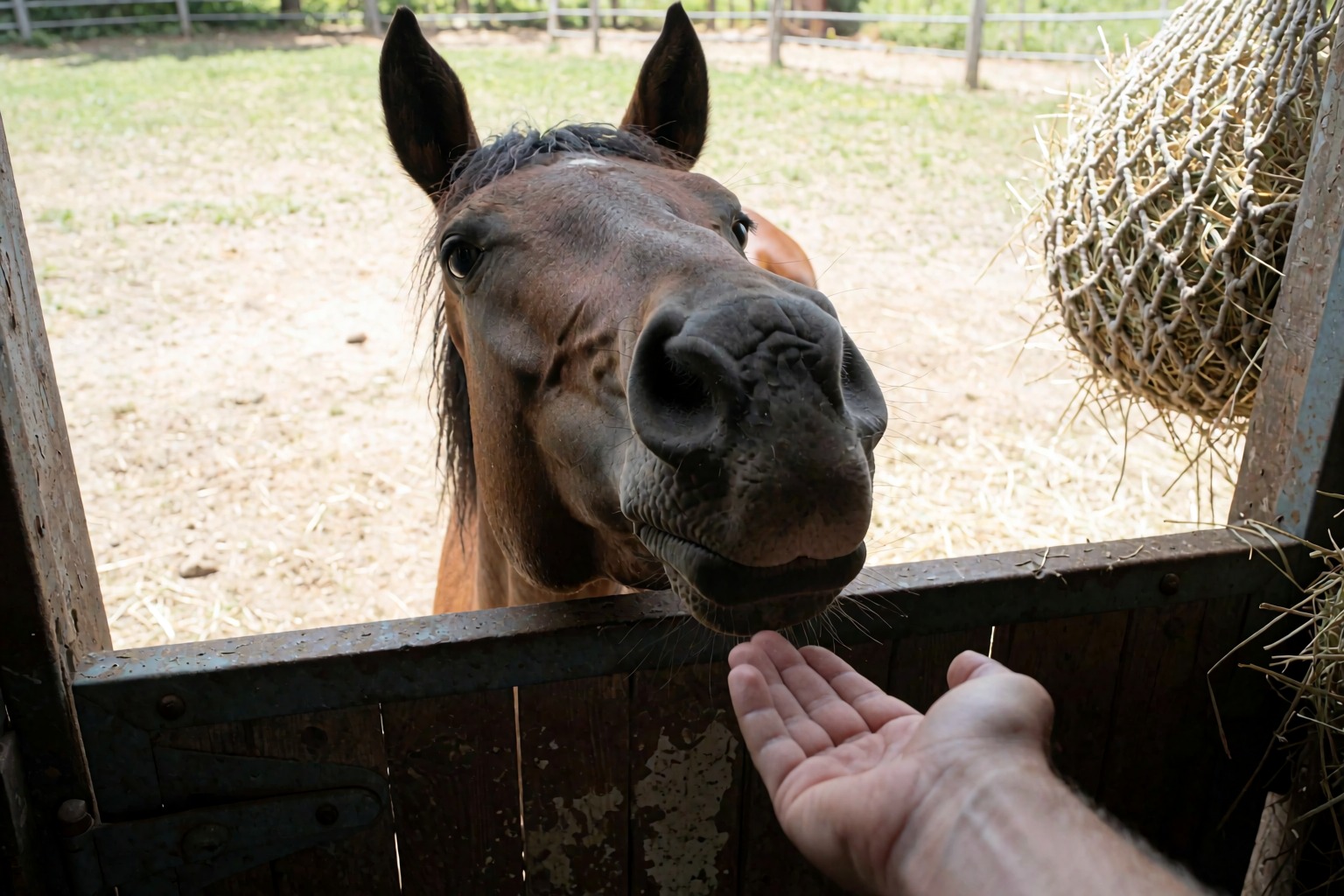
Horses love Polo mints because mint and sugar hit two different senses at once: a taste a horse's brain reads as genuinely rewarding, and a smell strong enough to reach him from well across the yard. Put a packet in your coat pocket and most horses know before you've said a word. Ears come up, heads swing over the door, and lips start working before the wrapper is even open.
If you've ever wondered whether your horse is just putting on a show for the packet, or whether there's something real going on underneath the greed, there is. It's one of those ordinary horse habits that turns out to have a proper explanation once you look past the obvious answer.
Do horses really have a sweet tooth?
Yes, and it isn't just a turn of phrase. Horses have taste receptors that respond to sweetness in the same basic way ours do, and when they're given a genuine choice, most will pick a sweet feed over a plain one every time. That preference isn't an accident of modern life. A horse grazing wild spends most of his day working through grass that varies hugely in sugar content depending on the time of day, the season and even the weather, and a horse with a strong nose for the sweeter patches is a horse getting more energy for the same mouthful. A taste for sweetness, in that setting, is useful.
A Polo mint is close to pure sugar wrapped around a strong peppermint flavour, which is about as concentrated a reward as a small white circle can offer. It isn't a trick that happens to work on horses because they've learned to like what we like. It's a horse's own biology responding to something that, out in a field, would have been rare and worth remembering.
That doesn't mean sweet is harmless in any amount, and that matters more for some horses than others. We'll come back to it.
Why the smell gets them before you've even opened the packet
A horse's sense of smell is far more sensitive than ours, and peppermint is a smell built to travel. It cuts clean through hay dust, bedding, diesel from the yard and the general smell of a field in a way that a chopped carrot simply doesn't manage. That's why a horse dozing at the back of a paddock can still swing round the moment you reach into a coat pocket, long before he's seen anything in your hand.
Menthol, the compound that gives mint its cooling bite, is also partly responsible for how far that smell carries and how sharply it registers. It's a small, volatile molecule that moves through the air easily, which is exactly why peppermint turns up in so many things meant to be noticed from a distance, veterinary products among them. A horse isn't imagining the strength of that smell. It really is stronger, and really does travel further, than most of what else is on offer in your pocket.
Is it the mint, or is it the moment?
Here's the part worth being honest about. Most horses don't meet a Polo mint in isolation, sitting on a fence post with no one around. They meet it attached to a person they already like, usually at a moment of fuss: a pat, a headcollar going on, the end of a ride, someone leaning over the door for a chat. The mint becomes tangled up with all of that attention, so the smell alone starts to mean something good is about to happen, in much the same way a dog reacts to the sound of a lead being lifted off its hook before anyone's said the word "walk".
The sugar is doing some of the work here. The association is doing plenty more. And this is exactly why some horses go from politely interested in a mint to properly pushy about it. If a horse learns that nudging an elbow, mugging a coat pocket or nosing at a zip gets a result, that behaviour keeps showing up, because from his side of things, it worked last time. It's not cheek for its own sake. It's a lesson he's learned from us, usually without anyone meaning to teach it.
This is worth knowing even if you never plan to change a thing about how you feed treats, because it explains a habit that otherwise looks like bad manners arriving from nowhere. It didn't arrive from nowhere. It was built, one mint at a time.
So how many is too many, and when to ask the vet
This is the part that actually matters for your horse's health rather than just his manners. An occasional Polo mint, given now and then rather than as a daily routine, isn't something most healthy horses need to worry about. The trouble starts when "now and then" quietly turns into "every single time I see him", because that's when a small sugary treat stops being occasional and becomes a steady habit, and habits add up in ways that are easy to miss day to day.
A few things worth keeping in mind. Treats of any kind, Polos included, should stay a small part of what a horse eats across a day, never a meaningful one. A horse's diet is built around forage, mainly grass and hay, with a properly balanced feed on top of that if he needs it. A mint is a bonus sitting outside that structure, not a food group in its own right.
If your horse has had laminitis, or has a condition like Cushing's, also called PPID, sugary treats stop being a minor indulgence and become a genuine risk that's worth asking your vet about directly rather than guessing from general advice online, your own or anyone else's. The same goes for any horse on a diet your vet has specifically restricted for sugar or starch. Vets and equine welfare advice generally agree that treats are judged by the whole diet they sit inside, not as a harmless extra bolted on top of it.
Feed from a flat, open palm rather than from your fingers or straight out of a pocket. It's safer for you, because a horse reaching for a treat held between fingers can't always tell finger from mint in the split second it matters, and it stops a horse learning to search pockets and clothing for treats, which is exactly how a lot of nipping habits start without anyone intending to teach them.
If you're looking for a treat with less sugar, apple pieces, carrots or a handful of chopped root vegetable give you the ritual and the taste without the concentrated hit. They won't carry the same waft across a yard, but most horses will still take them happily, and they fit more easily into a daily habit than a sugary mint does.
Watch the pattern, not just the treat itself. One mint as a thank you after a good ride is fine for most healthy horses. A mint every time you walk past the field, every time you catch him, every time he simply looks at you, is a habit that's easy to start and considerably harder to undo, and it's worth noticing while it's still a choice you're making rather than an expectation he's set for you. A simple fix, if mugging has already become a habit, is to ask for something small before the treat appears: a step back, a head down, a few seconds of standing still. It doesn't need to be formal training. It just needs to break the link between a person appearing and a treat appearing immediately, so the behaviour you're rewarding is patience rather than pushiness.
If you're ever genuinely unsure whether treats are appropriate for your particular horse, because of his weight, a known health condition or advice a vet has already given you, the honest answer is to ask that vet rather than go by what worked for someone else's horse in a yard down the road. They know his history. A packet of Polos doesn't.
None of this is really about Polo mints specifically. It's about a horse's sweet tooth being real rather than imagined, his nose being sharper than yours will ever be, and a habit, like most habits with horses, being something you're quietly training whether you mean to or not. So keep a packet in your coat if that's your habit too. Just keep it for the moments that deserve it, not for every single time you happen to be the one holding it.