Breed Histories · 26 September 2026
The History of the Welsh Mountain Pony
Why does a pony no taller than twelve hands so often turn up in the ring looking as though it owns the place?
We draw a lot of horses at Stirrup & Oak, and the Welsh Mountain Pony is one of those we never tire of. The head is small and neat, the eye is big and bright, the tail is carried high. It looks like a pony from a storybook, and yet the shape was not designed for looks. It was earned on cold, wet, thin hill grazing, over a very long time.
This is our attempt at its history. We have stuck to what the breed society and published breed histories support. Where a favourite story cannot be backed up, we say so.
A pony of the hills
The Welsh Mountain Pony is the Section A of the Welsh Pony and Cob Society's stud book. The society groups its native breeds into four sections: A, B, C and D. Section A is the Welsh Mountain Pony, not exceeding twelve hands. The others are the larger Welsh Pony (Section B), the Welsh Pony of Cob type (Section C) and the Welsh Cob (Section D). All four share a root, and Section A is generally treated as the foundation from which the rest were built up.
Ponies have lived on the Welsh hills for a very long time. The breed's own histories describe small, hardy hill ponies running on the mountains from ancient times, long before any register existed. Nobody can point to a single day when the breed began, and we would be wary of anyone who says they can. What we can say is that the ponies who survived on high, exposed ground did so by being tough, sure-footed and content with poor feed. Every generation on the open hill sorted the sensible from the silly, and the sensible bred on.
That is where much of the breed's character comes from. A pony that must find its own way over rock and bog, in weather that turns without warning, learns to think before it moves. Owners today often describe Section As as quick to learn and rather clever. Some would say a bit too clever. We think that is the hill talking.
The stories we leave as stories
You will hear that the Welsh Mountain Pony carries Arab blood from crusaders' horses, or from animals washed ashore from a wrecked Spanish ship, or from Roman cavalry stock left behind when the legions went home. These tales are told with great confidence. We have not found a source that proves any of them, so we treat them as folklore.
What is better documented is the later, deliberate use of other blood. In the nineteenth and early twentieth centuries breeders on and around the hills used Arab and Thoroughbred stallions on some Welsh mares, and Eastern blood is a well-recorded part of the breed's refinement. Even so, the breed societies have long put weight on protecting the true hill type, and the register that came later was drawn up with that in mind. A pony with a dished face and fine, clean limbs is not a happy accident. It is partly the product of chosen crosses, partly of the hill, and partly of what breeders decided to keep.
The Romans are a fair example of how a good story outruns the evidence. It is entirely believable that horses were kept at Roman forts in Wales. Whether they left a mark on the mountain pony, and how much, is a different question, and one we are happy to leave open.
What the work made
The Welsh hill farm needed a pony that could do a great deal on very little. Hill ponies carried loads and people over rough tracks where a cart could not go. They were used to gather sheep, to carry small goods to market, and to take the family to chapel or town. A pony like that could not be large, because a large animal eats more than the hill will give it. It could not be fragile either. So we get a compact body, a deep chest for lung room, a strong back and tough, well-shaped feet.
The Section A limit of twelve hands is not an arbitrary line drawn for the show ring. It reflects the size the hill breed had settled at, and the society has held to it. In a breed with so many competing uses, that limit is one of the ways the type has been kept recognisable.
Small Welsh ponies also went underground. Ponies of Welsh breeding were used in coal mines, pulling trams of coal through low roadways. We should be careful here, because the pit pony story is often told as if one breed did it all. Several types of pony were used in British mines, and it is the stronger, stockier Welsh types that are more usually linked with the pits than the finest Section A. Still, Welsh blood went into the mines, and when the mining industry changed, so did the market for those ponies.
Whichever job a pony did, temperament mattered as much as build. A pony working near children, near sheepdogs, in a yard full of people, has to be sensible. Kind, willing ponies were kept for breeding, and awkward ones were not. That is why the breed is now known as a first pony for children, and why adults who drive ponies often choose it too.
A society, a stud book and a bigger world
The biggest turning point on the record is organisation. The Welsh Pony and Cob Society was founded in 1901, and the first Welsh Stud Book followed in 1902. Before that, ponies were bred and sold by local knowledge alone. Once a stud book existed, a breeder could register a pony and trace its parents, and a buyer could ask for proof. For a breed spread over hill farms with little written down, that was a real change.
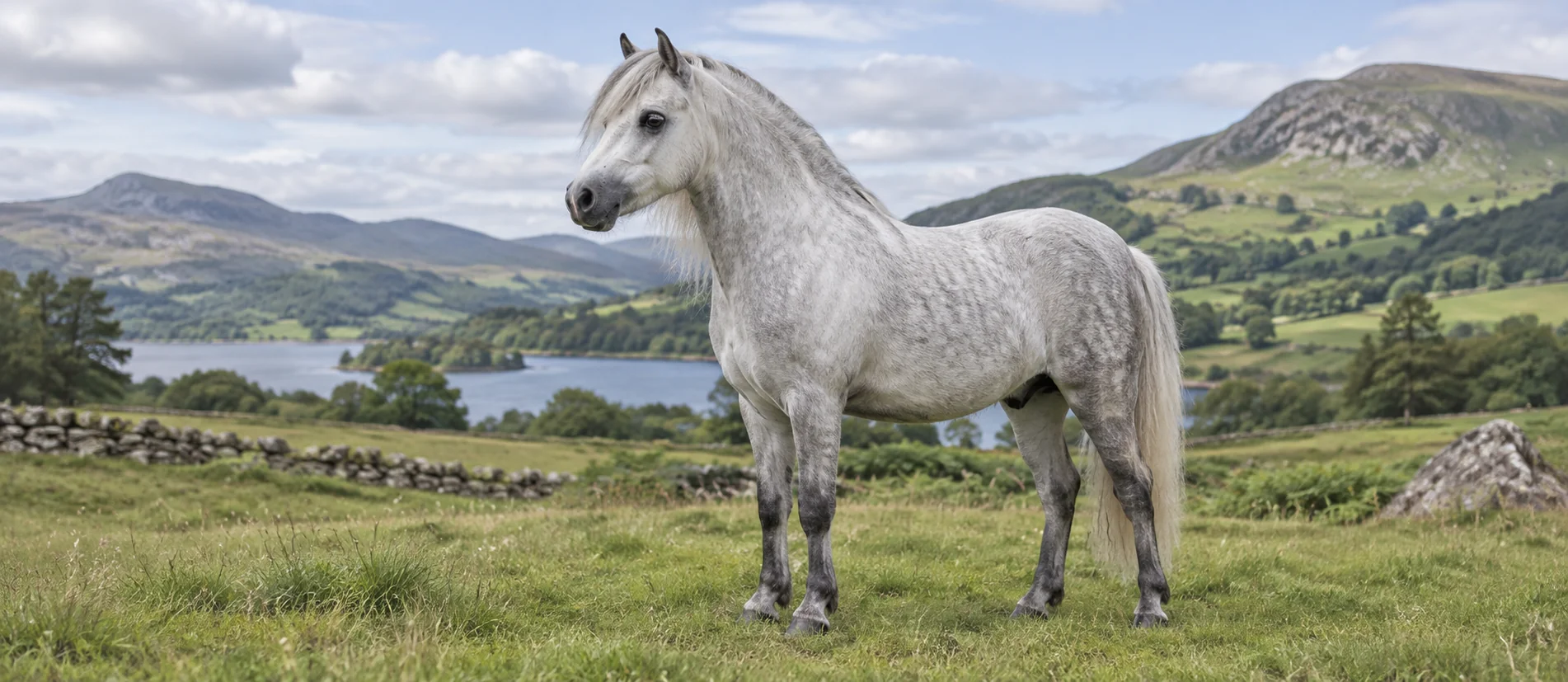
The register also gave the breed a public standard. The society describes the Section A as having a small, neat head, a large bold eye, small pointed ears, a dished profile, a well-set neck and a high tail. Movement is meant to be free, straight and quick. Nearly all colours are accepted, with the exception of piebald and skewbald. Those breed points are worth knowing if you ever try to pick out a Section A from a distance, and they are much of what we look for when we draw one.
The twentieth century then asked a hard question of every native breed. When engines took over the farm, the road and the mine, what would a hill pony be for? For the Welsh Mountain Pony, the answer was found in the saddle and in harness. Its size, its looks and its manners made it a children's riding pony, a show pony, a driving pony, and a source of quality when breeders wanted to improve other riding ponies. Many British riding pony types carry Welsh blood in their pedigrees. That is one reason a good Section A can look so much like a small, refined show pony.
The wider breed's story includes hard stretches. Native breeds in general lost their old jobs, and numbers of many hill ponies fell as work dried up. What kept the Welsh Mountain going was the society's register, breeders willing to keep good lines going, and a market that still wanted the pony for its temperament. We would be cautious of anyone who gives exact numbers for the low points without a source, and we have not offered any.
There are also groups of Welsh ponies that still live in a semi-wild state on the hills of Wales. The Carneddau ponies in Snowdonia are perhaps the best known. They are a useful reminder of where the breed began, though the ponies you see in the show ring are, of course, managed very differently.
The breed today, in the UK and the US
In Britain the Welsh Mountain Pony is a familiar sight at county shows and local classes, in ridden and in-hand sections, and in harness. The Welsh Pony and Cob Society still keeps the stud book, and Section A remains the smallest of the four. It is a pony that many people meet as children and remember for life.
The breed also crossed the Atlantic. The Welsh Pony and Cob Society of America, which describes itself as founded in 1906, keeps a stud book of its own and registers Welsh ponies and cobs in America. Welsh ponies there turn up under saddle, in driving classes and in children's hunter and pony classes, much as they do at home. Different countries, different fences, the same neat head and the same clever eye.
So what does the history tell us? A few plain things. The breed's toughness came from the hills, its manners came from working close to people, and its type was protected by an early, organised register. It survived the loss of its old work by finding a new one, and it still does that job very well. When we draw a Welsh Mountain Pony, we try to put all of that into the line: the alert ears, the level eye, the compact frame of an animal that was made to go anywhere.
Our plates are digital artwork in an engraving style. They are made now, and we do not pretend they are old prints. But the subjects deserve the care that a very old breed asks of an artist, and a pony with this much history is worth getting right.
See it in the collection: The Welsh Mountain Pony collection