Breed Histories · 26 September 2026
The History of the Welsh Cob
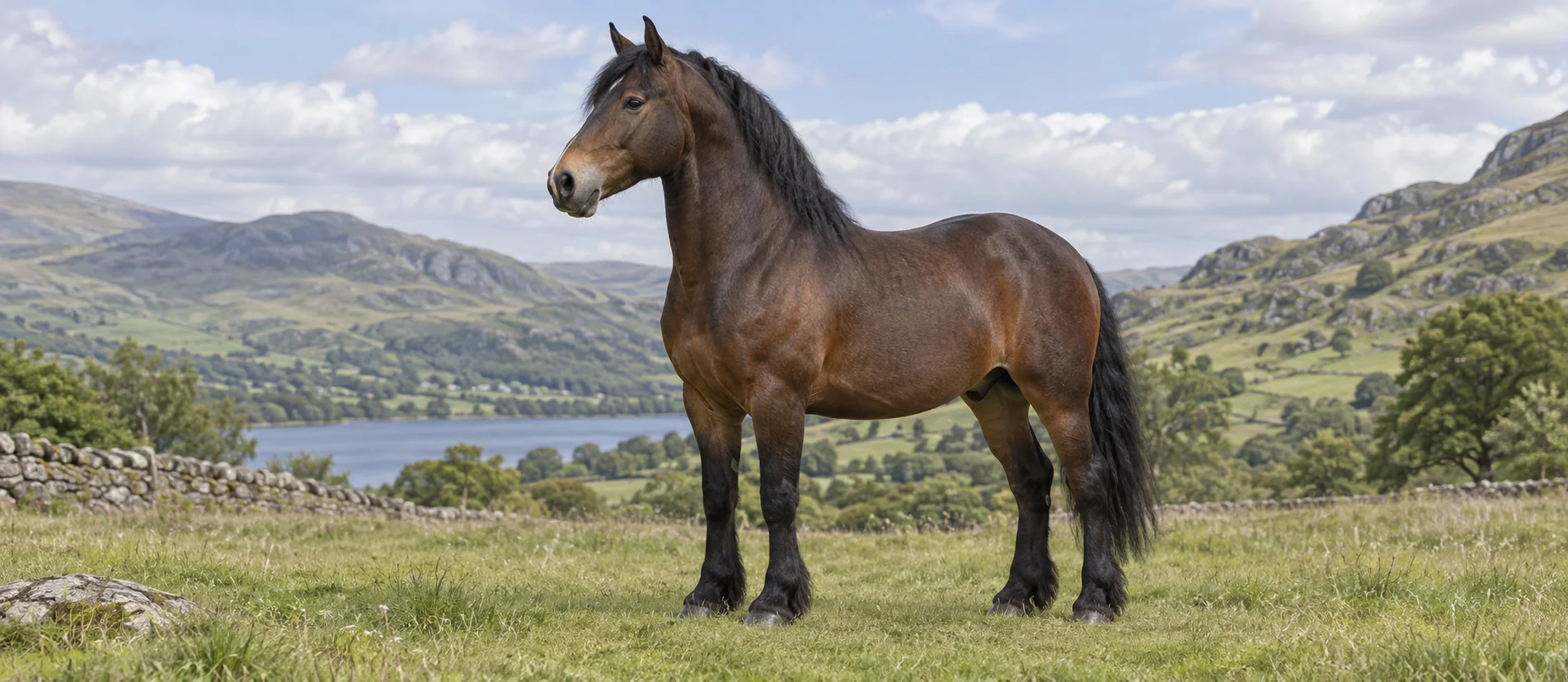
Ask a room of horse people what a Welsh Cob is and you will get the same answers again and again. Strong. Bold. A trot that goes on all day. A horse with a mind of its own and a heart to match. Those descriptions are not just fondness. They come from what the breed was asked to do for a very long time, in a country where the land is steep, the weather is unkind and a horse had to earn its keep.
We want to tell the history of the Welsh Cob the way we like to tell every breed's story. That means only what a breed society, a stud book or a published breed history will stand behind. Some of the best-loved tales about the Welsh Cob are lovely and impossible to prove. Where we mention one, we will say so.
Where the Cob came from
The Welsh Cob grew out of the native ponies of Wales. Those hill ponies lived on the mountains and commons for generations, and they were tough, sure-footed and thrifty. Breed histories describe how farmers in Wales crossed the larger, stronger pony mares with other types of horse to get an animal with more size and more power, one that could still live on Welsh grazing. Writers on the breed name several outside influences, and they do not all agree on the details, so we will not pretend to a tidy family tree. What the accounts share is the outcome: a compact, deep-bodied, strongly built horse with a big trot and a great deal of stamina.
You will often read that Welsh ponies go back to Roman times, or further, and that the breed is thousands of years old. It is true that the native pony of Wales is very old. It is not true that anyone can trace the Cob in a straight line through all those centuries. The Cob as a recognised type is better documented from the period when Welsh farmers and dealers were breeding for particular jobs, and it becomes properly traceable once the breed society began writing horses down.
The word "cob" itself is worth a moment. In English it has long described a sturdy, short-legged, stocky riding or driving horse. In Wales it came to belong to a particular breed, and that is the sense we mean here.
The work that shaped it
A breed is a record of the jobs it was bred for, and the Cob's jobs were many. It was a farm horse, working the small upland farms of Wales where one animal often had to do everything: pull a cart to market, work the land, and carry the family to chapel on Sunday. It was a road horse in the days when the trot was how you got anywhere. It was a riding horse for people who covered long distances over rough ground, and it was a driving horse too, because a cob that can trot well in harness is worth having.
That is why the temperament and the build go together. A horse working on a hill farm had to be sensible, because nobody had time for a fool. It had to be strong in the back and the hindquarters to pull, and deep through the girth to keep going on modest feed. It needed good, hard feet and a solid, muscular frame. It also needed something that is harder to measure: spirit. Welsh Cobs are famous for their courage and their free, forward movement, with a lot of knee action and a great deal of push from behind. The breed literature treats these as qualities that were selected for over many generations, because the horses that had them were the ones people wanted to keep breeding from.
Trotting was a serious part of Cob life. Fast, level-headed trotting horses were valued, and the culture of showing off a good trotter at fairs and markets goes back a long way in Wales. The breed's reputation for movement was built partly on this. Horse sales and fairs in Wales, especially those held for ponies and cobs, have long been where breeders and buyers meet, and some of those markets are still running.
The Cob was also used in wider work. Breed histories record Welsh horses and ponies serving in the military and in industry, and the demand for strong, dependable horses in wartime was part of what kept breeders producing them. We would rather not put a date, a regiment or a number on that here without the source in front of us. What can be said safely is that a breed as useful as this one was always going to be wanted when work needed doing, and that it was the end of that kind of demand which brought the breed's next problem.
The society, the stud book and the sections
The turning point for the Welsh Cob on paper came in 1901, when the Welsh Pony and Cob Society was founded. The society published its first stud book in 1902. Until then, the ponies and cobs of Wales were bred by knowledge, reputation and word of mouth, which is a fine way to breed horses and a difficult way to prove what one is. A stud book changed that. It gave breeders a written line of descent to trace, and a common standard to breed towards. It also gave the breed a name and an identity that could be defended and promoted, at home and abroad.
The stud book is organised into sections, and they matter because they explain a lot of confusion. Section A is the Welsh Mountain Pony. Section B is the Welsh Pony. Section C is the Welsh Pony of Cob type. Section D is the Welsh Cob. The Welsh Cob, Section D, stands over 13.2 hands, and there is no upper height limit. That last point surprises people. There is no official maximum, so Section D cobs vary from horses at the smaller end to some that are properly big. Height alone does not define the Cob. The type does: the substance, the bone, the movement and the character.
A small point on measurement, for anyone new to it. Horses are measured in hands, and each hand is four inches. The figure after the point is inches, so 13.2 hands means thirteen hands and two inches, not thirteen and two tenths.
We would like to name the great stallions here, because the Cob's history is full of them and the stud books are full of famous names. But we are writing from the record, and where a name, a date or a claim about a famous sire cannot be checked against the society's own pages or a published breed history, we would rather leave it out than repeat something that is only half remembered. The Cob's story does not need embellishing. If you want to trace a particular horse, the society's stud book and the published histories of the breed are the right place to start.
Near-loss, revival and the Cob today
The story of most working breeds in the twentieth century is the same. Mechanisation arrived, and the work that had needed a strong horse could be done with a tractor and a lorry. Demand for work horses fell across Britain, and many breeds saw their numbers drop. The Welsh Cob was affected as well, as the jobs it was bred for went away. What kept the breed going was the same thing that had made it so useful in the first place: it was versatile. A horse that could pull, carry and trot for miles could also be ridden for pleasure, driven in harness, shown, and used in competition.
Today the Welsh Cob is valued for exactly that range. It is a riding horse, a driving horse, a show horse and a family horse, and it is well known for its willingness and its strength. Its build gives it presence, and its temperament, bold but generous, is a large part of why people who have owned one so often go on to own another.
The breed did not stay in Wales. It is found across the United Kingdom and has a following overseas. In the United States the registry is the Welsh Pony & Cob Society of America, which keeps the records for the breed there. That is the organisation to speak to if you want to register a Welsh Cob or find out how American-bred horses are documented. It is not the same body as the Welsh Pony and Cob Society in Wales, which keeps the original stud book, and the two names are easy to mix up.
For sources, the facts that anchor this piece are these. The Welsh Pony and Cob Society was founded in 1901 and published its first stud book in 1902. Section D, the Welsh Cob, stands over 13.2 hands with no upper height limit. In the United States the registry is the Welsh Pony & Cob Society of America. Each can be checked on those societies' own pages and in published histories of the breed, and we would encourage you to do that rather than take our word for it.
The Welsh Cob is a breed whose character can be read straight from its past: made for work, tested by hills and weather, and kept by people who valued a horse that could do a bit of everything. Our artwork is digital engraving-style work, made to sit alongside that heritage rather than pretend to be part of it. It is a modern way of looking at an old breed, and the breed has earned the attention.
See it in the collection: The Welsh Cob collection