Breed Histories · 26 September 2026
The History of the Thoroughbred, from Newmarket to Kentucky
Most horse breeds were shaped by a landscape. A hill, a moor or a plough decided what survived. The Thoroughbred is different, because it was shaped by a stopwatch, or rather by a finishing post, and by the wagers of people who wanted to know which horse was quicker.
We think that makes it one of the most unusual breeds to draw. It is a horse bred to a single question, and the answer is visible in every line of the body. Here is how that answer was reached, where the story is solid, and where a good tale has got ahead of the evidence.
Racing before the breed: seventeenth-century England
Horse racing in England is far older than the Thoroughbred. Match races and hunting-field trials were well established by the seventeenth century, and Newmarket in Suffolk had become the centre of it. Royal patronage mattered a great deal. Charles II kept a keen interest in the sport and was a regular presence at Newmarket, and the stud of mares associated with the crown is often referred to as the Royal Mares.
Those mares were not a single pure type. English racehorses of the period were a mixture of native stock and imported horses, and breeders had been bringing in Eastern stallions for some time. Those horses came from the Middle East and North Africa and were described by the names of the regions and dealers they passed through. Terms such as Arabian, Barb and Turk were used loosely, and we would be inventing precision if we claimed to know exactly which was which in every case.
What we can say is that English breeders were crossing that Eastern blood with their own mares, and racing the results against each other. Speed was tested, and the fastest were bred on. That is the whole method, and it is why the breed is the way it is.
Three stallions and the trouble with a tidy story
Ask anyone who knows the breed and you will hear about the three foundation sires: the Byerley Turk, the Darley Arabian and the Godolphin Arabian. They are real, they matter, and their names are on the pedigrees of the modern racehorse.
The Byerley Turk is associated with Captain Robert Byerley, who is said to have acquired the horse during the campaigns against the Ottomans in the late seventeenth century and later had him at stud in England. The Darley Arabian was sent from Aleppo to Yorkshire by Thomas Darley, and stood at the family estate at Aldby. The Godolphin Arabian, sometimes called the Godolphin Barb, came to England from France and was kept by the Earl of Godolphin. Fine stories are attached to each of them, and some of the detail, especially the stable-boy and cat tales about the Godolphin, is folklore more than record. We will leave those to the storytellers.
The bigger correction is to the neat idea that the breed began with only three horses. It did not. The early pedigrees include many other stallions and a good number of mares, and the mares are too often forgotten. What happened is that, over time, most male lines narrowed down to descendants of these three. That is a fact about how the surviving lines fell out, not a claim that no other horses were involved.
The three lines grew through a handful of famous descendants. The Darley Arabian's line runs through Flying Childers and the Bartlet's Childers branch. The Godolphin Arabian is the great-grandsire of Matchem in the male line. The Byerley Turk's line comes down through Herod. Most of what is left today descends from the Darley Arabian, through the horse who came next.
Eclipse, and the book that made a breed
Eclipse was foaled in 1764, during the eclipse of the sun that gave him his name, and he was bred by the Duke of Cumberland. He went on to race unbeaten, and he became an outstanding sire. The claim is often made that the great majority of Thoroughbreds alive today trace their male line back to him. It is a widely repeated figure and the broad point is well supported, though we would not put an exact percentage on it here.
Alongside the horses came the paperwork. Racing needed to know whether a horse was what its owner said it was, and a pedigree was the proof. James Weatherby published An Introduction to a General Stud Book in 1791, gathering the pedigrees of the racehorses of the day. Later volumes became the General Stud Book, which Weatherbys still keeps. It is a closed book. A horse can be registered as a Thoroughbred only if both its parents are already in it, and the rule has held for over two centuries. That is what makes the Thoroughbred a breed in the strict sense, not just a type.
The Jockey Club, meanwhile, grew out of the racing community at Newmarket in the middle of the eighteenth century and became the governing body of British racing. The great races came with it. The St Leger was first run in 1776, the Oaks in 1779 and the Derby in 1780. They were set up to test young horses, and that shaped what breeders aimed for. A horse was bred to be at its best at three, over a mile and a half, and later at shorter distances too.
Two things followed. Racing over heats of four miles, common in the earlier period, gave way to shorter races run at a full gallop, and the horse changed with it. And because the book was closed and racing was the selector, every generation was a fresh examination.
What that work built, in the body and in the mind
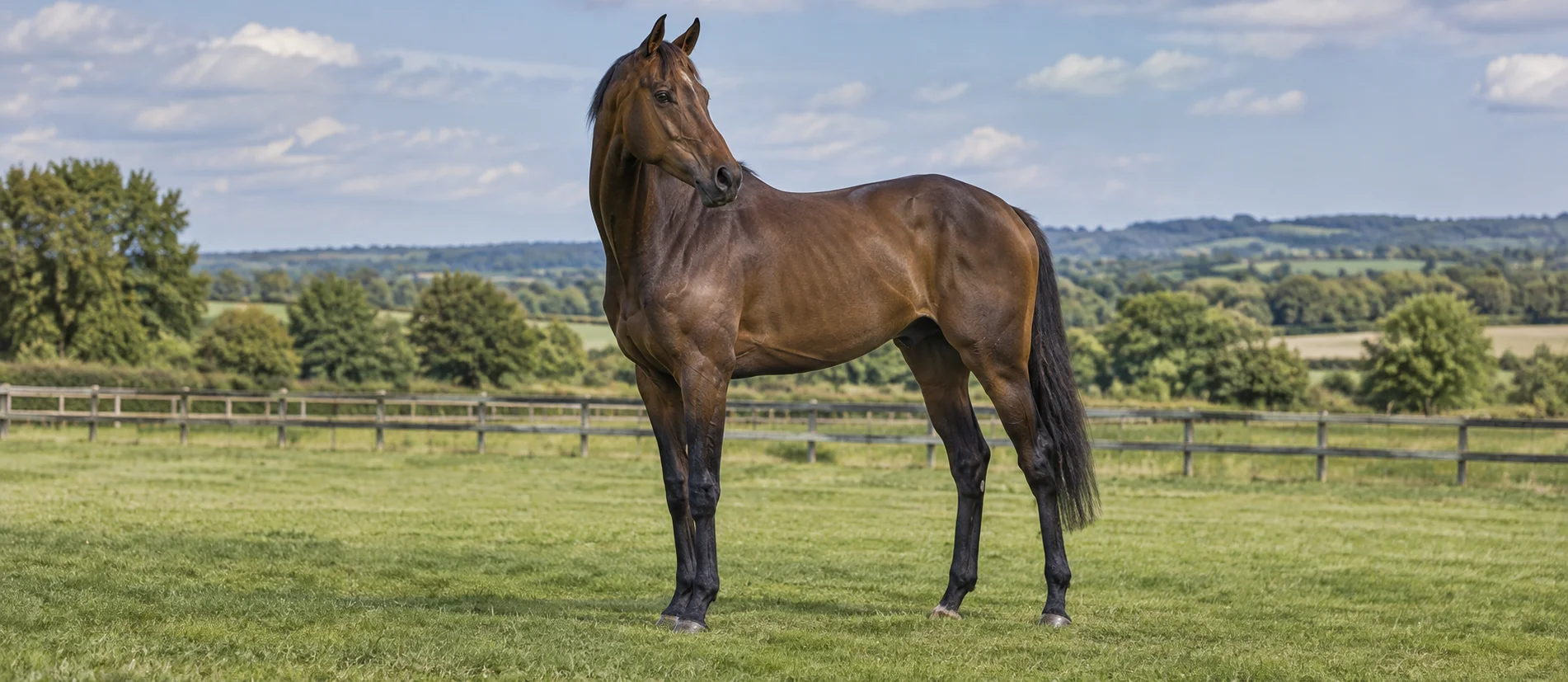
You can read the Thoroughbred's history in its outline. It is tall for a saddle horse, commonly around sixteen hands, though the range is wide. The chest is deep, giving room for heart and lungs. The legs are long and fine, the neck is long, the shoulder is sloping, and the skin is thin, so that veins show under it after work. It is built for the gallop, to cover the ground with a long, low stride.
The temperament follows the same logic. A horse chosen for racing is chosen for keenness. It is quick, sensitive to its rider and to its surroundings, and often intense. Horse people will tell you that a Thoroughbred is generous and brave with the right handling, and can be hot or anxious with the wrong sort. We would say that this is a fair reading of the record, not a rule for every horse. Individual animals differ, and so does the schooling they get.
It is also worth saying what the breed was not bred for. It was not developed as a warhorse, a carthorse or a moorland pony. Its blood has gone into all of those, and into a great many other breeds, since the same qualities of speed, stamina and courage are useful in the hunting field, in eventing, in showjumping and in the cavalry of earlier centuries. Thoroughbred blood has been used for generations to refine sport horses. But the breed itself was built for the racecourse.
Across the Atlantic
Racehorses went to the American colonies early. Bulle Rock, a stallion imported to Virginia in 1730, is commonly cited as one of the first Thoroughbreds to arrive, and racing took hold in Virginia, Maryland and the Carolinas. After the Revolutionary period the trade continued. Diomed, who won the first Derby in 1780, was exported to Virginia in the late 1790s and stood there as a stallion.
The American breed grew its own institutions. The first American Stud Book was compiled by Sanders D. Bruce in the 1860s, and The Jockey Club in New York was founded in 1894 to take charge of the register. Kentucky, with its limestone-rich grass, became the heart of American breeding, and racing developed its own traditions there, including the Kentucky Derby, first run in 1875 at Churchill Downs. American racing favours shorter, faster contests on dirt, and over time that pulled the type slightly in its own direction. Names such as Man o' War, foaled in 1917, and Seabiscuit made the horse a national figure.
Britain and America have traded bloodlines constantly since, in both directions, and the closed book means that a horse registered in one country is recognised in the other, subject to each stud book's rules.
What the history means today
Modern Thoroughbreds are all measured against the same starting line. Every one of them, whether it is racing at Ascot or in Kentucky or has retired to a field, goes back to that small group of horses in the General Stud Book. Every foal has an official birthday of the first of January in the northern hemisphere, a convention that keeps racing age groups simple. And breed registration still requires natural covering. Artificial insemination is not permitted.
The closed book has a cost as well as a strength. A population that has been bred from a limited number of ancestors for three centuries has a narrower gene pool than most people would guess. Breeders and researchers talk about this openly, and we are not qualified to say how it will play out. The record shows the breed thrives on selection, and that the same selection can narrow it.
There is also life after the track. Many Thoroughbreds do not stay in racing. They go on to become eventers, hunters, showjumpers, riding club mounts and companions, and in both countries there are organisations that retrain them for a second career. It suits a horse bred for keenness to be given something to do.
We draw the Thoroughbred in the same spirit as the others in our collection. Our plates are digital artwork in an engraving style, made by us, and we are careful never to present them as antique or hand-engraved. The subject is old, but the work is new. What we try to keep is what the breed's history makes obvious: the long line of the neck, the depth through the girth and the alertness of the ear. Three centuries of choosing the fastest horse produced something that is easy to recognise and hard to mistake.
If you love the Thoroughbred, for the racing, the history or simply the look of the animal, we hope this gives you a clearer picture of where it came from, and where the neat stories stop and the evidence begins.
See it in the collection: The Thoroughbred collection