Breed Histories · 26 September 2026
The History of the Suffolk Punch
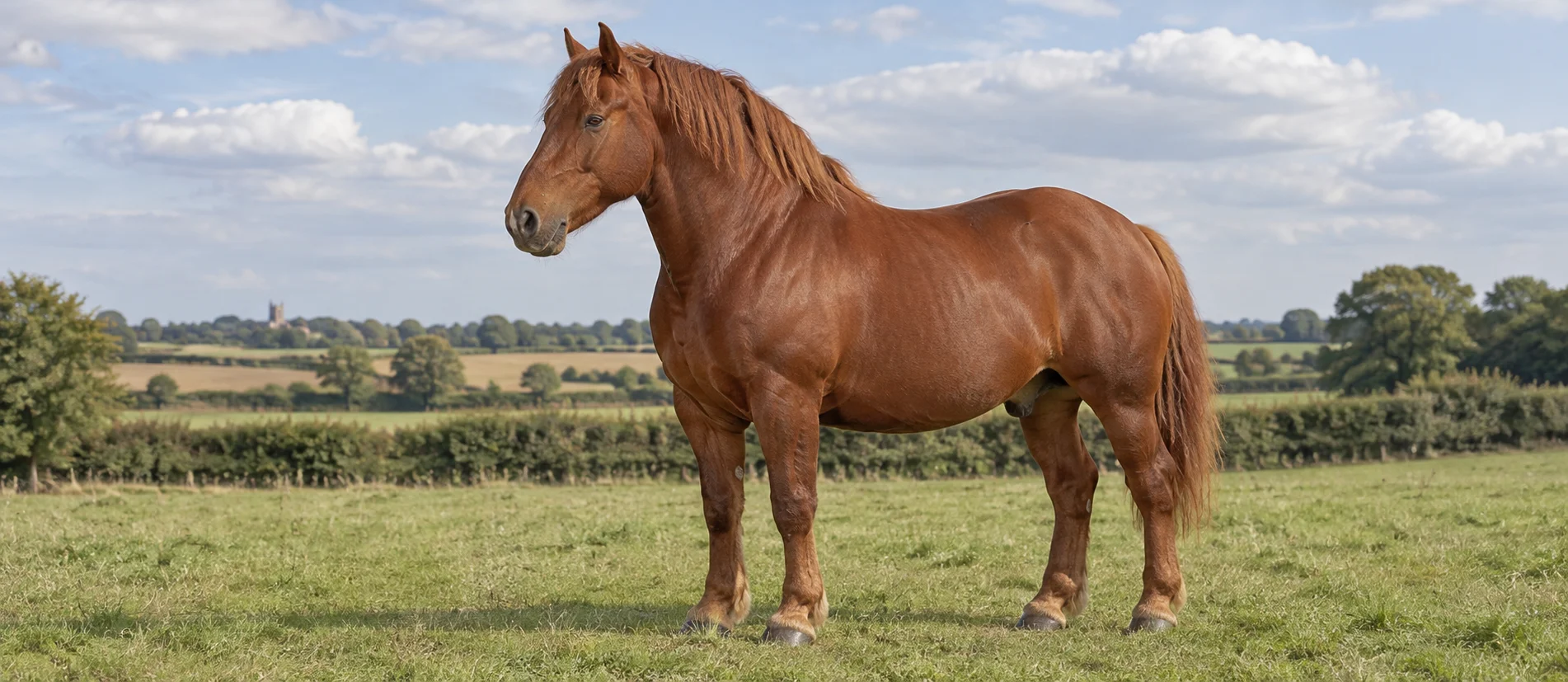
Have you ever looked at a Suffolk Punch and wondered why it looks the way it does? The round barrel, the short strong legs, the colour of a conker fresh from its case. None of it is accident. This is a horse that was shaped by a single job in a single corner of England, and once you know that job, the horse makes sense.
We are Stirrup & Oak, and we draw horses. Before we draw a breed, we try to learn how it came to be. This is what we found out about the Suffolk, and where the record goes quiet, we will say so.
A horse from one county
The Suffolk Punch takes its name from Suffolk, in East Anglia, and it is counted among the oldest of Britain's heavy horse breeds. That claim is not a boast. The breed has a documented line that runs back to a stallion known as Crisp's Horse of Ufford, foaled in 1768 and named for the village and the man who owned him. The breed society traces the male line of every registered Suffolk back to him, which is a remarkable thing to be able to say about any animal, let alone one born in the reign of George III.
Suffolk and its neighbouring counties are farming country, and much of the land is heavy clay. Clay is hard on a horse. In a wet spell it clings and drags. In a dry one it sets like brick. A farmer working it needed an animal that could lean into a collar and keep leaning, hour after hour, without fuss.
That is the work the Suffolk was bred for: the field. Ploughing, harrowing, drilling, hauling the wagon at harvest. It was not bred for the road, the battlefield, the mine or the show ring, and it does not carry the story of a horse that did a bit of everything. It was a farm horse, and a farmer's horse in the fullest sense.
The word "Punch" is worth a moment. It was used in the old days for something short, thick and round, and it suits the horse. There is a tale that the name comes from somewhere more colourful, but we have not found a source we would trust for it, so we leave it out.
Built for the furrow
Look at a Suffolk with the job in mind and each feature has a reason.
- The short legs and deep body. A low centre of gravity gives pulling power. The horse sits into the work rather than reaching for it.
- The clean legs. Many heavy breeds carry long feathering around the feet. The Suffolk does not. On sticky clay, feather collects mud and holds it, so a clean leg was a practical gift.
- The big, rounded body. It is built to carry weight of muscle and to keep working on a modest amount of feed, which was part of the breed's reputation among farmers who counted costs carefully.
- The temperament. A horse that spends its days walking steadily up and down a field, close to a person, has to be willing and even-tempered. The Suffolk has long been described as a kind, willing worker, and that character was worth as much to a farmer as any measurement.
Then there is the colour. Every Suffolk is chestnut, and the breed has traditionally spelled it "chesnut". You will see shades from a light, bright red to a deep liver, but no greys, no bays, no blacks. That uniformity is the result of careful breeding by people who knew exactly what they wanted, and it makes the breed instantly recognisable even from across a field.
We should be careful here. It is easy to say the Suffolk is "the strongest" or "the hardest working" of the heavy horses. We have not found a measure that would support a claim like that, and we would rather describe the horse than crown it.
Turning points: the register and the society
A breed is not only horses. It is also paperwork, and the paperwork is what turns a local type into something that can be protected. For the Suffolk, two moments stand out.
The first is the breed society. The Suffolk Horse Society was founded in 1877, and it produced a stud book in 1880. Recording pedigrees this early mattered enormously, because it fixed the breed's identity at the point when it was becoming valuable. Buyers could see what they were paying for. Breeders could see what they were breeding from. The single male line back to Crisp's Horse is, in effect, the fruit of that record keeping.
The second is the reach beyond England. Suffolks were exported, and the breed has a history in the United States too. An American society for the breed was formed in the early twentieth century, and Suffolks worked on American farms alongside the other heavy breeds. If you are reading this in the US, this is a horse with a real place in your own farming past, even if it was always a smaller presence than the Percheron or the Belgian.
We want to be plain about our sources on the American side. The dates and numbers for those imports are the kind of detail that should come from the American breed association and its stud book, and we would rather point you towards them than quote a figure from memory.
The fall, and the near loss
Then came the tractor. After the Second World War, farms across Britain turned to machines, and the working horse went from essential to redundant in the space of a few years. Every heavy breed suffered. The Suffolk, being a specialist of one district and one kind of work, suffered badly.
Numbers fell to the point where the breed was in serious danger of vanishing. The registers of the later twentieth century show how thin things became, with very few foals recorded in the worst years. It was a small band of breeders who kept it going, people who valued the horse when there was no commercial reason to. The breed survived because a few people refused to let a line that had been tracked for two centuries simply stop.
We are not going to give you an exact count of the lowest year here, because we want it checked against the society's own records before it appears on our site. What is clear from the history is the shape of it: a golden age on the farm, a steep fall with the arrival of machinery, and a narrow escape.
What that history means today
Today the Suffolk Punch is still counted among the rare breeds. Numbers have recovered from the bottom, but the breed remains small, and conservation bodies continue to watch it. That means each foal matters, and it means the people who breed and keep Suffolks today are doing something closer to stewardship than farming.
The work has changed. You are more likely to meet a Suffolk at a county show, in a harness class, at a heritage farm or hitched to a dray for a brewery-style turnout than pulling a plough for a living, though some people do still work them on the land for the love of it. In the United Kingdom, the horse remains tied to its county and to the memory of East Anglian farming. In the US, it is a rare and prized sight, kept by enthusiasts who appreciate a quiet, powerful horse with a straightforward face.
What we like most about the Suffolk's story is how honest it is. It did not become famous for charging into anything. It became a breed because a group of farmers in one county wanted the same thing, wrote it down carefully, and kept the line true. When machinery made it unnecessary, other people stepped in and decided it was worth keeping anyway.
A horse is often more than its use. The Suffolk started as a tool for a field and ended up as a piece of living history, and the reason that history survives is that people cared enough to keep the records and the horses going.
Our Suffolk Punch plate is digital engraving-style artwork. It is made in the spirit of old natural history illustration, but it is not antique, and we would never pass it off as such. If the round, chestnut, short-legged horse in this story has caught your eye, the products below carry our Suffolk artwork.
See it in the collection: The Suffolk Punch collection