Breed Histories · 26 September 2026
The History of the Shire Horse
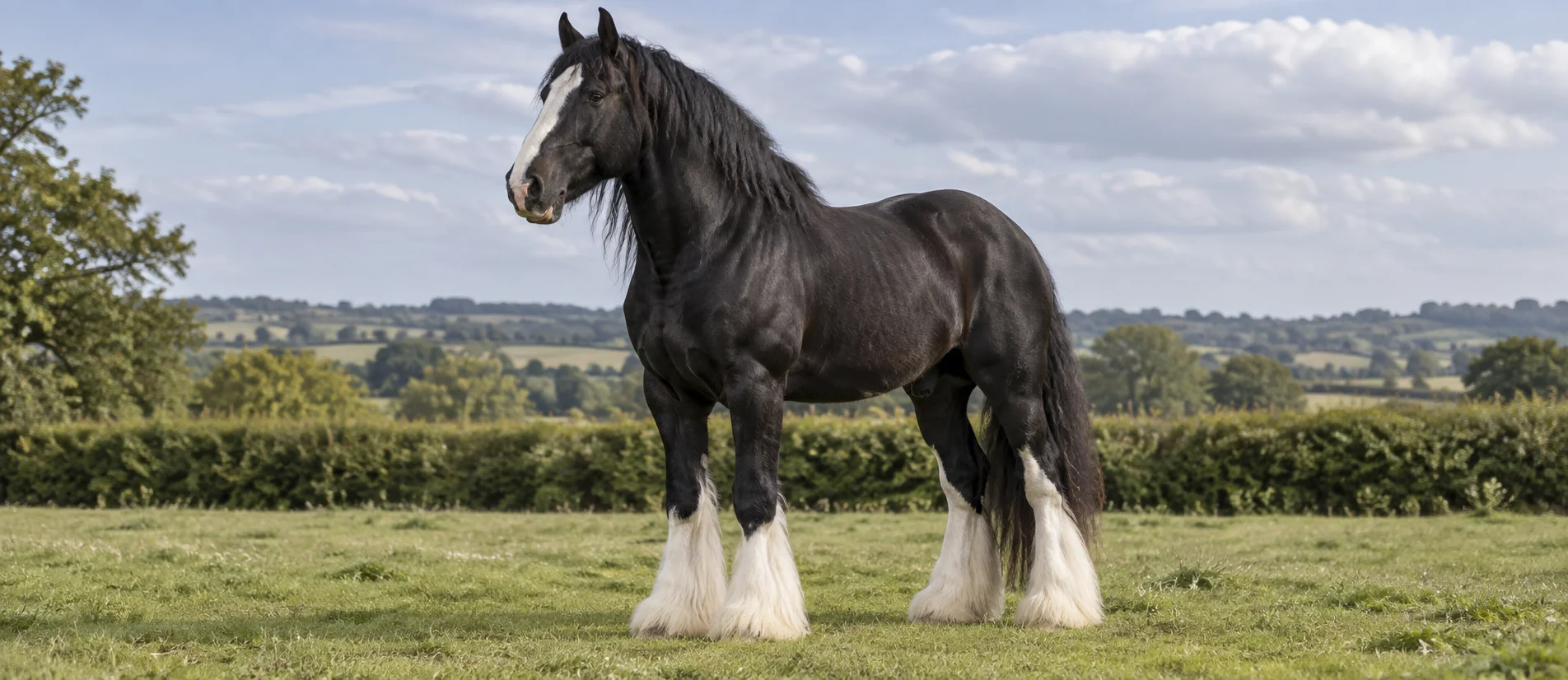
Have you ever stood beside a Shire and felt the ground seem to lower under you? Most people who have will tell you the same thing. The size is one part of it. The calm is the other, and it surprises them more.
We draw horses at Stirrup & Oak, and the Shire is one of the breeds that asks you to slow down and look properly. Before we put pen to screen, we wanted to know where this enormous, gentle animal came from, and what its history actually supports. So this is the story as the records tell it, with the myths named as myths.
A horse named for the counties
The Shire's name is a clue to its home. It comes from the shires of the English Midlands and the eastern counties, places such as Lincolnshire, Cambridgeshire, Leicestershire and Derbyshire, where big, strong horses were bred to work the heavy land. Before the name settled, the breed went by other names. You will meet the Great Horse, the War Horse, the Black Horse and the Old English Black Horse in older writing, and they are not always the same animal.
That is where the first myth sits. It is often said that the Shire is simply the medieval warhorse, unchanged, carrying a knight in full armour across a battlefield. The truth is more modest and more interesting. The medieval destrier was a valued, powerful horse, but historians generally do not picture it as anything like the size of a modern Shire. The heavy horse of the Middle Ages was a strong, weight-carrying animal that sits somewhere in the Shire's family tree. It is an ancestor, not a photograph.
What we can say with more confidence is that the crown cared about the size of the country's horses. In 1535 Henry VIII's government passed an Act for the breed of horses, aimed at stopping the nation's stock from shrinking. Stallions below a set height were kept off common grazing, and landowners were expected to keep breeding animals of a proper size. It was a state worried about strength, because strong horses were a matter of defence and of farming alike.
Over the following centuries the need shifted. Armour faded, guns and roads changed, and the demand for a huge horse moved from the battlefield to the field, the wharf and the street. The Great Horse did not vanish. It found new work.
Fens, stud books and the great age of the Shire
The eighteenth and nineteenth centuries are where the modern Shire takes shape. Breed histories often point to the draining of the Fens in the seventeenth century, when Dutch and Flemish engineers and their horses worked in eastern England, and suggest that continental blood strengthened the local stock. It is an old and widely repeated account, and it makes sense of the breed's heavy build, though the details of exactly which horses did what are not well documented, so we would treat it as a likely part of the story rather than a settled fact.
The improvers of the eighteenth century are better recorded. Robert Bakewell of Dishley in Leicestershire is best known for his work on sheep and cattle, and he is often linked with the selective breeding of the Black Horse as well. His wider legacy was an idea: that you could choose your breeding animals on purpose and record what you had done. That idea mattered when the horse breeders came to put their own house in order.
The stud book is where the Shire becomes a breed in the strict sense. The English Cart Horse Society was founded in 1878, and its first stud book followed in 1880. In 1884 the society took the name we still use, the Shire Horse Society. The early volumes trace many lines back to a foundation stallion called the Packington Blind Horse, said to have been foaled in the middle of the eighteenth century. The stud book is what turned a regional type into a registered breed, with named sires, named mares and pedigrees you could argue about in public.
Shows did the rest. The society's London show, held in the capital from the 1880s, gave breeders a stage and a market. Prices rose, and stallions of good lines became valuable property. The breed was at its height in these decades, working hard and admired for it.
It also produced the most famous Shire of all. Born in 1846 in Bedfordshire, a colt called Sampson, later renamed Mammoth, grew to just over 21 hands, roughly 2.2 metres at the withers, and is still recorded as the tallest horse ever measured. He is a wonderful fact, but he was an outlier, and he should not be taken as the ordinary Shire. Most stand a good deal shorter, at somewhere around 17 hands and above, which is still a very large horse.
The Atlantic crossing came in the same period. Shires were exported to North America in the 1880s, and the American Shire Horse Association was formed in 1885 to keep its own records. American farmers wanted a horse that could pull heavy ploughs and wagons on new ground, and the Shire's strength and steady manner suited them.
What the work made
A breed carries its job in its body. The Shire was bred to pull, and to do it all day.
Look at the build. The chest is deep and the shoulders are powerful, the back is short and strong, and the quarters are broad. The legs carry long, silky feathering, and the feet are large to spread the load on soft ground. Coats run to bay, brown, black and grey, often with white on the face and legs. None of it is decoration. A horse that hauls a loaded wagon through mud needs bone, muscle and balance, and generations of breeders selected for exactly those things.
The work itself was varied. On farms the Shire ploughed, harrowed and carted, and it was a familiar sight at harvest. In towns and cities it worked the streets, hauling goods from docks and stations, and pulling brewery drays that kept pubs supplied. Those brewery horses turned into a kind of moving advertisement. A well matched team with polished harness told the public that the firm was doing well.
Then there is the temperament, and this is the part people remember. A horse working in a busy street, among crowds, carts and noise, has to stay calm. A horse working close to a farmer, in a team, has to be patient and willing. Breeders who lived and worked beside these animals valued that quiet character alongside the strength, and the breed's gentleness is the outcome of that long, practical choice. Shires are often called gentle giants, and the name has a reason behind it. We would add only that individual horses vary, as horses always do.
Near loss, and the Shire today
Every heavy horse breed faced the same enemy in the twentieth century, and it was the engine. The First World War took horses from farms in huge numbers for army work, and the tractor and the lorry improved steadily afterwards. After the Second World War, mechanisation moved fast. Farms that had kept teams of horses for generations sold them or let them go. Breeding fell away, and the Shire, once the great working horse of England, slid towards the edge.
By the middle of the twentieth century the numbers were low enough that the breed's future was genuinely in question. We will not quote a figure we cannot source here, but the pattern is well known across the heavy horse world: registrations collapsed, and only the commitment of a small number of breeders kept the lines alive.
What saved the Shire was a mix of stubbornness and affection. Enthusiasts kept breeding. Some breweries kept their dray teams for deliveries and for show, which kept horses in public view. Ploughing matches and county shows kept the skills of working with heavy horses alive, and the breed society kept the stud book going. The Shire Horse Society still keeps that stud book today, and its shows remain a fixture for people who love the breed.
Today the Shire is no longer a commercial workhorse on any scale, but it has not become a museum piece either. You will find Shires in the show ring, in harness at events, and in traditional and low impact work such as forestry, where a horse can move timber without damaging the ground. Some breweries still use them for local deliveries. Many are also ridden and driven for pleasure, because the breed's kind nature suits a patient rider.
In the UK the breed is looked after by the Shire Horse Society, which maintains the stud book, and the breed is still counted among the native breeds that need careful stewardship. In the US the American Shire Horse Association continues the work it began in 1885, with a small but committed community of owners and breeders. On both sides of the Atlantic the story is much the same. A breed that once did the heaviest work in the country now survives because people choose to keep it.
That is what stays with us. The Shire's history runs from royal breeding laws to the drainage of the Fens, from a stud book started in 1880 to a tallest horse ever recorded, and then to a near loss and a careful recovery. It was shaped by work, it was almost ended by progress, and it was kept by people who simply could not let it go.
Our Shire plate is digital artwork in the style of an engraving. It is not an antique and it was not cut by hand, but it comes from the same wish to look at this horse properly, line by line, and to give its shoulders, feathering and calm the space they deserve. If the Shire has ever stopped you in your tracks, you will know why.
See it in the collection: The Shire collection