Breed Histories · 26 September 2026
The History of the Shetland Pony
How does a pony smaller than most large dogs are long end up hauling loads that would make a much bigger horse think twice? The answer lies in the islands it came from, and in a long history of work that asked a great deal of a small frame.
We are Stirrup & Oak, and this is our history of the Shetland. We have kept to what the breed societies, the stud books and published breed histories support. Where the record runs thin, we say so rather than fill the gap with a good story, because horse people can tell.
Where the Shetland came from
Shetland is a scatter of islands in the far north of Britain, exposed to wind and salt spray, with thin soil and short summers. Ponies have lived there for a very long time. Archaeological finds are generally taken to show small horses on the islands going back to the Bronze Age, well before anything we would call a breed existed.
Beyond that, the story gets less certain. It is often said that Norse settlers brought ponies of their own, and that these mixed with the animals already there. It is a reasonable idea, and you will find it in most breed histories, but nobody can say precisely which ponies came from where. Treat any tidy family tree for the earliest Shetlands with suspicion. Nobody was keeping one.
What we can say is that, over many centuries, isolation and a hard climate did the selecting. There was little shelter and never much grazing. Ponies that needed too much feed or too much protection from the weather did not thrive, and they did not pass much on. The ones that did were compact, sure-footed and frugal. Nobody designed that. The islands did.
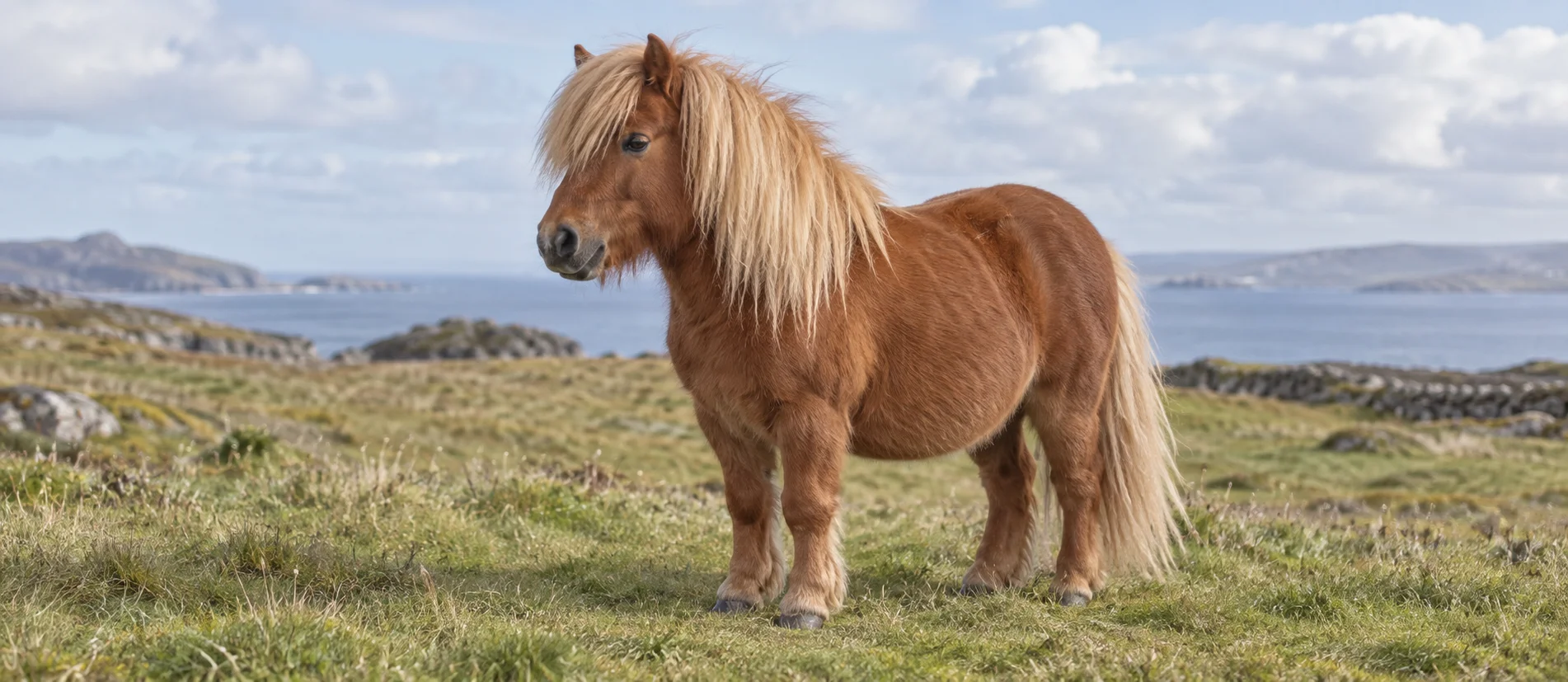
That is the root of the Shetland's famous shape. Short legs, a deep body, a broad chest and a small head are not fashion. They are a pony built to keep warm, keep its balance on rough ground and get by on poor grazing. Look at the outline and you are reading the landscape.
The work that shaped it
For most of its history the Shetland was a working animal on small farms known as crofts. Crofters had little land and little money, and a pony had to earn its keep several times over. It carried peats down from the hill, where the fuel was cut for the winter fire. It brought seaweed up from the shore to feed the ground. It hauled and it carried, and it was used for light work in the fields and about the township.
Think of it as the most sensible tool in a very small workshop. A big horse would have eaten more than a croft could grow. A pony that could do the same jobs on rough ground and modest feed made the whole holding work. When your margin is that thin, every mouthful has to pay.
Many ponies spent much of the year out on the hill on open grazing rather than in a stable, and were gathered when they were needed. That matters for temperament, and it is worth saying plainly. A pony that lived half wild, then worked close to people in small spaces and depended on human help only when the weather turned, learned to be sensible and to think for itself. Many owners describe Shetlands as clever and strong-minded, and that is fair. They are also known for being stubborn when they choose. That is another way of saying they make their own decisions, which is no surprise in an animal whose ancestors survived by doing exactly that.
The coat tells the same story. The Shetland grows a thick winter coat, with a dense undercoat and a heavy mane and tail. It is an answer to weather, and it is one reason the breed does well outdoors in the British climate. If you have ever watched one stand square to a wet wind, quite content, you have seen the design working.
Down the mines
The chapter most people know is the pit pony. As the coal industry grew in nineteenth-century Britain, mines needed animals to haul coal tubs along low underground roads. Legislation in the 1840s changed who could work underground, and mine owners looked for other ways to move the coal. Small, strong ponies suited narrow, low workings, and Shetlands were among those used.
It is a chapter with two sides, and we would rather say so honestly. Shetland ponies were valued for their strength for their size, and the demand shaped breeding and trade in the islands. Ponies that could be sold south were worth more to a crofter than ponies that could not, and that pressure did not always favour the best of the breed. But it was hard work in poor conditions, and the pit pony is remembered with a mix of respect and unease. It is part of why the breed became better known outside Shetland, and part of why later rules on the care of working animals mattered.
The same skills that made a good croft pony made a good mine pony: a low centre of gravity, a steady head and a willingness to keep going without fuss. That is the thread running through the whole history. The work changed, from hillside to coal face, but the qualities that earned the pony its place did not.
If you want exact numbers on how many ponies left the islands, or which owners bought them, you will need the detailed published histories and the society's own records. We have not put figures here that we cannot stand behind.
The stud book and the society
Until the late nineteenth century, breeding on Shetland was mostly a matter of local knowledge. A crofter knew his mare, her mother and the stallion on the next hill, and that was the pedigree. Then came the move to write it down. The Shetland Pony Stud-Book Society was founded in 1890, and its first stud book followed soon after. That step turned a local type into a recorded breed.
Why does that matter? A stud book fixes pedigrees, defines what counts as a Shetland and gives breeders a shared standard to work to. It also protects the breed from drifting. Without a register, a pony sold south could be bred to anything, and within a few generations nobody could say what was Shetland and what was not. The book drew the line.
The society still keeps the breed's height limit, which is small by any measure, and it registers ponies to this day. It is one of the more useful places to look if you are thinking of owning one, because it explains what a registered pony should look like and how its lines are recorded.
Across the Atlantic
Shetlands crossed to North America in the later nineteenth century, and Americans took to them quickly. The American Shetland Pony Club was formed in the 1880s to record the breed there. From that point the two countries did not stay identical. In the US, breeders pursued a somewhat different type, with a finer, more refined look suited to driving and showing, and the American Shetland has its own registry and its own ideals as a result.
That is why you can meet two ponies both called Shetlands and see clear differences in build. The British pony stays closer to the sturdy island original: short in the leg, heavy in the coat, deep through the body. The American type has been shaped by a different market and a different idea of what a small pony is for. Neither is wrong. They are two branches of the same story, and it helps to know which one you are looking at before you form an opinion about what a Shetland ought to be.
What the history means now
The mines have gone, and the croft ponies that hauled peats are mostly a memory. The Shetland has changed jobs. Today it is a children's first pony, a driving pony, a show pony and a cherished companion. Its history still shows in every one of those roles. The strength for its size is why it can carry a small rider steadily. The clever streak is why a good owner learns to be patient and consistent. The hardiness is why a Shetland often looks happiest with room to graze and a bit of weather.
It also explains the warnings experienced owners give. A pony bred for centuries to manage on very little tends to put on weight easily when the grazing is rich, and the answer is usually care over feeding rather than more of it. That is the island history speaking through a modern paddock.
For anyone new to the breed, that is the useful lesson. A Shetland is not a toy horse. It is a working breed in a small package, and it repays owners who respect that.
We draw our own plates in a digital engraving style, and the Shetland is a favourite subject because its outline says so much about where it came from: the low, solid frame, the heavy mane, the confident stance of an animal that has always known its own worth. If this history has made you want to look at one properly, we hope our artwork does the pony justice.
See it in the collection: The Shetland collection