Breed Histories · 26 September 2026
The History of the Quarter Horse
Why does a horse get named after a distance? Most breeds are named for a place, a valley or an island, or a region where people kept them. The Quarter Horse is named for a measurement, and the measurement tells you almost everything about how it began.
We keep a rule in this series that every date, person and horse has to stand on something firmer than a good story. The Quarter Horse has plenty of good stories, and some of them are tidier than the records allow. Where the evidence is thin, we say so.
A horse named for a quarter mile
The breed's beginnings are in the English colonies of the Atlantic seaboard, chiefly Virginia and the Carolinas, in the seventeenth century. The settlers there had little of the space that racing in England took for granted. Long, carefully kept turf courses were not available to people who were still clearing land. What they had were short, straight stretches: a cleared lane, a village street, a field edge. Races were run over a quarter of a mile or less, and the horses that won them were the ones that could leave the mark fastest.
That is the origin of the name, and it is well supported. The horses were quarter-mile horses, and eventually they were simply called Quarter horses.
Where those horses came from is a matter of blending rather than one clean line. Breed histories describe a base of horses of Spanish descent, often called Chickasaw horses in the Southeast, crossed with English stock brought over by the colonists. English racing blood added speed and size. The Spanish-descended horses added handiness and a level head. Nobody drew up a plan. People bred the horses that won on Sunday and pulled a plough on Monday, and the type settled out of that.
One name turns up again and again in the early records: Janus, an English Thoroughbred foaled in 1746 and taken to Virginia in 1756. He was a grandson of the Godolphin Arabian, and he is widely credited as one of the most influential sires behind the early short-distance horses of Virginia and North Carolina. It is worth being careful here. Janus is a genuine and well documented figure, but the colonial racing horse was never the product of one sire, and anyone who tells you the breed began with a single horse is simplifying.
The build that work gave it
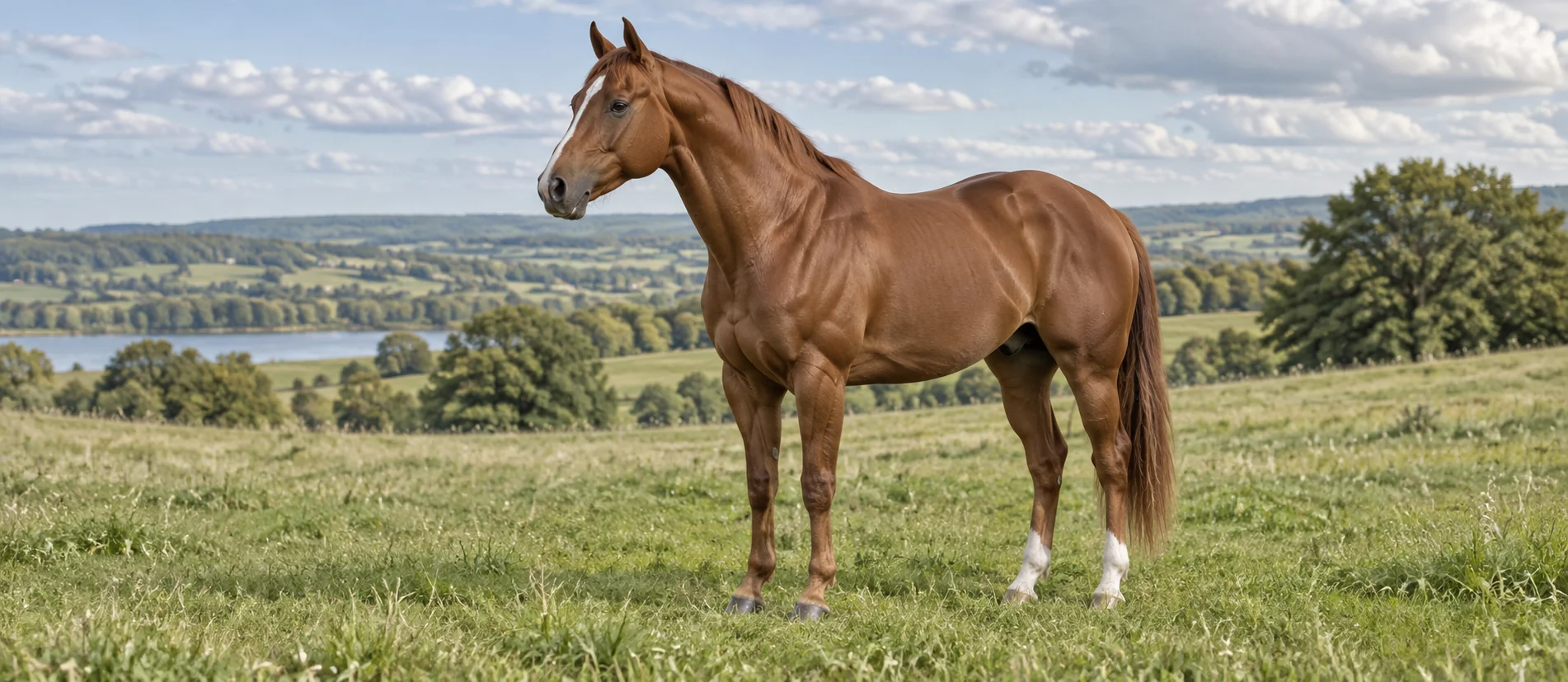
The shape of a Quarter Horse is not an accident of fashion. Look at one standing square and you can read its job. The hindquarters are deep and heavily muscled, because a horse that has to launch from a standstill needs its power behind. The chest is broad, the neck set to let the head carry low, the legs short and strong for their size, and the whole animal compact rather than long and leggy.
That build served two masters. On the track it gave the burst of speed over a short distance that made the name. Then, as the population of settlers moved west, the same build turned out to suit a different kind of work altogether: stock work.
Cattle work asks for something a racehorse is never asked for. The horse must start quickly, stop hard, turn on its hocks and stay with a single animal that is trying to be somewhere else. That is a lot of sudden athletic demand, and it favours a short-coupled, balanced horse over a rangy one. It also asks for temperament. A ranch horse spends long days close to people, working with a rider who is watching the cow and not the horse. A calm, willing, quick-thinking animal is worth far more in that job than a flighty one, and generations of choosing for it left the breed with the steadiness it is still known for.
People who ride Quarter Horses tend to describe the same thing in their own words: a horse that seems to wait for you to ask. That is the temperament of the ranch showing through, not sentiment.
West with the settlers, and into the ranch
As settlement pushed west, the horses went with it. In Texas and the wider Southwest, the Quarter-type horse met the cattle industry, and that meeting made the breed's second career. Cowhands needed a horse that could work all day, handle rough country and hold a rope. The compact, quick, sensible horse of the eastern short tracks did all of it.
Several names from this era carry weight in the breed's own histories. Steel Dust, a horse associated with Texas in the mid nineteenth century, became a byword for a certain type of fast, muscular horse, so much so that for a time the name was used almost as a label for the type. Records from that time are patchy, and the stories about him have grown in the telling, so treat the details with caution. Peter McCue, foaled in 1895 in Illinois, is better documented and is remembered as an important sire whose blood runs through many of the foundation lines. He was a large, powerful horse, and he shows how the breed was being shaped by both racing and ranching at once.
The King Ranch in Texas is another anchor. Its breeding programme is closely tied to a stallion known as Old Sorrel, foaled in the early twentieth century, who became a cornerstone of the ranch's horses. Ranches like it were not breeding for a show ring. They were breeding for the horses their own hands needed, and they kept careful track of who had produced what.
A stud book, a society and a horse called Wimpy
For a long time the Quarter Horse was a type more than a registered breed. That changed in 1940, when horsemen met in Fort Worth, Texas, and founded the American Quarter Horse Association. The aim was to define the breed, record its horses and keep a stud book so that bloodlines could be traced instead of argued over.
The first registration number, P-1, was given to a stallion named Wimpy, bred at the King Ranch. He had been named grand champion at the 1941 Southwestern Exposition and Fat Stock Show in Fort Worth, and his number has stood as the opening line of the Association's stud book ever since. A horse being first in the book does not make him the first Quarter Horse, of course. It makes him the first one written down.
That distinction matters, because it was the record, not the horse, that turned the breed into an institution. Once there was a stud book, there were shared standards, organised showing and a way to prove what a horse was. Growth followed. The American Quarter Horse Association is now generally described as the largest breed registry in the world, with well over three million horses recorded across its history.
The Quarter Horse today, in the US and the UK
The breed's story never stayed on the ranch. In the United States, the Quarter Horse is a working horse and a sport horse. It is the horse of cutting, reining, barrel racing, team penning and ranch versatility classes, and it also remains a racehorse, still running the short distances that gave it a name. Because of its steady nature it is also a common choice for riders who simply want a sensible partner for the trail or the lesson ring.
In the United Kingdom the picture is smaller but real. The Quarter Horse arrived here alongside a growing interest in western riding, and it has a following among people who ride western disciplines, work cattle-style events or just like the type. There is a UK breed society for it, and owners here compete in the same kinds of classes as their American counterparts. It is not a native breed, and it does not carry the weight of tradition that a Cleveland Bay or a Welsh Cob does, but it has earned its place through what it does under saddle.
What stays constant across both countries is the reason people choose the breed. It is a horse that grew out of work, and the work left its mark on both body and mind. Speed from a standstill, a low centre of gravity, a calm head, and a readiness to get on with the job. Those are not marketing points. They are what centuries of use, on short tracks first and then on open range, bred into the animal.
The plate we have made for this breed is digital artwork in the engraving style. It is not an antique and it is not hand-engraved, and we would never present it as either. What we can promise is that the horse it draws on has one of the more straightforward histories in the stable: a breed made by the job it was asked to do.
If you love a Quarter Horse, or simply like a horse with a story you can trust, we hope this gives you a fair account of where it came from. The gaps we have named are gaps in the record, and we would rather leave them open than fill them with something that only sounds right.
See it in the collection: The Quarter Horse collection