Breed Histories · 26 September 2026
The History of the Przewalski's Horse
Most of the breeds we draw came to us with a job attached. A plough, a mail coach, a cavalry charge, a mountain track. The Przewalski's horse is different, and that is exactly why it belongs in this series. Nobody bred it to work. It is the horse that turned up in the books of science late, vanished from the wild soon after, and was rebuilt from a handful of animals in zoos.
So this is not a story about what a horse was made to do. It is a story about what a horse is when nobody has made it into anything.
A wild horse, described late
The steppes of Central Asia have been horse country for a very long time. The people who lived there knew the small, sandy coloured wild horse of the Dzungarian basin and the Mongolian plains long before any European wrote it down. In Mongolian it is takhi, which is usually translated as "spirit" or "spirited", and that is the name still used in Mongolia today.
The European record begins in the nineteenth century. Nikolai Przhevalsky, a Russian army officer and explorer who led expeditions through Central Asia, was given a skull and hide of an unfamiliar wild horse at the edge of the Russian empire. The Russian zoologist Ivan Poliakov studied the material and, in 1881, described it as a distinct species. It carries Przhevalsky's name in its Latin form, and the spelling of that name has been argued over ever since, which is why you will see Przewalski's, Przhevalsky's and several other versions in print.
We should be honest about the limits here. Przhevalsky did not discover the horse in any sense the Mongolian herders would recognise. What he did was bring it into the European scientific record, and that mattered, because the moment a wild animal is named it becomes something people want to collect.
Captured, shipped and nearly lost
Around the turn of the twentieth century, wild foals were captured in Mongolia and sent to Europe. The animal dealer Carl Hagenbeck of Hamburg was a central figure in getting them to zoos and private collections. Capturing a foal generally meant killing or driving off the adults that protected it, so every animal that reached a European enclosure cost the wild herd more than one horse.
Those captures matter for a reason that has nothing to do with romance. Almost every Przewalski's horse alive today descends from a very small number of wild caught animals. The commonly cited figure is about a dozen founders, and a domestic mare is thought to appear somewhere in the pedigree as well. That is a narrow gene pool to build a species on, and the people who look after the breed still work with that fact every day.
In the wild the decline was steady. Harsh winters, hunting, competition with livestock for water and grazing, and the disruption of the twentieth century in the region all played a part. The last confirmed sightings in the wild came in the late 1960s, and the species was then treated as extinct in the wild. Meanwhile the zoo population was hit hard too. By the end of the Second World War only a few dozen animals remained, scattered across a small number of collections in Europe and beyond.
The stud book that held it together
This is the part of the history we find most moving, because it is unglamorous. Nobody rode these horses to victory or painted them in front of a stately home. People simply kept careful records.
A stud book for the breed was begun in Germany in the 1930s, associated with the zoologist Erna Mohr, and the work was later carried on and internationalised. Prague Zoo took on the keeping of the international stud book, and it remains a core reference for the population. Every animal in it is traced, and breeding recommendations are made so that related horses are not paired if it can be avoided. It is the same principle that sits behind the stud books of the horse breeds we already know, applied with unusual strictness because there was so little to work with.
The other turning point was organisational. In 1977 the Foundation for the Conservation of the Przewalski's Horse was set up in the Netherlands, and it worked with zoos and Mongolian partners toward the idea that the horses should not stay behind bars for ever. The aim was a return to Mongolia, which was a long way from certain at the time.
Back to the steppe
The reintroduction began in the early 1990s. Horses bred in European collections were flown to Mongolia and released into protected areas, among them Hustai National Park and the Great Gobi B Strictly Protected Area. Other releases followed in China and Kazakhstan, and horses have also been placed in places as different as the Hortobágy region of Hungary and the exclusion zone around Chernobyl in Ukraine, where they have been left largely to themselves.
The results have been uneven, and it is worth saying so. Severe winters have set the Mongolian herds back more than once, and small populations are always fragile. Even so, the species was moved on the international conservation list from Critically Endangered to Endangered in the early 2010s, a change that reflected the horses breeding successfully in the wild again. Roughly two thousand exist today, most of them in a few managed herds. That is a recovery, but a young and watchful one.
What the horse actually is
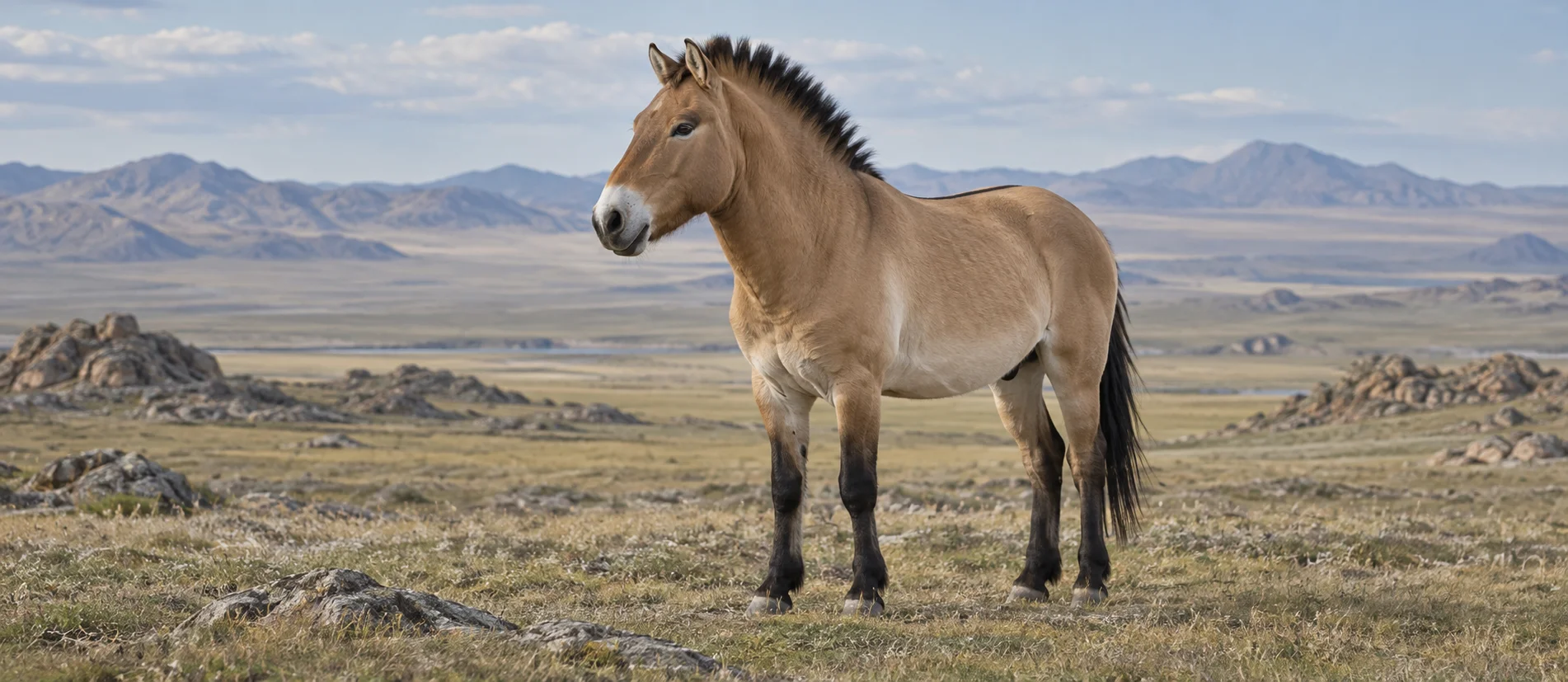
Look at one and the difference from the horses in a British field is plain. It is short and heavily built, with a thick neck, a big head and a short, stiff upright mane that stands like a brush. There is no forelock. The colour is a dun shade, sandy to buff, with a pale belly and muzzle, and darker legs that sometimes carry faint zebra like barring. It is a horse shaped by cold winters, thin grazing and wolves, not by any human who wanted a particular kind of animal.
It also has 66 chromosomes where the domestic horse has 64. For a long time this was taken as proof of a separate lineage that had never been domesticated, and the horse was called the last truly wild horse.
Then the science moved. A large genetic study published in 2018 compared the Przewalski's horse with ancient horses from the Botai culture of northern Kazakhstan, people who kept horses thousands of years ago. Its finding was that the living Przewalski's horses descend from those early domesticated animals, so they are better described as feral than as never tamed. The domestic horse we know, it turned out, comes from a different lineage altogether. This does not make the takhi less remarkable. It makes it stranger. A horse that once lived alongside people went back to the wild and stayed there for millennia.
Temperament follows from that history. These are not horses to be handled as riding stock. Stallions and mares live in tight family groups, they are wary, quick and independent, and the people who manage them treat them as wild animals, not as unusually hairy ponies. Nothing in the breed's recent history has selected for a horse that wants to please.
The breed today, in Britain and America
You can see Przewalski's horses in Britain, mostly in zoological collections and wildlife parks that take part in the international breeding programme. The animals are moved between collections on the advice of the studbook keepers so that bloodlines stay as varied as possible. It is a very quiet sort of stewardship, and it is the reason the species is still here.
In the United States the picture is similar. Conservation institutions keep herds, and one story from the last few years has drawn wide attention. In 2020 a Przewalski's foal named Kurt was born, cloned from cells that had been frozen decades earlier from a stallion whose genes were otherwise missing from the living population. The work was carried out through a partnership involving a San Diego conservation organisation and a genetic rescue group. The aim was not novelty. It was to add back variety that the founders' small number had lost. Whatever you think of cloning, it shows how far a species can be pushed toward the edge, and how much effort it takes to bring it back.
We come back to this horse because it is a good reminder of what a horse breed is at bottom: a line of animals, a record of who they came from, and people who decided to keep it going. Our plates are digital artwork in the engraving style, made for people who love that lineage of record keeping and working horses. The Przewalski's horse gave us a plate with more weight than most, because it stands for the horse before any of the work began.
If you love horses, learn to recognise this one when you see it. It is the only wild horse most of us will ever have the chance to meet, and it is here because a few people cared enough to write everything down.
See it in the collection: The Przewalski’s horse collection