Breed Histories · 26 September 2026
The History of the Percheron, from Perche to the Plough
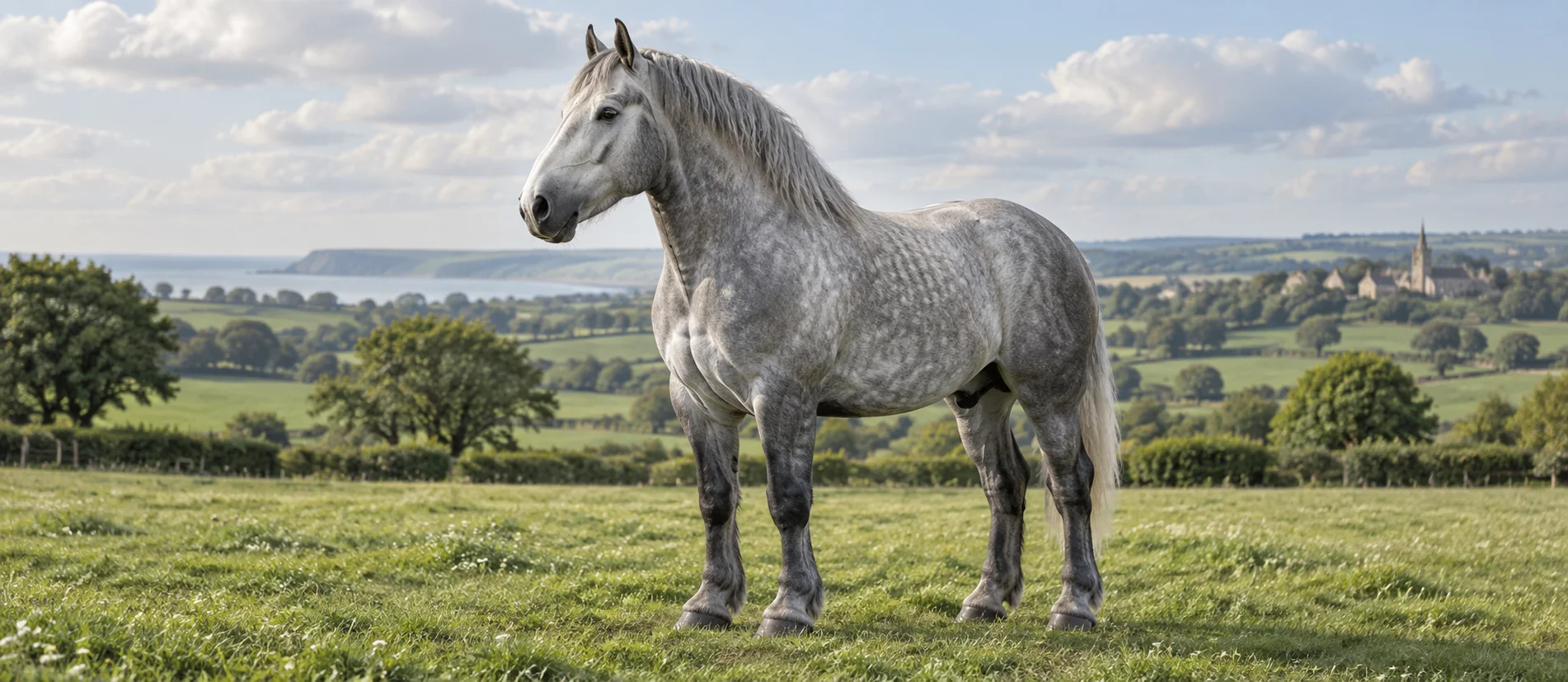
Why does a horse the size of a small van move like something far lighter? Anyone who has watched a Percheron trot will have wondered. The breed is big, often grey, and very solid, yet it carries itself with a freedom that many heavy breeds do not. The reason sits in its history, and that history starts in a quiet corner of France.
At Stirrup & Oak we draw horses, so we care about how a breed came to look the way it does. This is the story as it is told in the breed societies' own accounts and in published breed histories. Where a popular tale cannot be properly supported, we say so.
Where the Percheron came from
The name comes from Le Perche, a historic region of northern France, south-west of Paris and on the edge of Normandy. It is a landscape of gentle hills, pasture and small farms. Horses were bred there for generations, and the ones that suited the work of the district were the ones farmers kept breeding from.
You will often read that the Percheron descends from great medieval warhorses, and that Arab horses left behind by the invaders defeated at Poitiers in the eighth century added their blood. It is a romantic story and it is repeated everywhere. It is also a legend. The Arab connection is better documented in a later period, when Eastern stallions were used in France to add quality and refinement to the local horses. That, not a single battle, is the sounder explanation for the breed's clean lines and fine head.
One name turns up again and again in the early records: Jean le Blanc, a grey stallion foaled in 1823. Breed histories treat him as a founding sire, and a great many Percherons trace back to him through the male line. That tells you something about how the breed was built. It was not designed in one stroke. It was shaped by farmers and stallion keepers choosing the horses that did the job best, and using the good ones over and over.
The work that made the build
The Percheron was never only a farm horse. In France it was used on the land, but it was also a road horse, pulling heavy coaches over long distances before railways took that work. Slow strength alone does not do that job. A horse pulling a loaded coach needs to keep going, keep a decent pace, and stay sound on hard roads.
That is why the breed looks as it does. Compared with some of its heavier cousins, the Percheron is generally cleaner in the leg, with little feather. It has a deep chest, a strong back and quarters, and a good length of stride. Adults commonly stand somewhere in the sixteens in hands and weigh close to a tonne. The typical colours are grey and black. The grey is worth a word: a grey horse is born darker and lightens through life, and many old Percherons end up nearly white.
Temperament follows from the work too. A horse that goes into town with a coach, or works close to people every day, has to stay calm around noise and traffic and willing to be handled. The Percheron has a long reputation for being biddable and intelligent, and for taking its work seriously without fuss. Breeders kept the horses that could do that, and drove out the ones that could not. Anyone who has worked with the breed will tell you it still shows.
Its ancestors' reputation as warhorses is harder to pin down. Horses of this general type were certainly used for military work, and in the late nineteenth and early twentieth centuries there was serious demand for strong horses to move artillery and supplies. The First World War drew heavily on horses from many countries. It is fair to say the breed's quality was noticed by the buyers. It is not fair to claim a particular unbroken line from a medieval charger, and we will not.
Stud books, societies and the crossing of the Atlantic
As the nineteenth century went on, the breed's reputation spread well beyond Le Perche, and the record keeping followed. A breed society was formed in France in the early 1880s and a stud book was begun, giving breeders a way to prove a horse's descent. That paperwork matters more than it sounds. Once a breed has a stud book, it can be defined, protected and traded with confidence.
Percherons went to the United States early. The first known importation is credited to a Mr Edward Harris of New Jersey, who brought horses over from France in 1839. From there the trade grew, and after the middle of the century a steady stream of stallions and mares crossed the ocean. American farmers and hauliers wanted a big, willing horse that could pull ploughs on the prairie and heavy loads through growing cities, and the Percheron suited both. The American breed association and its stud book were founded in the 1870s, and the breed became one of the most numerous draught horses in the country. Percherons were also used in western work, and on ranches, wherever a strong steady horse was needed.
Britain came to the breed later and in smaller numbers. The British Percheron Horse Society was founded in 1918, at a time when the war had left the country very short of horses and thinking hard about what kind of horse it needed next. British heavy horse people already had the Shire, the Clydesdale and the Suffolk Punch, so the Percheron had to earn a place. It did, partly on its own merits and partly because its lighter, active build made it useful for commercial and town work. Brewery horses and heavy vans are the classic image, and you can still see Percherons in that role at shows and demonstrations today.
Mechanisation and the breed today
Then came the tractor. Between the two world wars, and more sharply afterwards, petrol and diesel replaced horsepower on farms and in towns. Draught breeds everywhere lost their work almost at once, and with it the reason to breed them. Many horses went to slaughter, and breeders lost heart. The Percheron survived because a core of enthusiasts kept a small number of good horses going, and because the breed found new jobs.
Those jobs are still varied. Percherons are driven in harness at shows, used in forestry and on small farms by people who prefer horse power, and ridden as well as driven. Crossed with lighter blood, they have also contributed to riding horses, since the breed's temperament and movement carry through. The breed societies in Britain, France and America continue to keep the stud books and to promote the horse, and the numbers are far healthier than they were in the years of the great decline, though it is still a heavy horse breed that depends on people who care about it.
What does that history mean if you simply love horses? It means a Percheron is not a museum piece. It is a working horse that was chosen, generation after generation, for strength that did not cost it its manners or its movement. When you see one standing quietly in a show ring, or striding out in front of a cart, you are looking at the result of a very long conversation between farmers and horses.
That is what we try to catch in our artwork. Our plates are digital engraving-style pieces, made to draw out the shape and character of each breed. They are not antiques and they are not hand-engraved, but they are made with the same respect for the animal. A Percheron is a good subject: the arch of the neck, the deep body, the clean leg and the calm eye are all there to be drawn.
If this history has made you curious, keep reading about other breeds, because each of them carries its own story of work, luck and the people who refused to let it disappear. The Percheron's story is a good place to start, and it is far from finished.
See it in the collection: The Percheron collection