
Breed Histories · 26 September 2026
The History of the Paint Horse
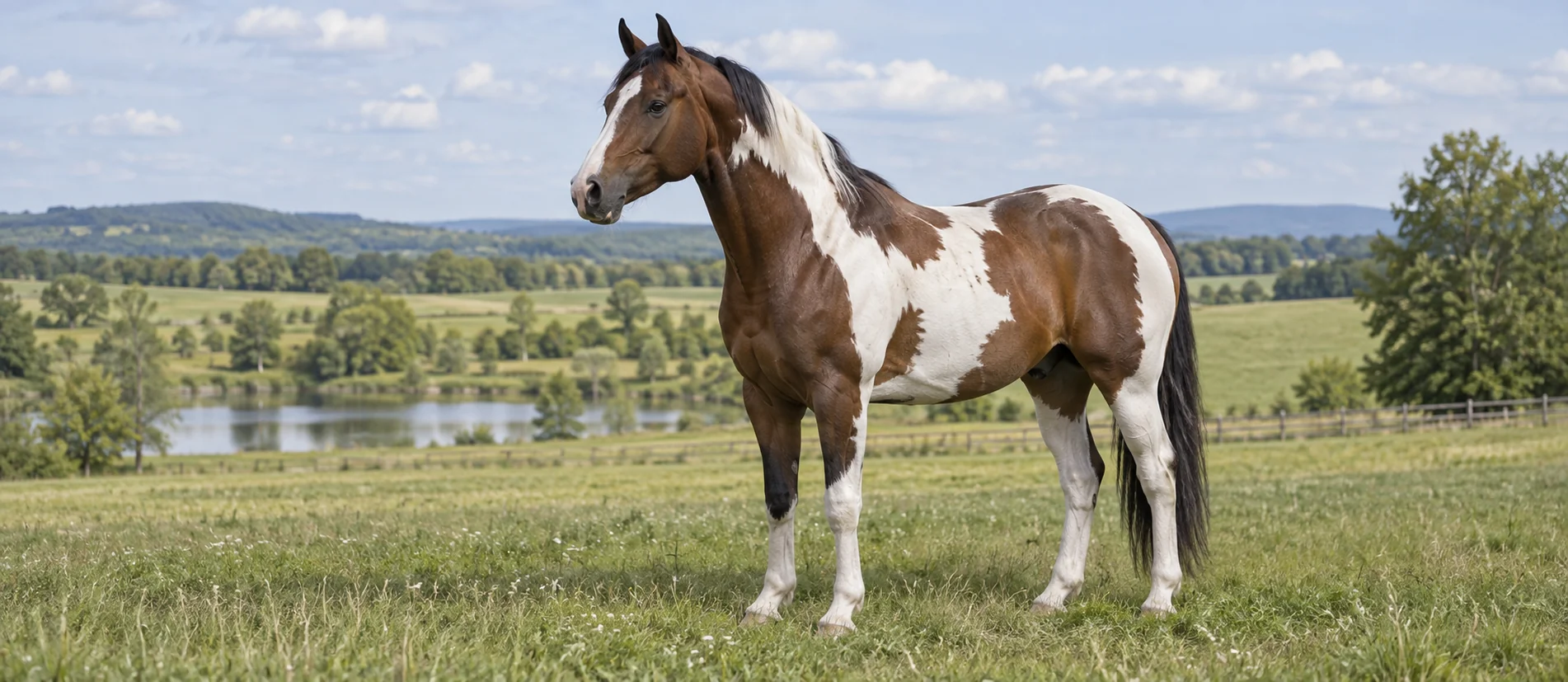
Ask a room of horse people what a Paint Horse is and you will get two answers. One is about colour: big patches of white over a dark base, or the reverse. The other is about breeding: a stock horse with Quarter Horse and Thoroughbred blood in it. Both answers are right, and the history of the breed is really the story of how those two answers were joined together.
We draw a lot of horses at Stirrup & Oak, and the Paint is one that rewards a long look. Our plates are digital artwork in the engraving style, not antique or hand-engraved pieces, so the patterns are ours to render. But the pattern itself is old, far older than any stud book.
Spanish horses and a coat that kept turning up
The horses that became the American stock horse began in Spain. Spanish expeditions carried horses across the Atlantic from the early sixteenth century, and those horses came in many colours, patched ones among them. Coat patterns of this kind are known from horses in many places and periods, so it would be wrong to say the Paint pattern belongs to any one country. What we can say is that the patched coats in the Americas were carried in by the Spanish horses and then multiplied there.
For a long time, nobody was breeding for the pattern as such. Horses escaped, were traded, were stolen and were bred, and the colour went along with them. The great spread came after the Spanish colonies in the south-west lost control of their herds, and horses moved north across the plains through trade and raiding. By the eighteenth century, horse cultures had grown up among many Plains peoples, and horses had become central to hunting, travel, warfare and wealth.
Many of those riders valued the patched coat highly. Accounts of Plains horse culture describe painted horses being prized, and the bold pattern had practical appeal on open ground, where you could pick out your own horse at a distance. We would be careful with claims that go much further than that. You will read a good deal about war paint, medicine horses and spiritual meaning attached to particular markings. Those meanings varied between nations and between individuals, and a single tidy story about "what the Paint meant" is not one we can support. It is better to say that the horses were valued and let those nations speak for their own traditions.
Ranch work and the horse under the pattern
As settlers, cattle ranchers and cowboys spread across the American West in the nineteenth century, the horses that did the work were the tough, quick, sensible types descended from those Spanish and Plains lines, crossed with imported breeds. The job was cattle: cutting, roping, long days in the saddle, sudden bursts of speed over short distances and the ability to stop and turn on a coin.
That work shaped the build. A working stock horse is compact and muscular through the hindquarters, with a deep chest, a strong short back and sound legs. Temperament mattered as much as shape. A ranch horse has to stay calm around cattle and noise and still have plenty of "cow sense", the instinct to watch the animal in front of it. The Paint Horse of today is described in these terms by its own society: athletic, willing and steady. Those qualities are the ones the ranch selected for, and they are the ones people still buy the breed for.
Patched horses were always part of that ranching world, but they were often treated as something of an accident. A ranch bred for speed and stamina, and a foal with a lot of white on it was, in some yards, simply less wanted. In the early twentieth century, the big Quarter Horse and Thoroughbred registries were built on strict ideas of type and, in some cases, of colour. Horses with too much white could be turned away, however good their pedigree. That left a great many good horses unregistered.
From a colour to a stud book
The turning point came in the middle of the twentieth century. The Pinto Horse Association of America was founded in the 1950s, and it registered horses mainly on colour. That suited many owners, but it did not satisfy those who wanted a breed defined by its bloodlines as well as its coat.
In 1960 to 1962, breeders in Texas began organising. Rebecca Tyler Lockhart, of Texas, is the name most often given as the driving force behind the American Paint Quarter Horse Association, which she founded in 1961. It was followed by the American Paint Stock Horse Association in 1962, based in Amarillo. The two bodies merged in 1965 to become the American Paint Horse Association (APHA), which is still based in Fort Worth, Texas. If you want the exact wording of that history, the APHA publishes its own account, and we would send you there for anything we have not put down here.
The important idea was the combination. To be registered as a Paint, a horse must have Paint, Quarter Horse or Thoroughbred parentage, and it must show the required white patterning on unpigmented skin. In effect, the society took a pattern that had been an obstacle in the older registries and built a breed around it, with a stock horse's conformation underneath. Horses that carry the breeding but not the pattern can still be registered in a separate category, so the bloodline is not lost.
The society also put words to the patterns. You will hear three terms all the time:
- Tobiano: white that usually crosses the back between the withers and the tail, with legs that are often white, and a head that is usually marked like a solid-coloured horse's.
- Overo: white that tends to start low on the sides and stay away from the back, with a head that is often extensively white.
- Tovero: a mix of the two, and a term you will meet in Paint circles more than elsewhere.
Those descriptions are simplified. Paint people will tell you that a lot of horses do not sit neatly in one box, and the overo group in particular includes several distinct patterns.
There is one piece of genetics that is worth knowing about, because responsible breeders talk about it openly. Foals born to two carriers of a particular gene associated with some overo patterns can be born with a fatal condition, usually called lethal white overo syndrome. A genetic test exists for it, and testing has become an ordinary part of careful breeding. It is a reminder that a beautiful coat is the surface of a very complicated inheritance.
What the history means now, in the US and the UK
Today the Paint is thought of as one of the American stock horse breeds, alongside the Quarter Horse and the Appaloosa. It competes in Western disciplines: reining, cutting, barrel racing, working cow horse and pleasure classes. Its own society runs shows and championships for the breed. You also find Paints in English work, trail riding and as family horses, which is entirely in keeping with a temperament bred to be steady.
In Britain, the picture is a little different. British horse people already had their own words for patched coats, piebald for black and white and skewbald for any other colour with white, and coloured horses have a long life in British riding and driving. Those are a separate story from the American breed, and they are not the same thing as a registered Paint. The Paint Horse has followers in the UK all the same, riding Western and working with the breed's association, and the pattern has a following among people who have simply fallen for the look. If you are thinking of a registered Paint in Britain, check the current registration and import requirements with the relevant society, because those rules change and we would rather not guess at them.
What stays with us is how the breed got its shape. It began as a scatter of coloured horses that came from Spain and spread across a continent, passed through the hands of ranchers who often did not value the colour, and was finally recognised by people who thought both the coat and the horse deserved a stud book. It is a history built on ordinary working merit and a great deal of stubbornness from the people who kept faith with the horses everyone else overlooked.
That is the part we try to carry into the plates. A Paint in engraving style is a study in pattern: the line of a patch, where dark meets pale, the way the shading follows the muscle. It is our own digital artwork, drawn to look at the horse properly, and it is the reason we keep coming back to this one.
If you have a Paint of your own, or you simply admire them, we would love to hear which pattern you favour. Tobiano, overo or tovero: everyone has an opinion, and it is a good argument to have.
See it in the collection: The Paint Horse collection