Breed Histories · 26 September 2026
The History of the New Forest Pony
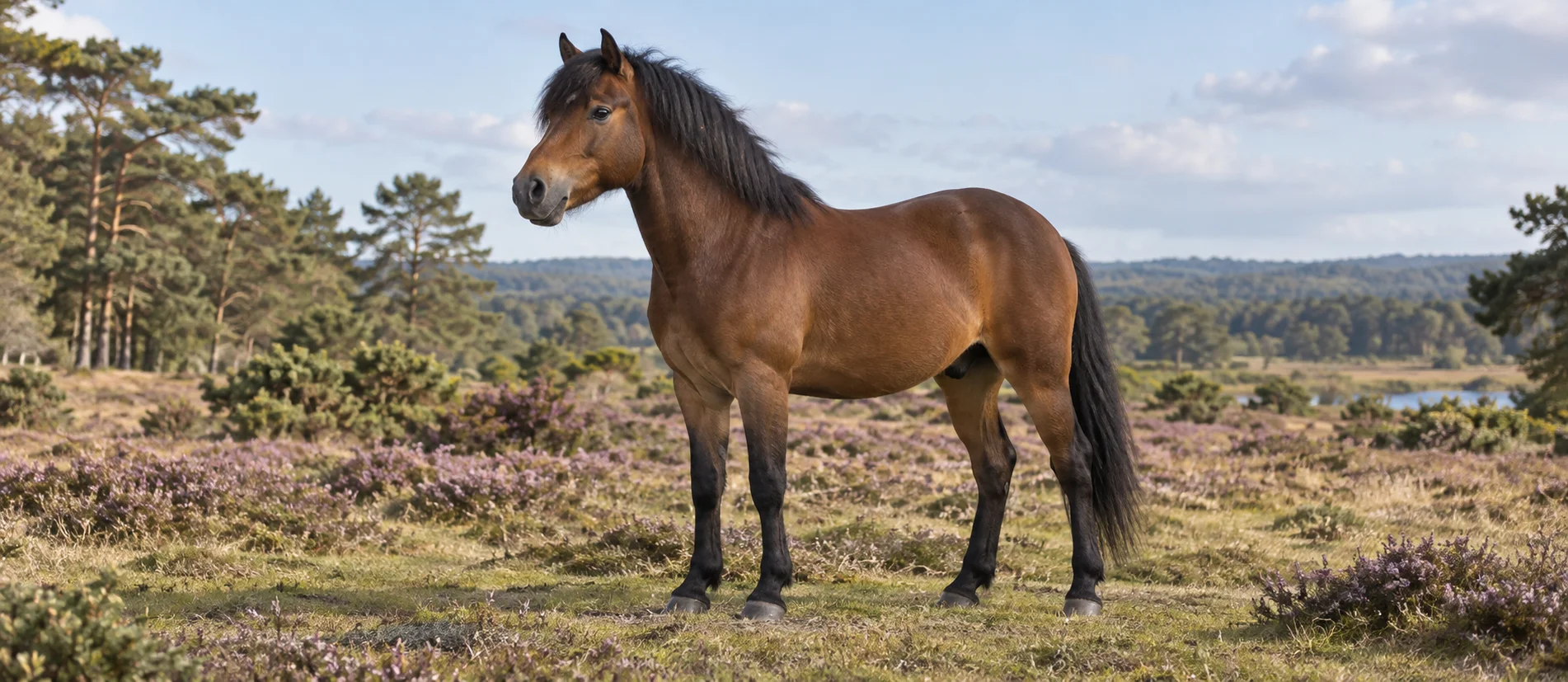
Have you ever watched a pony stand at the edge of a road, entirely unbothered, while a queue of cars waits for it to make up its mind? If you have been to the New Forest, you probably have. It is one of the first things visitors notice, and it is a good place to start, because that calm is part of the breed's history. It was not trained in. It was lived into, over a very long time.
At Stirrup & Oak we like a breed history that stays close to the evidence, so I will tell you what is well supported, what is uncertain, and where a good story turns out to be only a story.
A forest made for the hunt, and ponies that were already there
The New Forest in Hampshire was set aside as a royal hunting forest by William the Conqueror in the eleventh century. Its name means exactly that: the new forest. But the ponies were not a royal project. Published breed histories and the breed society agree that ponies of a native type had been running on this ground for a great many years, with written references to horses in the Forest reaching back roughly a thousand years. Nobody can give you a clean date for the first one, and I would be wary of anyone who does.
What we can say is how the arrangement worked. Forest law protected the deer for the Crown, but local people held ancient rights to use the land. These rights of common let people who lived on or held certain properties turn out animals to graze: cattle, donkeys, pigs in the autumn for the acorns, and ponies. Those people are the commoners, and they are the reason the breed exists in the form we know. The ponies were kept by working households as part of a small, mixed way of making a living, not by estates breeding to a fashion.
That matters for how the pony is built. A pony that spends its life out on open heath, wet valley mire and beech woodland, with no stable and little shelter, has to be tough, sure-footed and economical. It has to keep condition on rough grazing that would defeat many horses. It has to find its own way across bog without panicking, and it has to be sensible enough to live among people, dogs, cattle and, eventually, traffic. The breed standard today asks for a pony from 12 hands to 14.2 hands, and that range tells its own story: big enough to carry a grown person or draw a light cart, small enough to thrive on poor ground.
The work it did, and the work people invented for it
The New Forest Pony was never bred for one single job, and I think that is the secret of its character. Commoners used their ponies as all-round working animals: for riding to check on stock, for carrying and light haulage, and for getting the family about. Children learned to ride on them, which is still what the breed is loved for. A pony that does everything a little needs a level head, and a level head is what the breed is known for.
I will be plain about the limits of what I can claim. Some breeds have a famous war record, a mining record or a ranching record that can be pinned to a date and a document. For the New Forest Pony I would rather not stretch the record to make it sound grander. What is well supported is the Forest working life, the drift, the sale and the ordinary daily use of a hardy native pony. Where the wider story of the twentieth century comes in, it is mostly a story of what the breed survived rather than what it was sent to do.
The annual drifts are the clearest living link to that past. Every year, the ponies are gathered from the open Forest by mounted stock keepers and local people, checked over, and either returned to the heath or sold. The Forest's official stock keepers, called agisters, oversee the ponies and record who owns what. Each agister has a tail mark, a pattern of cut in the tail hair, which tells you which agister's area a pony belongs to. It is a very old system of identification that is still in daily use, and I find it one of the most satisfying details in British horse history.
Governance of the Forest's animals sits with the Verderers, an ancient body whose court still meets in Lyndhurst. They regulate the commoners' grazing and, importantly for this story, they have long had a say in which stallions may run on the Forest. That one power turns out to be the hinge of the breed's history.
Crossbreeding, and the fight to keep the type
The nineteenth century brought trouble. As fashions in riding and driving changed, and as people wanted a bigger or more showy animal, outside blood was put into the Forest herds. Breed histories record Arab, Thoroughbred, Hackney and other native and heavier breeds being used, sometimes with the encouragement of the great and the good and sometimes by commoners hoping for a more saleable foal. The results were uneven. Some crosses gave taller, finer ponies. Many lost the toughness that made a Forest pony worth keeping. Ponies that looked wrong for the ground, and did not do well on it, were a real concern for the people who depended on the herds.
The response is where the breed becomes a breed in the modern sense. Societies formed to improve and protect the type. The breed society dates its beginnings to 1891, and a second local society, based around Burley, followed in 1906. In 1938 these came together as the New Forest Pony Breeding and Cattle Society, which still keeps the stud book today. Alongside this, the Verderers moved towards approving only suitable stallions for the Forest, and in time towards allowing only registered stallions of the breed itself. The aim was to restore and hold a recognisable native pony rather than a random mix.
Stud books can sound dry, but they are what turn a local pony into a recognised breed. They record parentage, they set a standard, and they let someone in another county, or another country, buy a pony that is what it says it is. The New Forest's own herds, running free under the Verderers' rules, remain the source that the whole registered breed draws from.
The twentieth century: wars, machines and the road
Two world wars and the coming of the engine changed the countryside for every native breed. Working ponies were needed less as farms mechanised, and the small commoning households that kept them found it harder to make it pay. Breed histories describe the mid twentieth century as a difficult time, with numbers falling and the future of the traditional system by no means certain. I am not going to give you a figure here because the sources I trust disagree in the detail, but the direction of travel is clear enough.
What helped was that the pony found new work. Riding for pleasure grew, and the pony's reputation as a first pony, a family pony and an all-round riding pony spread well beyond Hampshire. A pony bred to be sensible on the Forest turned out to be exactly the animal a nervous child, or a nervous adult, would want. Showing, driving and pony club activities gave the breed a role that did not depend on the heath alone.
The other change is the road. As the Forest filled with cars, the ponies became a hazard to drivers and drivers became a hazard to the ponies. Accidents remain a real cost to the Forest's animals and to commoners' livelihoods. Speed limits, warning signs and reflective collars on ponies have all been used to reduce the risk, and the Forest's ponies have simply learned to coexist with traffic as best they can. If you visit, please drive slowly, do not feed the ponies, and give them room. Feeding is discouraged for good reason: it draws them to the roadside.
A few myths worth leaving out
You will sometimes read that the New Forest Pony descends from horses that swam ashore from wrecked Spanish Armada ships. It makes a fine tale, but I cannot find the evidence for it in the breed society or in the published histories, so I treat it as a legend and nothing more. The same goes for confident claims about an exact founding date or a single royal origin. The honest answer is that the pony grew out of the Forest and its commoners over centuries, and later people did the work of writing it down.
What that history means today
The New Forest became a national park in 2005, and the ponies are now valued for more than riding. Their grazing, along with that of the cattle and other commoners' animals, helps shape the open heath and woodland edges that many other species rely on. That is not a modern excuse for keeping ponies. It is a happy consequence of a system that has been running for a very long time. The commoners still own the ponies, the Verderers still oversee them, and the agisters still keep watch.
The breed is not confined to Hampshire either. New Forest Ponies are registered and ridden well beyond the Forest, including in the United States, where riders have taken to them for the same reasons British families did: a steady temperament, a hardy constitution and a pony that suits a range of riders. If you are a horse person on either side of the Atlantic, the breed's message is much the same. A native type, kept by working people on hard ground and protected by careful records, can be both tough and kind.
That, in the end, is why we chose to draw the New Forest Pony for our archive. Our plates are digital artwork in an engraving style. They are not antiques and they are not hand engraved, and we would never dress them up as either. What we can do is give a breed with a long, real and rather modest history the careful line work it deserves. If a pony that grew up on heath and gravel road, among cattle and cars and commoners, seems a fitting subject for something you might wear or hang on a wall, then I hope you will take a look at what we have made of it.
See it in the collection: The New Forest Pony collection