Breed Histories · 26 September 2026
The History of the Mustang
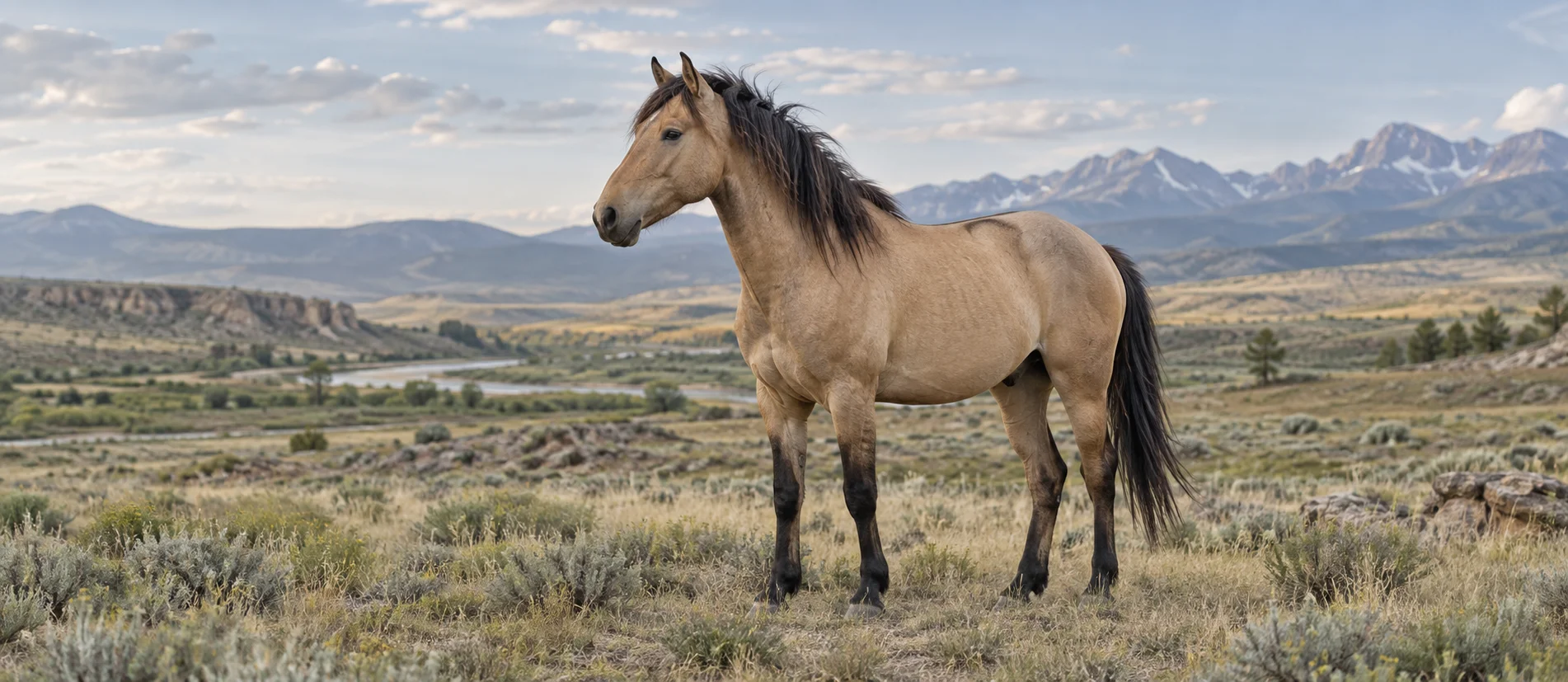
Ask most people what a Mustang is and they will say a wild horse. It is a good answer, and it is very nearly right. The more careful word is feral. Nobody bred the Mustang on the open range to be wild. Its ancestors were working horses that came over the Atlantic in the care of men, and then, one way or another, ended up on their own. That difference matters, because it explains almost everything about the horse.
We are Stirrup and Oak, and we draw horses for a living. When we came to the Mustang, we found a history that is less romantic than the posters suggest and a good deal more interesting. Here is how we understand it.
Spanish horses, and where they went
There were no horses in the Americas that people could ride when Europeans arrived. Horse-like animals had lived there in the deep past, but the horses of the Mustang's story came by ship. Spanish expeditions carried them across from the late fifteenth century, first to the Caribbean and then onto the mainland with the conquistadors of the early sixteenth century. These were Iberian horses, the sort of compact, tough, sure-footed riding horse Spain had bred for war and for travel, with North African blood in its background.
Those horses were built for the job. A conquistador needed a mount that could carry a rider and his kit over rough ground, go on short rations, turn quickly and stay sound. He did not need a giant. That practical, medium-sized frame is still what a great many Mustangs show today.
Horses do not stay where they are put. Some strayed from Spanish settlements and missions, some were stolen, and some were lost in hard country. The word itself comes from the Spanish, from mesteño or mestengo, used for stray or ownerless stock. English speakers turned it into mustang. So even the name tells you what the animal was: a stray, and the descendant of strays.
From those first escapes and from the ranches of the Spanish frontier, horses spread north across the continent over the following generations. The Pueblo Revolt of 1680 in what is now New Mexico is often named in published histories as a turning point, because Spanish horses were left behind and moved into trade networks running north. However the details fell out, by the eighteenth century a great many peoples of the Plains had horses and had become superb horsemen and horsewomen. Horses changed how they hunted, travelled, traded and fought. A horse that had begun as a Spanish military tool became central to a whole way of life across the grasslands.
What work shaped the Mustang?
This is the question we always ask of a breed, and with the Mustang the honest answer is that it was shaped by several jobs and by survival itself.
First came the Plains work: hunting, riding long distances and carrying families and belongings. Then came the ranch. As cattle ranching spread across the American West in the nineteenth century, ranchers and cowhands caught mustangs and used them for stock work. A horse that could turn on a sixpence, live off poor grazing and keep its feet sound over stony ground suited the job. Mustangs also went into harness, and they were used by the army and by riders of all kinds. Published histories describe the type being caught, broken and put to work in very large numbers, and it is the hardiness of the horse that gets remarked on again and again.
Then there was the work the range itself did. A horse that lives free in dry, open country has to find water, cope with heat and cold and get away from predators. Foals that could not keep up did not last, and the horses that did last passed on their feet, their stamina and their nerve. So the Mustang's build is a mixture of what people chose for it and what the land did not allow it to lose. It is generally a fairly compact horse, often somewhere around fourteen to fifteen hands, though the herds differ from one another. Tough feet, a strong back and a lean, economical frame are the traits we see described most often.
The temperament follows from the life. A Mustang that grows up watching for danger is alert, observant and quick to think for itself. Trainers who work with gathered Mustangs often speak of them as careful rather than difficult: they want to understand what is being asked before they agree to it. Once trust is established, people who ride them tend to describe a loyal, thoughtful partner. We would be wary of treating that as a promise about every individual, because a breed is a tendency and never a guarantee. But it fits the history well.
One thing we will say plainly is that the Mustang is not one uniform, registered breed in the way a Thoroughbred is. Herds across the western states have different origins. Some carry a lot of Spanish ancestry, and there are registries and breeders dedicated to preserving Spanish type. Others show the mixing you would expect from generations of ranch horses, army horses and escaped farm stock joining the wild bands. Anyone who tells you that every Mustang is a pure Spanish horse is telling a nice story, not an accurate one.
Hunted, nearly lost, and then protected
For a long time the Mustang was treated as a resource or a nuisance rather than as a heritage. As the West filled up with fenced land and livestock, wild horses were competing for grazing, and they were rounded up, sold and shot. Mechanisation took away much of the everyday work. Once tractors and lorries did what horses had done, the ordinary market for a tough little ranch horse shrank, and horses on the range had fewer defenders.
By the middle of the twentieth century the hunting had become cruel and widespread. Mustangs were chased by aircraft and motor vehicles until they were exhausted, and many were sold for slaughter. Numbers are debated, and we will not quote any we cannot stand behind, but the accounts are clear that the wild population had fallen far below what it had once been.
What changed things was an ordinary person who would not look away. Velma Johnston, a secretary from Nevada who became known as Wild Horse Annie, was shocked by what she saw of the roundups and campaigned against them. She won a law in 1959 that restricted the use of aircraft and motor vehicles to hunt wild horses on public land. Schoolchildren wrote letters in support, which is a detail worth remembering, because a national issue was carried by a great many small voices. In 1971 the Wild Free-Roaming Horses and Burros Act extended federal protection to the animals on public lands, and it is still the basis of the law today.
The story did not end happily ever after, and it would be dishonest to pretend it did. The protected herds are now managed by federal agencies, chiefly the Bureau of Land Management, and there is real and continuing argument about how many horses the range can carry, how they should be gathered, how many are held in pens and how many can be adopted. People who love horses sit on both sides of that argument, and we are not going to settle it here. What we can say is that adoption and training programmes have found new homes for many gathered Mustangs, and that the horse has proved itself as a riding horse in trail work, ranch work, endurance and general sport.
The Mustang today, in the US and the UK
In the United States the Mustang is now a symbol as much as a horse. It stands for the open West, and it is protected by law in a way that few horses anywhere are. That is quite something for an animal that was once hunted with lorries and aeroplanes.
In the UK the picture is quieter. There is no wild herd here, and we are not aware of any large population, so we would not want to claim numbers. Most people in Britain will meet the Mustang through books, films, the name on a car badge and the occasional imported horse. For those of us on this side of the Atlantic, the horse is a reminder that a breed does not need a stud book to have a history. The Mustang was shaped by Spanish riders, by Plains horsemanship, by cowhands, by hard country and by the stubborn people who fought to keep it. If you love horses, you probably recognise a little of the tough, watchful, self-reliant animal we have been describing, even if you have only ever ridden in the wet fields of somewhere very different.
We draw the Mustang the way we see it: lean, alert, a little wary and entirely itself. Our plates are digital artwork in an engraving style, made by us. They are not antiques and they are not hand-engraved, and we would never say otherwise. What we hope they do is honour the horse's shape and character, the way a good history should.
The Mustang began as a Spanish working horse and became something the land itself had a hand in making. It came close to being lost, and then a determined woman and a lot of children with pencils helped to save it. That is a history worth knowing, and a horse worth looking at properly.
See it in the collection: The Mustang collection