Breed Histories · 26 September 2026
The History of the Morgan Horse
How many breeds can you trace back to a single animal? Not a type, not a region's worth of horses, but one particular colt, foaled around 1789? The Morgan is one of the few, and that is why its story reads more like a family history than a breed history.
We tell it carefully at Stirrup & Oak, because the Morgan has more legend attached to it than most. Where a story cannot be supported, we say so.
One small colt in New England
The horse gave the breed its name, and so did the man who owned him. Justin Morgan was a teacher of music and a small farmer, born in Massachusetts in 1747 and later settled in Randolph, Vermont. Around 1791 he travelled back to Massachusetts to collect a debt and came home with two horses in part settlement. One of them was a young bay stallion, then known as Figure. Because Morgan owned him, people began calling him Justin Morgan's horse, and in time simply Justin Morgan.
The colt was foaled around 1789 in West Springfield, Massachusetts. That much is broadly agreed in the breed's own histories. His parentage is another matter. A stallion called True Briton is the most commonly named sire, and the dam is usually described as a mare of mixed or unrecorded breeding. Nobody wrote a pedigree down at the time, and later writers filled the gap with confident claims of Arabian, Dutch or Welsh blood. None of those can be proved. The honest position is that the foundation sire of the Morgan had a plain, undocumented start, and that the breed grew out of what he passed on rather than out of any paperwork.
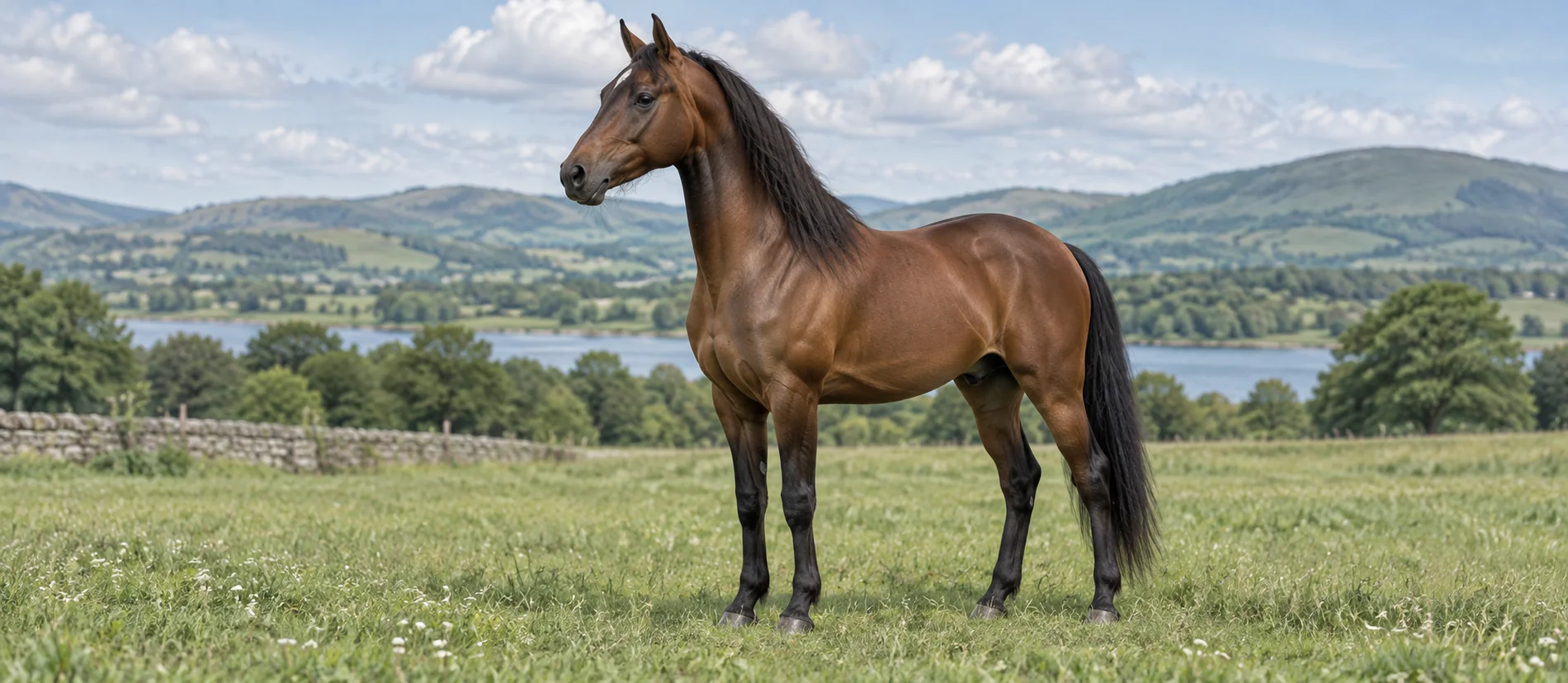
What we do know is what he looked like and how he was used. He was small, usually described as about fourteen hands, and compact, with a short back, a strong neck and a great deal of bone for his size. Vermont in the 1790s did not need a showy horse. It needed one that could clear stumps in the morning, draw a load of logs, carry a rider to the meeting house, and, if the neighbours had money on it, run a short match on Saturday. Accounts of him doing all of these are part of the breed's founding story. Some of the individual tales, such as a famous log pulling contest, are told with more colour than evidence, so treat them as folklore that fits the horse rather than as recorded events.
Justin Morgan the man died in 1798, and his horse passed through a series of owners and farms in Vermont and New Hampshire, working hard until his death in 1821. He was reportedly kicked by another horse and never fully recovered. Whatever else was true of him, he lived a very long working life for a stallion of his day.
Three sons and a reputation
The breed exists because of what his foals looked like. Whatever mare he was put to, his colts and fillies tended to resemble him: the same size, the same compact frame, the same willingness. Farmers noticed. A horse that looked like its sire, worked like its sire and asked for little feed was worth breeding from.
Three sons carried the line forward and are named in every Morgan history: Sherman, Bulrush and Woodbury. Sherman Morgan, foaled in 1808, is the one usually credited with the most influence, and his descendants stayed close to the type of the founding sire. Sherman's line also led to Black Hawk, foaled in 1833, whose own descendants spread the Morgan influence well beyond Vermont.
The breed, in other words, was built the way farm horses usually were: from neighbouring stallions and local mares, with people breeding the best they could see. Its temperament came from the job. A horse expected to plough, haul, carry a family to church and go home with the same sensible manner has to be kind, tough and steady, and the Morgan has kept a reputation for exactly that. Its stamina and economy are, in effect, the record of a working past.
Road, war and the leaving of Vermont
During the nineteenth century, Morgans travelled. They were popular as road and carriage horses because they could trot at a good pace for a long way without fuss. Trotting became a sport in its own right, and Morgan blood contributed to the making of other American breeds, including trotting horses and saddle horses, so the influence of that one colt is wider than the number of purebred Morgans might suggest.
Morgans also went to war. During the American Civil War, they served as cavalry and artillery horses, valued for their hardiness and for being easy to keep on short rations. One of the best known is the horse that General Philip Sheridan rode, named Rienzi and later renamed Winchester. Sheridan's mount is widely recorded as a Morgan, though as with many war horse stories, the precise details vary between sources. The wider point is not in doubt: the war took many horses, and the breed's numbers suffered for it.
Then came the second danger. As the century closed, railways, fashion for larger horses and later machinery began to change what people wanted. Breeders chased speed and height, and the compact all rounder was not the fashionable choice. The Morgan did not vanish, but it thinned and blurred, with too many horses that carried the name but not the type.
Saving the type
The rescue came from records and from people who cared. In 1894 the Morgan Horse Register was published by Joseph Battell of Middlebury, Vermont, a landowner who had become determined to preserve the old blood. It was the breed's first stud book, and it gave breeders a shared reference at a time when the type was in doubt. Battell also bred Morgans at his farm in Weybridge, Vermont.
In 1907 the United States Department of Agriculture took up the cause and established a government Morgan horse farm at Weybridge, using land Battell had left. The aim was to breed useful horses of the true type, including for the army's cavalry. The farm later passed to the University of Vermont, where the breeding programme continues. The national breed society was formed in 1909 as the Morgan Horse Club, and became the American Morgan Horse Association, which now maintains the registry. Vermont later named the Morgan its state animal, which tells you how closely the breed is tied to the place.
These are unglamorous turning points: a stud book, a farm, a society. They are also the reason a Morgan you meet today is still recognisably related to that colt from two centuries ago. Without them, the breed would probably have dissolved into the general run of American horses.
The Morgan today, in the US and the UK
In its home country, the Morgan is now valued as a versatile riding and driving horse. You find it in pleasure riding, trail work, dressage, western and English disciplines, and in harness, where its style and trot suit it well. Its size makes it approachable, and its long history as a working partner shows up in a temperament many owners describe as sensible and people-focused.
In the UK, the breed is a rarer sight. It is an American breed, and British horse people are more likely to know it by reputation than by having ridden one. It has its enthusiasts on this side of the Atlantic, but we would rather not quote a figure we cannot source. What travels well is the idea: a compact, strong, willing horse built for real work, whose history is unusually well documented for a breed that began with so little paper.
That is the part we find worth remembering. The Morgan was never bred for a fashion. It was shaped by farms, roads and hard use, nearly lost when the world stopped needing that, and then rescued because enough people could see what it was worth. One small colt from Massachusetts became a breed, and that breed then had to be saved from its own success and from changing times.
If you love horses with a story behind them, the Morgan deserves a place on your list. It is also the sort of history we enjoy putting into our own engraving style artwork, drawn digitally by us, with the character of the horse at the centre of the plate.
See it in the collection: The Morgan collection