Breed Histories · 26 September 2026
The History of the Lusitano, Portugal's Working Horse
Ask a rider what a Lusitano is for, and you will probably hear "dressage". Ask a Portuguese breeder, and the answer starts somewhere much muddier: a field, a herd of cattle, and a man on horseback who needs a horse that stays calm when something enormous is looking at him.
That difference matters. The Lusitano's look, its balance and its manner all make more sense once you know the job it was asked to do. Here is the story as we understand it, with the gaps left as gaps.
An old horse from an old peninsula
The Lusitano belongs to the Iberian horse family, the horses of Portugal and Spain. Its name looks back to Lusitania, the Roman province that covered much of what is now Portugal. Breed histories agree that horses have lived and been ridden on the peninsula for a very long time, and that the Iberian horse was valued for war and for handling stock well before anyone kept a stud book.
You will read a lot of confident claims about exact origins. Some breed writers link the Lusitano to the Sorraia, a primitive type of horse from the Sorraia river region of Portugal. Others treat that as one theory among several. Because the wider story of Iberian horse origins is still argued over by specialists, we are not going to tell you the horse "descends" from any single ancestor. What can be said safely is that the Lusitano is a very old type, shaped by the land, the climate and the work of the peninsula over many centuries.
Nor were Portugal and Spain ever entirely separate horse worlds. Horses crossed the border in trade, in war and in breeding, and for a long time the Portuguese and Spanish horses were thought of as one Iberian type. That shared past is part of why the Lusitano and the Spanish horse are still called cousins.
The work that made the shape
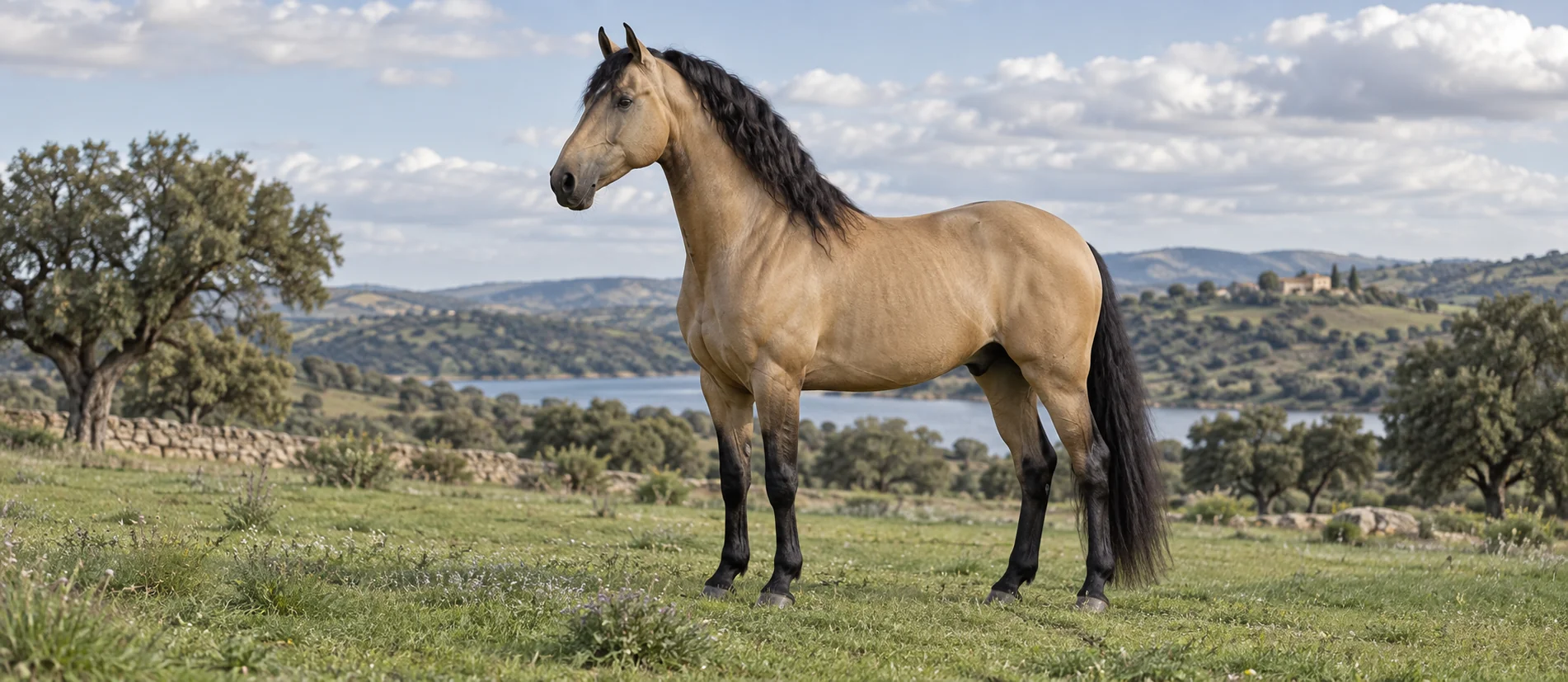
Look at a good Lusitano and you are looking at a working design. The body is compact and short in the back. The neck is arched and carried high, the shoulders are sloping, and the quarters are strong and set under the horse so that it can sit and turn. The profile is often slightly convex, and most stand somewhere around 15 to 16 hands.
Those are not fashion features. A horse that has to work close to cattle needs to stop hard, turn on the spot and accelerate again, without losing its head. A short, well-muscled, well-balanced body does that better than a long, rangy one.
The work in question was, above all, the handling of cattle and the mounted bullfight as it is practised in Portugal, where the rider on horseback, the cavaleiro, works the bull from the saddle. The Portuguese tradition is distinct from the Spanish one, and it demanded horses of unusual courage and unusual obedience. A horse that panics in front of a bull is dangerous to everyone. A horse that is bold, but listens, is worth a great deal.
That is the temperament people still describe in the breed: spirited, quick to learn, sensitive to the rider, and willing. It is worth being honest that individual horses vary, as they do in every breed. But the pattern is not an accident. For generations, breeders in Portugal kept back the horses that could do this job and let the others go.
Riding schools, royal studs and the art of the manège
The same qualities that suited a horse to the bullring suited it to the riding school. Portugal had its own tradition of classical horsemanship, and the Marialva name is closely tied to it. The Marquis of Marialva family was influential in the eighteenth century in Portuguese horsemanship, and the school of riding that carries the name is still discussed today as one of the roots of Portuguese equitation.
Royal breeding mattered too. In 1748, King João V founded a royal stud at Alter do Chão in the Alentejo. It was built on Andalusian mares brought in from Spain, and the horses that came from it became known as the Alter Real. The line is still bred today at the Coudelaria de Alter, the national stud, and it is one of the best documented strands in the Portuguese horse world. If you want a concrete place to point to on a map, that stud is it.
It was not a smooth story. The Napoleonic invasions of the early nineteenth century disrupted Portugal badly, and the royal stud suffered along with much else. Studs lost horses and records, and the tidy picture of a single, unbroken royal line is one we would be wary of. What survived did so because private breeders and estates kept good horses going.
Machines, a near miss and the stud book
The twentieth century brought a different threat. As farming mechanised, and as roads and railways changed how people worked and travelled, the everyday reasons for keeping a horse thinned out. Breeds all over Europe shrank in this period, and many working horse types were lost or diluted.
The Lusitano survived because a group of Portuguese breeders decided the type was worth keeping pure. The tradition of horseback bullfighting gave those breeders a reason to go on selecting for courage, agility and calm. Good riding masters gave them another reason to want the horse to be trainable at the higher levels of dressage.
One name comes up again and again in the story of Portuguese classical riding: Nuno Oliveira, the celebrated Portuguese master who taught across Europe in the twentieth century. He is regarded by many as one of the great riding teachers of his age, and the Iberian horse was central to his work. His influence helped carry the reputation of the Portuguese horse well beyond Portugal.
Formal recognition came in the 1960s. The name "Lusitano" was adopted for the Portuguese horse in the middle of that decade, taking over from the earlier practice of treating it simply as part of the Iberian type, and the Portuguese stud book for the pure-bred Lusitano followed shortly afterwards. Breed sources give the stud book's start as 1967. That was the point at which the horse stopped being merely a type and became a registered breed with its own paperwork, its own rules and its own responsibility for keeping the lines clear. A breed association for its breeders, the Associação Portuguesa de Criadores do Cavalo Puro Sangue Lusitano, was set up afterwards, and it is the body most often named in connection with the breed today.
We have deliberately not listed a roll of famous individual stallions here. Several named horses appear in Lusitano pedigrees and in breed writing, but we would rather send you to the stud book and the breed society than repeat a name we cannot check.
What it means now, in the UK and the US
Today the Lusitano is far better known than it was a lifetime ago. You will see it in classical and competition dressage, in working equitation, which grew out of the same farm and cattle traditions, and in general riding and display. It is also a horse that people simply fall for on sight, which counts for more than any rulebook.
In the UK, there is a breed society for Lusitano owners and breeders, and the horse has a small but committed following. In the United States, the International Andalusian and Lusitano Horse Association looks after both Iberian breeds and has done so for several decades. For an owner or a would-be owner, the practical point is the same on both sides of the Atlantic. Ask about registration, ask what the horse's pedigree says, and ask what work it has actually done. The stud book is not a formality. It is the reason the breed still exists in a recognisable form.
There is a lesson in that for any horse breed. A horse type can look secure for centuries and still be within a generation of vanishing, once the work that justified it goes. The Lusitano was kept because people valued what it did, and then organised to protect it.
We draw our horses as engraving-style plates, made digitally in our own studio. They are not antiques and they are not hand-engraved, but the aim is the same one a good plate has always had: to show what a breed is like as a working animal, with the build and the bearing that history gave it. The Lusitano has plenty of both.
See it in the collection: The Lusitano collection