
Breed Histories · 26 September 2026
The History of the Lipizzaner, from Lipica to Vienna
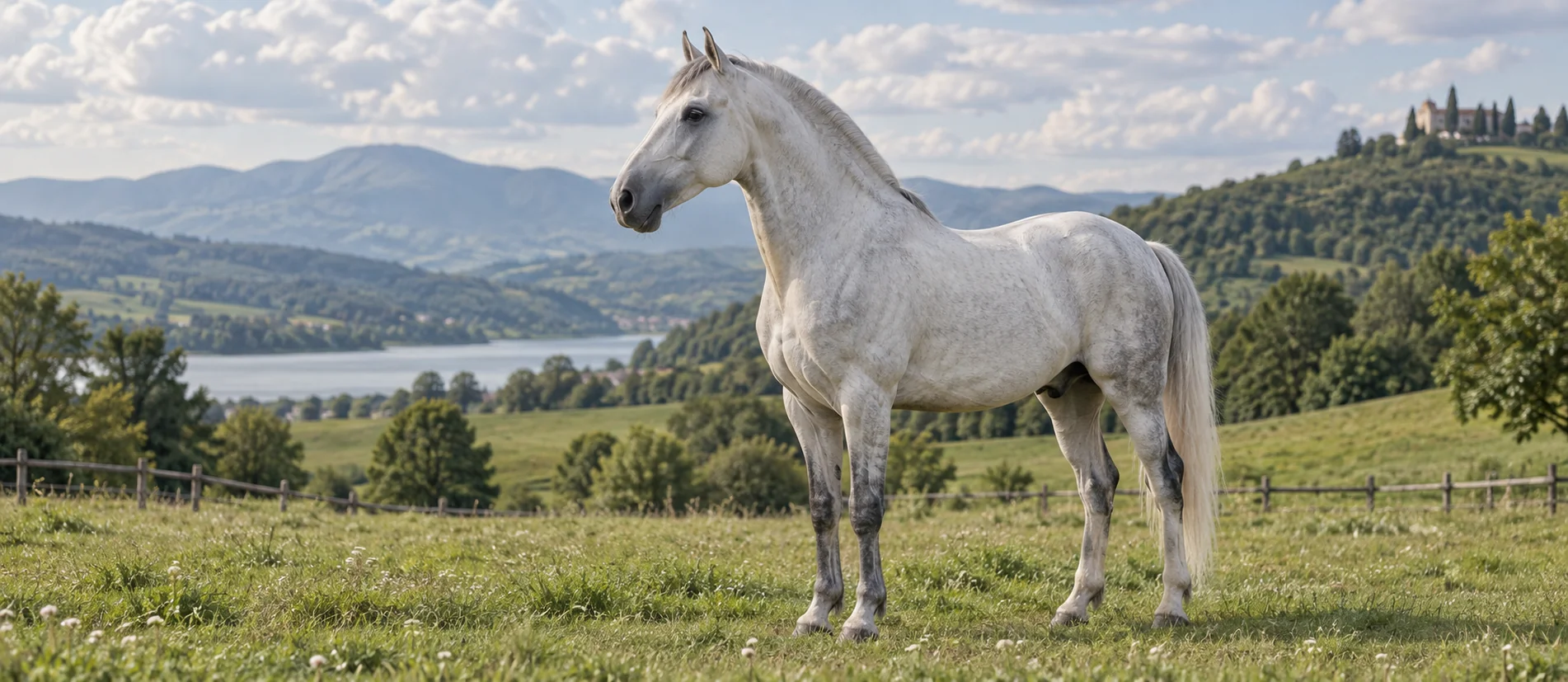
Ask most people to picture a Lipizzaner and they will describe a white stallion rising on its hind legs in a chandelier-lit hall in Vienna. It is a fine picture. It is also only the last chapter of a story that starts on rough limestone ground, with a ruler who wanted the right horse for his court.
We draw horses for a living, so we have spent a good while looking at this one. What follows is the history as it is set down by the breed's own studs and the Spanish Riding School, with the tidy legends left where they belong. Where a story is popular but cannot be pinned down, we say so.
A court horse from the Karst
The name comes from Lipica (Lipizza in Italian), a village on the Karst plateau in what is now Slovenia. In 1580 Archduke Charles II of Inner Austria set up a stud there. The purpose was practical and a little vain. The Habsburgs wanted a supply of handsome, strong horses for the court, for carriages, for ceremony and for the riding hall.
The foundation stock came from Spain. That matters, because Spanish horses were the fashionable riding horses of the age: compact, proud in the neck, willing to collect themselves and sit down behind. Over the following generations the Lipica stud mixed in other blood. Neapolitan and Danish horses were used, along with Arabian blood and horses from the Kladruby stud in Bohemia. The result was not a copy of the Spanish horse. It was something sturdier and calmer, raised on hard, stony ground.
That ground is worth a moment. The Karst is thin soil over rock, with hot summers and a hard wind in winter. A stud there could not rear soft horses. The Lipizzaner's reputation for toughness, for making do and for a long working life is at least partly a product of the place it was made.
It is worth being plain about the job, too. The breed was not made for the plough, the mine or the open range. It was made for the baroque riding hall and the imperial carriage. Those two jobs asked for the same things: a strong, short-coupled body, a powerful hindquarter, an arched neck, and above all a level head. A horse that will piece together difficult movements in a confined space, day after day, has to be a thinker. It also has to forgive.
Vienna, the school and the six lines
The Spanish Riding School in Vienna takes its name from those Spanish horses. Riding at the Habsburg court was already being recorded in the 1570s, and the Winter Riding School, the great white hall people know from photographs, was built in the 1730s to the designs of Joseph Emanuel Fischer von Erlach for Emperor Charles VI. The Lipizzaner became the school's horse, and the school became its shop window.
The classical work taught there was built on the idea that a rider should make a horse more beautiful under saddle, not less. Its most famous movements are the airs above the ground: the levade, where the horse lifts its forehand and holds a deep, controlled sit; the courbette, a series of hops on the hind legs; and the capriole, a leap with a kick out behind. You will often hear that these began as battlefield manoeuvres. That is a popular account and it may hold some truth, but we would not swear to it, so we leave it as a story rather than a fact. What the school itself will tell you is that the work is old, it is difficult, and it is done for its own sake.
Stallions at the school are not rushed. They tend to begin serious training at around four years old, and they can go on working well into their teens and beyond. That slow start and long career is part of why the breed is thought of as late maturing.
As the stud books developed, the breed came to be organised around six foundation stallion lines. Each is named for a stallion born in the eighteenth and early nineteenth centuries:
- Pluto, a Danish horse foaled in 1765
- Conversano, a Neapolitan foaled in 1767
- Maestoso, from the Mezőhegyes stud in Hungary, foaled in 1773
- Favory, from the Kladruby stud, foaled in 1779
- Neapolitano, foaled in 1790
- Siglavy, an Arabian foaled in 1810
Those names are still used today. A young stallion at the Spanish Riding School carries one of them, along with his dam's name, and that is how the stud books track the family. When people talk about the breed as unusually well documented, this is the reason. The lines are not a marketing idea. They are the working record of a breeding programme kept up for centuries.
Wars, moves and a rescue
A stud that belongs to an empire shares its troubles. During the Napoleonic wars the horses at Lipica were moved out of the path of advancing armies more than once, and they returned when the danger passed. It was an early lesson that the breed would survive only if someone was prepared to load the horses and go.
The bigger break came after the First World War. The Habsburg empire fell apart, and Lipica ended up in Italy. The horses were divided up between the successor states, and the breeding programme that Austria had run for centuries had to find a new home. In 1920 the Austrian stock was gathered at Piber, in Styria, a stud that had been founded earlier as a military stud. Piber has supplied the Spanish Riding School with its stallions ever since.
Then came the Second World War, and the episode that turned a breed into a legend. As the fighting drew closer, the school's director, Colonel Alois Podhajsky, moved the school's stallions out of Vienna to safety in Upper Austria. Meanwhile a large part of the breeding stock had been sent by the German authorities to Hostau, in what was then Czechoslovakia. In the last days of the war in spring 1945 the mares and foals there were in a dangerous spot, between the front lines.
Podhajsky appealed to the American army. He is remembered for putting the case to General George Patton, after the school gave a display for him and his officers. Patton had ridden competitively himself and understood what was at stake. American soldiers under Colonel Charles Reed, with German officers cooperating on the ground, brought the Hostau horses out to safety. This has been told and retold, and Disney turned it into a film, so it is fair to warn that the film tidies things up. But the outline is well documented: the mares came out, the breed lived, and the American connection to the Lipizzaner began that spring.
The war left the breed small and scattered. There was no going back to the world of imperial studs, so the breed was rebuilt across several countries. Besides Lipica and Piber, studs at places such as Đakovo in Croatia, Szilvásvárad in Hungary and Topolčianky in Slovakia carry on the work.
The white horse today
Before we finish, a point worth clearing up. Lipizzaners are not born white. Foals arrive dark, usually bay or brown, and turn grey gradually, most often reaching the white people expect somewhere between six and ten years old. They are not albino. They are grey horses, like many others, and some adults keep a little dark colour or stay bay. The Spanish Riding School has a long tradition of keeping a bay horse in its ranks. The story goes that it is for luck, which is a nice tradition whatever the truth of it.
In build, the breed sits between baroque and modern. The Lipizzaner is usually not tall, often around 15 hands, with a strong neck, a broad chest, a short back and strong quarters. The head is large and expressive, often with a slightly convex profile. The horses are known for intelligence and for a steady, thoughtful temperament, which is what you would expect from a breed made for a hall full of people and a life of patient schooling.
Today the Lipizzaner has a wider audience than any Habsburg could have imagined. The Spanish Riding School's classical riding was added to UNESCO's list of intangible cultural heritage in 2015, and in 2022 the traditions of Lipizzan horse breeding were added too, in a joint listing by several countries. Lipica in Slovenia still breeds horses and welcomes visitors, and Piber still supplies Vienna.
The breed is kept on both sides of the Atlantic as well. In the UK and in the US there are enthusiasts, breeders and societies who keep Lipizzaners as riding horses, as driving horses and as classical dressage partners, and the American tours of the Spanish Riding School helped to make the horse known well beyond Austria. For most owners the appeal is what it always was: a strong, kind, clever horse that gives its best when it is asked properly.
We should say something about our own part in this. Our Lipizzaner plate is digital artwork, drawn in the style of an engraving. It is not an antique and it is not hand engraved, and we would not want anyone to think it was. What we can do is draw the horse with the attention that its history deserves: the arched neck, the deep quarters, the calm eye. If that is the horse you love, you will find the Lipizzaner's products below.
See it in the collection: The Lipizzaner collection