Breed Histories · 26 September 2026
The History of the Irish Draught
Is the Irish Draught a carthorse? It is a fair guess from the name, and it is the first thing we would put right. The word "draught" suggests a great feathered giant leaning into a plough, but the Irish Draught was never that. It was lighter, quicker and far more useful to a family with a small farm and one or two horses to do everything.
We are Stirrup & Oak, and we draw horse breeds as digital artwork in the style of old engraving. We want to be plain about that: our plates are made digitally, and are not antique or hand-engraved. Each breed we draw gets a history alongside it, and we only put in what the breed societies, stud books and published breed histories can support. The Irish Draught makes that easy in one way and hard in another. The character of the horse is well documented. Its earliest origins are not, and we will say so where it matters.
A horse for every job on a small Irish farm
Start with the work, because the work explains the horse. For centuries the typical Irish holding was small. A farmer could not keep a heavy horse for the plough, a fine one for the road and a hunter for the weekend. He kept one animal, and it had to do all three.
So the Irish Draught did the lot. It pulled the plough and the harrow, and hauled the cart to market. It was ridden to church and to the fair, and in hunting country the same horse carried its owner or a landlord across banks and ditches on a Saturday. Working days came first. Sport was the extra.
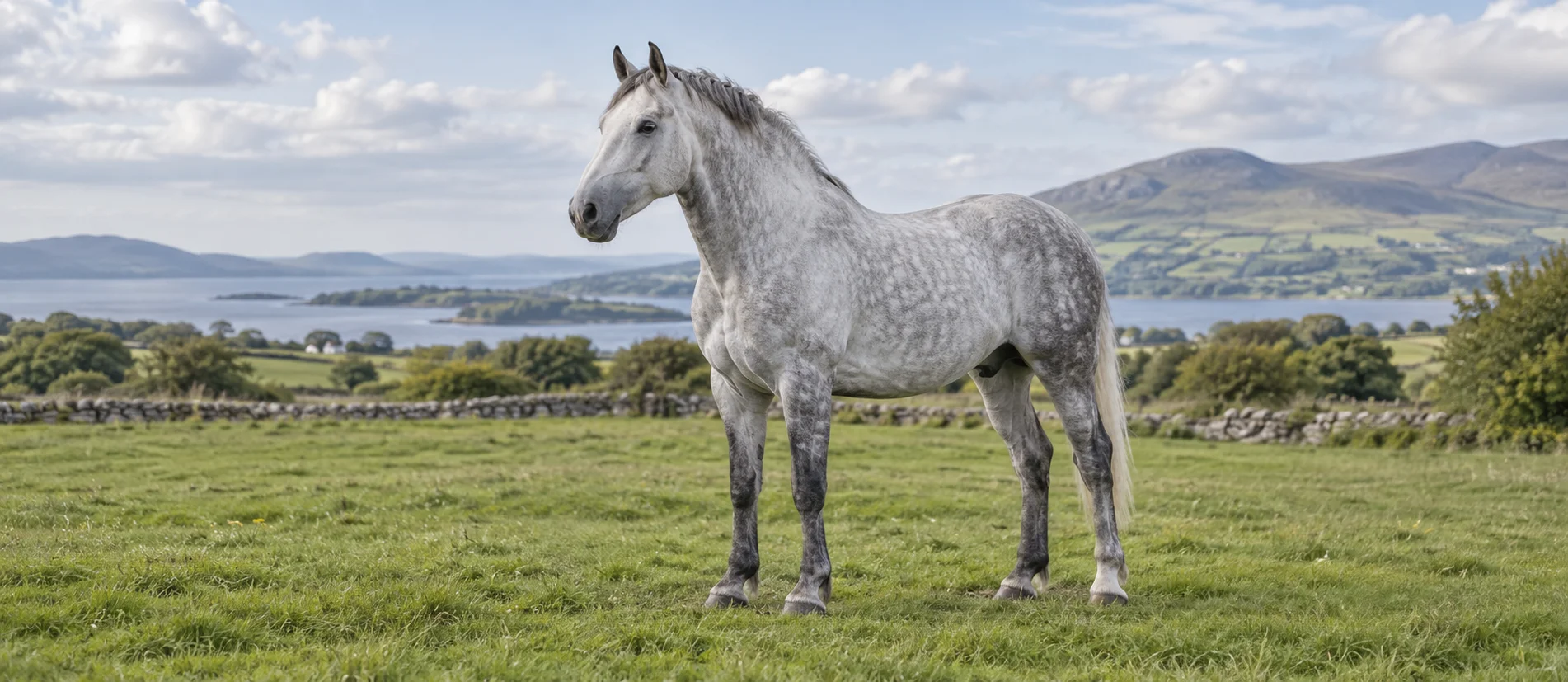
That kind of life breeds a very particular animal. The Irish Draught is a strong, deep-bodied horse with good bone and a powerful hindquarter, but it is not coarse. It stands on sound, sensible limbs and moves freely, with an active walk and trot. It has to have some scope as well, because a horse that can only plod is no use on a hunting day. It also has to be kind, because the person working it might be a child, and the horse might be hungry, tired or heading home in the dark.
Temperament is where the farm shows most. A horse that lives beside the family, is handled every day and is asked to turn its hand to anything tends to become steady and willing. Breeders selected for animals that stayed quiet and sound on hard, ordinary work. That is why people who know the breed talk about sense before they talk about looks.
Where it came from, and what we can honestly say
Here we need to be careful. You will read tidy accounts of the Irish Draught's origins, with a neat list of ancestors and a date to begin. We do not trust the tidiest ones, and neither should you.
What published breed histories agree on is broader. Ireland had a long-established population of hardy native horses. Over the centuries, other blood came in. Breed accounts commonly point to Norman and later continental influences, and to Spanish blood arriving in various ways over time. Thoroughbred blood was used too, often to give more quality and jumping ability, particularly once sporting demand grew. There was no single founding moment, and no single founding stallion that anyone can prove.
The Irish Draught was a type long before it was a registered breed. It was a working type shaped by farms, fairs and the countryside, and mares were kept for their usefulness rather than a paper pedigree. That matters, because it means the "purity" some people claim for the breed is really a purity of purpose. We would rather say that than invent an ancestry.
One myth is worth naming directly: that the Irish Draught was a heavy horse in the mould of the big continental or British draught breeds. It was not. If you set one beside a Shire, the difference is obvious. The Irish Draught is a general-purpose horse, and its whole value lay in being lighter and more athletic than a true heavy horse while still strong enough to work the land.
Turning points: loss, export and a register
The breed's story is not a comfortable one. Several forces pressed on it, and some of them came close to ending it.
The first was the plain economics of a good horse. Irish horses have a long reputation, and a horse that is strong, sound and bold is wanted in wartime. Breed histories describe large numbers of Irish horses leaving the country to meet military demand in the wars of the nineteenth and early twentieth centuries. When the best animals go, breeding stock goes with them, and a small-farm population cannot always replace what it loses.
Then came mechanisation. Once the tractor became affordable, the everyday reason for keeping an Irish Draught mare began to disappear. Fewer farms needed a horse for the plough and the cart, and a great many mares were sold on, or bred to no plan, or not bred at all. Alongside that, exports of horses for meat in the middle of the twentieth century further thinned the population. The breed was at real risk in the decades after the war.
The response was the thing that saved it: registration. In the early twentieth century the Irish authorities began inspecting and approving mares and stallions, in an effort to keep good breeding stock in the country and build a record of it. In time this developed into a proper stud book, and breed societies followed in Ireland and in Britain, run by people who cared about the horse and wanted to see it kept in its proper form. Inspection of mares became a cornerstone of how the breed is managed, and it still is.
We would love to give you the names of individual foundation horses here. There are stallions and mares that breeders speak of with reverence. But we can only put a name in this article if we can support it from a stud book, a society or a published history, and we do not want to hand you a name that has drifted from telling to telling. If you know a great Irish Draught's line, the society's own records are the place to start.
Crossing with the Thoroughbred, and the sport horse
The other part of the modern story is the sport horse. Crossing an Irish Draught mare with a Thoroughbred stallion produces what is widely known as the Irish Sport Horse. The idea is straightforward: the mare gives bone, sense and scope, and the Thoroughbred adds quality, speed and courage. It has been a productive cross for eventing, showjumping and hunting, and it is a large part of why Ireland is so well known for its sport horses.
This brings a tension that the breed has lived with for a long time. The Irish Draught is valued in its own right, and it is also the foundation of a much bigger sport horse industry. When demand for the cross is strong, there is a pull towards using the mares for crossbreeding rather than keeping pure Irish Draught lines going. The breed societies have had to hold both ideas together: celebrate what the horse gives to sport, and protect the pure breed it comes from.
So the Irish Draught today is both a breed and a kind of foundation. That is something to be proud of, and something to look after.
The Irish Draught today, in the UK and the US
In Ireland, the breed is recognised as a national treasure, and its management is tied to inspection and registration. In the UK, there is an active breed society and a following of owners who ride, show and compete Irish Draughts, and who use them for the traditional things: hacking out, hunting and general riding. The breed's steadiness makes it a favourite for riders who want a horse that will look after them.
In the United States the numbers are much smaller, and we would rather say that than make it sound bigger than it is. There is a breed organisation there, and American owners have imported animals and bred from them. Here the Irish Draught tends to be appreciated by riders who want a strong, sensible all-rounder, and by those who breed sport horses using the cross. Because the population is small, every good mare and stallion matters more, and the community around the breed tends to be close.
Whichever side of the Atlantic you are on, the case for the Irish Draught is the same one the small farm made. It is a horse built to be useful, and to be kind while it works. Nothing in its build is there for show. The depth through the girth, the good bone and the sloping shoulder all came from work that had to be done, and from people who wanted a horse they could trust.
That is the reason we like to draw it. An engraving-style plate suits a horse like this, with its plain, honest lines and solid frame. If the Irish Draught has been part of your family, your yard or your riding, we would be glad to have you look at what we have made for it.
See it in the collection: The Irish Draught collection