Breed Histories · 26 September 2026
The History of the Icelandic Horse
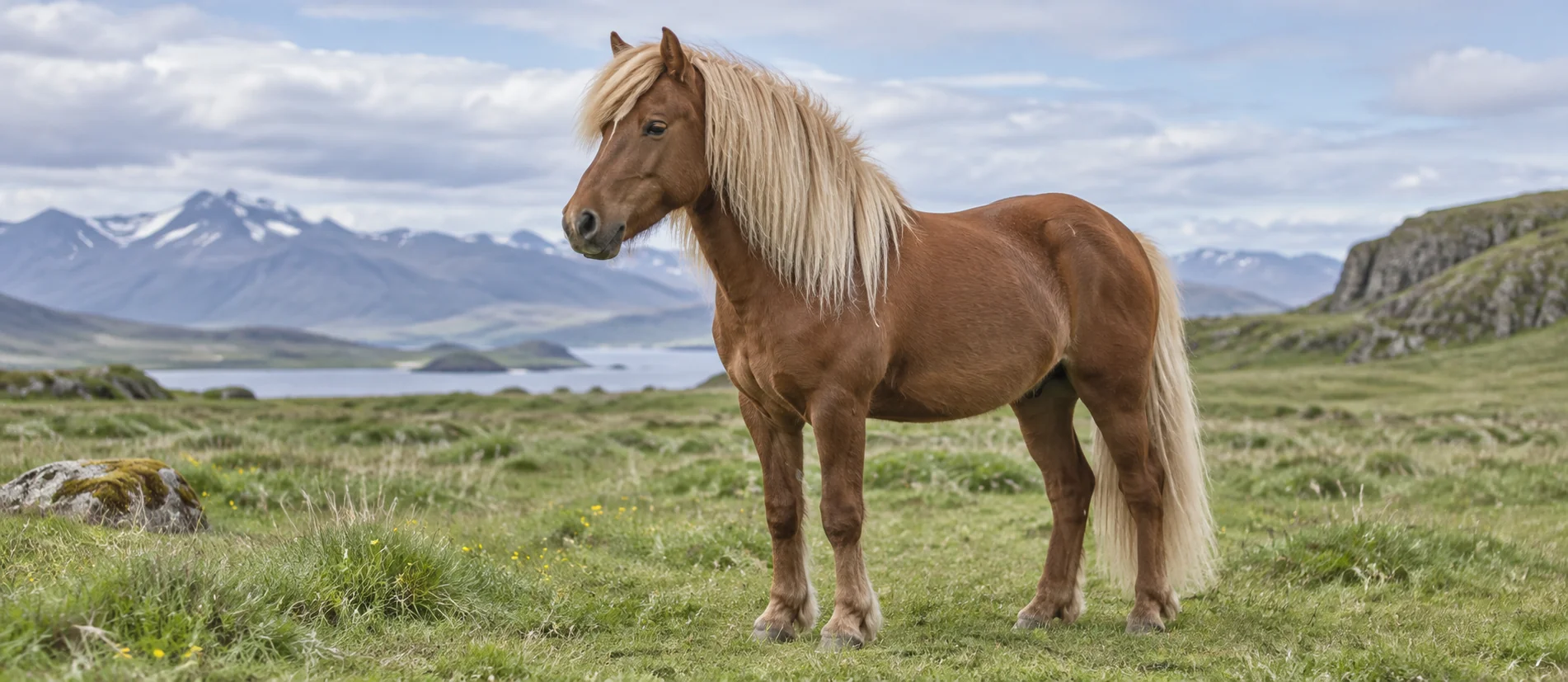
Why does a horse that stands not much taller than a large pony get called a horse by everyone who knows it? Ask an Icelander and you will get a short answer: because it is one. That small piece of stubbornness tells you a good deal about the breed. It has been valued for what it does, not for how tall it is, for well over a thousand years.
We draw a lot of horses at Stirrup & Oak, and the Icelandic is one we come back to, because its story is unusually clear. Most breeds have a tangle of crosses and rebrandings behind them. This one has an island, a law and a very long stretch of people who simply refused to change things. Here is how we understand it, and where we have kept to what the sources can support.
Across the sea with the settlers
Iceland was settled by Norse people from the later ninth century, and the traditional date given for the start of settlement is 874. They came by open ship, and they brought their animals with them: sheep, cattle, and horses. The accepted account is that the horses came mainly from Norway and from the Norse settlements around the British Isles, so the founding stock was a mixture of Scandinavian and Celtic-type ponies.
Think about what that voyage asked of a horse. Space on a ship was small, the crossing of the North Atlantic was long, and only animals worth the room were taken. The horses that arrived were, by necessity, sturdy, calm enough to travel and tough enough to be worth feeding through a first Icelandic winter. Nobody set out to design a breed. The selection was done by the boat and then by the island.
Once ashore, the horse became central to nearly everything. There were no roads to speak of, and no wheeled traffic worth mentioning across lava fields, glacial rivers and moorland. People rode to the assembly, rode to church once there was one, rode to bring in sheep, and packed goods across country on horseback. Horses also carried weight in the old religion and the sagas. Horse fights were a form of sport and entertainment, and the Norse myths give Odin the eight-legged horse Sleipnir. When Iceland accepted Christianity around the year 1000, the old accounts record that the eating of horse meat was allowed to continue for a time as part of the settlement. We mention it because it shows how ordinary, and how valuable, the horse was to daily life.
The law that closed the door
The turning point for the breed is the ban on importing horses. The Althing, Iceland's national assembly, is generally recorded as having forbidden the import of horses in about the year 982. The reasons usually given are practical: to protect the island's stock from disease and to keep the quality of the horses that were already there. Whatever the exact motive, the effect was enormous, and it has been kept ever since.
The rule also works in the other direction. An Icelandic horse that leaves the island does not come back. Horses exported for shows, sale or competition stay abroad for good. That means the population in Iceland has had no new blood from outside for over a thousand years, which is something almost no other breed can say. It is a tidy piece of history to have in a breed: a single sentence in a law, followed faithfully for centuries.
This is why the Icelandic is so often described as one of the purest horse breeds in the world. We would be careful with any claim that goes further than the documented facts, but the central point is well supported: the breed was closed to imports early, and it stayed closed.
What the island made of it
An isolated population on a harsh island will be shaped by that island, and the Icelandic shows it clearly.
Its build is compact and strong, with a deep body, short sturdy legs and a big-boned, hardy frame. It grows a thick double coat for winter, and in Iceland it has long been kept largely outdoors, finding its own way through weather that would test most breeds. Horses that could not cope with cold, thin grazing and hard travel did not do well, and those that could were the ones people kept.
Its temperament follows the same logic. A horse used every day for travel, gathering sheep and carrying people over difficult ground needs to be sensible, willing and steady, and to keep its head when a river is running high. Icelandic horses have a well-earned reputation for being friendly and confident with people, which is a fair result of a long history of close working relationships. We would not claim every individual fits the description, because horses are individuals. But the pattern runs through what riders and breeders say about them.
Then there are the gaits. Most horses have three: walk, trot and canter (or gallop). The Icelandic is famous for having two more, and it is the reason many riders fall in love with it.
- Tölt, a four-beat gait that is fast and smooth, with a rider who barely bounces at all. It suits long days in the saddle over rough ground.
- Skeið, the flying pace, a fast, two-beat gait used in racing, where the horse's legs move in lateral pairs.
Many Icelandic horses also have a naturally strong tendency to tölt, which is one reason the breed has been so prized for travelling long distances comfortably. Riders describing it will often say it feels like sitting in a moving armchair. We would only add that individual horses vary in how they carry the gaits, and that this is exactly what breeders have worked on.
Hard times, hard work and a long way from home
Iceland's history is not a gentle one, and the horse went through it alongside its people. Volcanic eruptions, harsh winters and famine repeatedly hit the island. The Laki eruption of 1783 is one of the best known of these disasters, with the poisoned grass and fluorine-laden ash that followed it killing a large share of the island's livestock, horses included, and bringing famine to the population. The breed survived, and the survivors were, again, the toughest.
The horse also found work far from home. In the later nineteenth century Icelandic horses were exported to Britain, where some were put to work in coal mines. Small, strong and steady, they suited the low tunnels. It is a working chapter that sits oddly beside the comfortable image many of us have of the breed today, but it is part of the record, and it shows how far a reputation for hardiness could travel.
Then came the twentieth century and the machine. As tractors, lorries and roads arrived in Iceland, horses were no longer needed for transport and farm work, and numbers of working horses fell as mechanisation spread. The breed could have faded into a curiosity. Instead, riding for pleasure and sport grew, and the horse found a new place in life: as a riding companion, a competition horse and a family animal.
Recording, sharing and the breed today
Alongside that shift came the tools of a modern breed: organised breeding, shows to judge the horses, and records. Iceland keeps a national studbook for the breed, and the international database WorldFengur is used to register Icelandic horses and their ancestry across countries. Horses are judged in breeding shows, where conformation and ridden abilities, including the gaits, are assessed. This is how the qualities that mattered to the settlers, and to every rider since, are tracked and passed on.
The breed also spread beyond Iceland as riders elsewhere discovered it. National clubs grew up in countries around the world, and in 1969 the international federation FEIF was founded to bring the national Icelandic horse associations together. Today there are active communities in the UK and the US, with their own national associations, riding holidays, shows and clubs. Every one of those horses descends from stock that left Iceland, and none can go back, which gives each one a small piece of the island's history.
For riders in the UK and the US, that history has practical meaning. If you ride an Icelandic, you are on an animal bred by long selection for endurance, sense and comfort over difficult ground, with gaits that were built for real travel rather than the arena. Its character is not a marketing story. It comes from work, weather and centuries of people who valued a horse they could trust.
Ours is a modest way of saying thank you to it. Our plates of the Icelandic are digital artwork in the engraving style, made by us for this site. They are not antiques, and they are not hand-engraved. What they borrow from the old print tradition is the patience: line by line, the same way the breed was built.
The Icelandic horse is what happens when a small population, a hard place and a firm rule meet over a thousand years and are left to get on with it. It is a strong reminder that a breed's shape often begins with a decision as plain as a law, and continues because ordinary people looked after it.
See it in the collection: The Icelandic collection