Breed Histories · 26 September 2026
The History of the Highland Pony
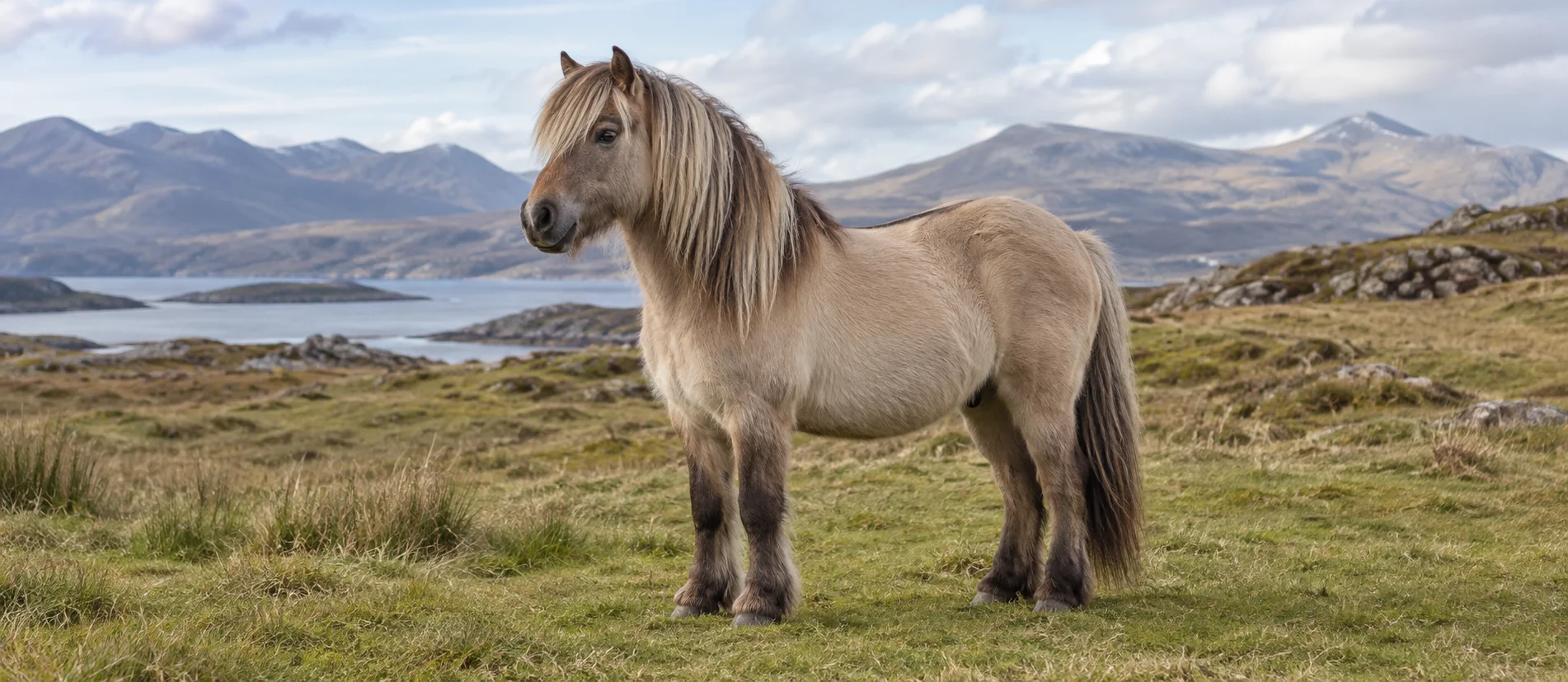
Some breeds look as if they were designed on paper. The Highland pony looks as if it was designed by weather.
Broad through the chest, deep in the body, short in the leg, with a thick mane and a calm eye that has clearly seen worse than you. If you want to understand it, you have to start with the ground it grew up on: steep, wet, rough country in the north and west of Scotland, where there was very little to spare and every animal had to earn its keep.
At Stirrup & Oak we draw breeds one at a time, and the Highland is one of those where the history is written straight into the outline. So this is the story as we can support it, with the myths named as myths.
Bred by the work, not by fashion
The Highland pony belongs to the Scottish Highlands and the islands off the west coast. For centuries the people who kept it were crofters and estate workers, not breeders in the modern sense. Nobody was chasing a look. They needed an animal that could do several jobs on poor grazing and come home sound.
The jobs are well recorded. Ponies carried peat down from the hill. They brought in hay and seaweed, dragged timber, and pulled light ploughs and harrows on small patches of arable ground. They took people to church and to market along tracks that were no more than a suggestion. On the sporting estates that grew up in the nineteenth century, they did the job most people now associate with them: carrying shot deer off the hill.
That last task explains a great deal. A stalking pony has to stand quietly while a heavy load is strapped on, then walk steadily down steep, boggy, broken ground, often in poor light, without panicking and without putting a foot wrong. Strength alone is not enough. It needs a level head, a sure step and enough sense to look after itself. Those qualities were kept because the ponies that had them were the ones people wanted to keep.
You can see the result. The short, strong back and good bone carry weight. The deep body and thick coat cope with cold and wet. The dense mane and tail, and the feathering on the legs, are part of a coat built for a climate that is rarely kind. The temperament that people describe again and again, patient, willing and rather unbothered, is not an accident of marketing. It is what a working hill life selected for.
Two types, one stud book
Older accounts tend to describe two kinds of Highland pony. The Western Isles type was the smaller, lighter animal from the islands, where grazing was thinner. The Mainland type was larger and heavier, the sort more often used for farm and estate haulage and, later, for stalking. Both were called Highland ponies, and both still sit within the breed standard today, though the size range is one of the things a modern breeder pays attention to.
The turning point for the breed on paper came at the end of the nineteenth century. Until then it was a type of pony, known locally, with no formal record. A national stud book changed that. Highland pony records began to be organised in the 1880s, under the Highland and Agricultural Society of Scotland, and from that point individual ponies and their parentage could be traced.
The record of those years is honest about the difficulty. Some estates brought in outside blood, and Arab stallions in particular are named in several histories of the period. Other breeders were suspicious of it and worked to keep the old type. The arguments over what a proper Highland looked like were real, and they were argued in the open. What we can say safely is that the stud book gave breeders something to measure against, and the debate over type was part of how the modern breed took its shape.
The Highland Pony Society was founded in 1923. That gave the breed a body of its own, with a standard, a register and people whose job was to look after the breed rather than any one estate's ponies. Its work has continued ever since, and it remains the reference point for anyone who wants to check what a Highland pony is meant to be.
Royal ponies and a well-known painter
Every breed collects a few famous names, and the Highland has a particularly good one. Queen Victoria was a devoted visitor to the Highlands and her Balmoral years brought the ponies to a far wider audience. The painter Sir Edwin Landseer, who worked in the Highlands and was known to the royal household, made the stalking pony and the deer forest a popular subject. Paintings of that kind did a lot to fix a picture of the breed in the public mind: sturdy, dun-coloured, standing patiently in the heather beside a stalker.
The royal connection did not stop with Victoria. Highland ponies have been kept at Balmoral for a very long time, and they are still associated with the estate. It is a good example of a breed staying useful in the place it belongs, rather than being turned into something ornamental.
A word on colour, because it comes up whenever people talk about Highlands. The dun coat with a dark stripe down the back is the one everyone pictures. It is common and much loved, but it is not the only colour the breed allows. Greys, blacks, browns and shades of bay and chestnut all occur, and the Highland Pony Society's standard is the place to check the full list. We are careful about this when we draw. A breed portrait that shows only the famous colour tells half the story.
The myths worth naming
Every old breed comes with a story about its beginnings, and the Highland is no exception. You will hear that the ponies descend from horses that swam ashore from wrecked ships of the Spanish Armada, or that they are simply the direct descendants of ancient wild ponies that were never touched by human hands.
We have not found solid support for the shipwreck story, and we would rather say so than repeat it because it is charming. What is better supported is the plain, less dramatic picture: hardy native ponies, kept for generations by Highland and island communities, gradually shaped by the work and the land, and later recorded and standardised when the stud book and society came along. That is quite enough of a story. It does not need a shipwreck.
Machines, near-loss and the breed today
The twentieth century was hard on every working horse. Tractors and lorries took over the haulage jobs, and the crofting way of life that had needed the pony was shrinking. Numbers of many native breeds fell as work disappeared, and the Highland was not immune from the pressure. What kept it going was that it was good at something machines still struggled with. Steep, soft, roadless ground is exactly where a pony can go and a vehicle cannot, so the stalking work continued, and with it a reason to keep breeding good ponies.
There was also a change in what people wanted from the breed. As the working roles narrowed, riders and drivers began to value the Highland for what its temperament made possible. It became a good family pony and a reliable mount for trekking and pony trekking centres, and it has done well in driving and in showing. The same steadiness that suited a stalker suits a nervous rider, and the strength that once carried a stag will carry an adult without complaint. Some owners also use them for light forestry work, which is a quiet return to the old job.
In the UK, the Highland Pony Society and its registers are still the basis of the breed, and the ponies are a familiar sight at shows and in the hills. The breed also has a following overseas, including in North America, where people who love native breeds and working animals keep them for riding, driving and trail work. We would not put a number on it, because we have not verified one, and we would encourage anyone thinking of buying a pony to go to the breed society for current guidance rather than rely on us.
What we do know is this. The Highland pony is a working animal whose shape, coat and manner are all explained by the country and the tasks that formed it. Once you know that, the outline starts to make sense: the broad chest, the short strong legs, the heavy mane and the patient face.
That is what we try to capture in our Highland plate. It is digital artwork in an engraving style, made by us, not an antique print and not a hand-cut original. The aim is to honour the pony's build and character with a bit of restraint, rather than dress it up as something it never was. If you love a horse that was made by hard country and honest work, we think you will see the point.
See it in the collection: The Highland collection