Breed Histories · 26 September 2026
The History of the Hanoverian Horse
Why does a horse from northern Germany carry the name of a British royal house? The answer is a dynasty, a stud and a lot of practical farming, and it explains most of what people love about the Hanoverian today.
We are Stirrup & Oak, and we like a breed history best when it says what the horse was for. So this one starts with the work, then the people who organised it, and only then arrives at the arena.
A stud founded by a king
The Hanoverian's story is tied to the Electorate of Hanover, in what is now Lower Saxony. From 1714 the Elector of Hanover was also the King of Great Britain: George I, then George II, and so on down a line of Georges until 1837. That year Victoria came to the British throne, but Hanover could not pass to a woman under its own succession law, and the two crowns parted company. For more than a century, then, one ruling family held both places.
It was George II who, in 1735, founded the state stud at Celle. The idea was not glamorous. Farmers in the region kept working mares, and the state wanted better horses from them: strong enough for the plough and the wagon, but also good enough for the carriage and the cavalry. Celle's approach was to keep stallions of quality and send them out to stand for the local farmers' mares, rather than to breed everything in one yard. That model of a state stud supplying stallions to private breeders is still how the breed is organised, and it is one of the reasons the Hanoverian is a breed of many small breeders rather than a few big estates.
The early stallions were chosen from the best available blood of the day. Sources on the breed commonly describe Holstein horses and other heavy, well-mannered stock as the base, with Spanish and Neapolitan types, and later the English Thoroughbred, used to add quality. We would rather be plain than exact here: the breed society and published breed histories are the places to check the finer detail of exactly which stallions came first, and we have left out the stories that cannot be traced to them.
Bred for the farm, the road and the army
Think of the horse a country needs in the eighteenth and nineteenth centuries. It has to pull a plough on Monday, take the family to church on Sunday, and, when the state asks, go to war. A horse for all three had to be sound, sensible and kind to handle, because the person who worked it every day was usually the person who fed it. Temperament was not a luxury. A difficult horse on a small farm was simply a liability.
That is why the Hanoverian is known for a willing, workmanlike character. It was selected, generation after generation, for horses that people could live and work beside. The build followed the job: a good, strong frame, a substantial back and hind quarters, and movement that could keep going. The army wanted a horse with more presence and pace than the farm horse, which pulled the type towards the lighter, more elegant animal.
Thoroughbred blood mattered a great deal in this. Used carefully, it gave lightness and scope to the heavier local mares. Used heavily, it could take away the calm and the bone that farmers wanted. Much of the breed's history is breeders adjusting that balance to suit what the market needed in their own decade.
Changing hands, and a change of purpose
The nineteenth century brought upheaval. In 1866 Prussia annexed the Kingdom of Hanover, and the stud at Celle carried on under new ownership. Breeders in the region continued to organise themselves, and a breeders' society and a stud book grew up in the decades that followed. If you want the exact dates for those, the Hanoverian Verband, which keeps the stud book today, is the authority we would send you to.
The bigger shock came in the twentieth century. Two world wars took a heavy toll on horses in Europe, and after them the tractor arrived on farms and the lorry on the roads. The cavalry horse and the farm horse, the two things the breed had been built to supply, were suddenly not wanted in the old numbers. Many breeds of working horse in Europe shrank badly or vanished at this point.
What saved the Hanoverian was a decision to change what it was for. Breeders and the society turned deliberately towards riding horses for sport and leisure. That meant selecting for movement, jump and rideability, and it meant using outside blood again where it helped, with Thoroughbred and Trakehner lines among those commonly named. The heavy carriage type gave way to a lighter, more athletic horse. Stallion inspections and performance testing became central: a stallion had to show he could do the work and pass on the right qualities before he was approved to breed. It was a slow, systematic piece of breeding, and it is why the Hanoverian is described as a warmblood that was shaped by selection rather than left to chance.
Named stallions matter enormously in a story like this, because in a warmblood studbook a handful of sires can shape a whole generation. We are careful about which names we put in print, because listing a famous horse in the wrong breed is an easy mistake and an annoying one. If you follow the breed, the society's published sire lists will show you which stallions the modern Hanoverian descends from.
The Hanoverian today, in the UK and the US
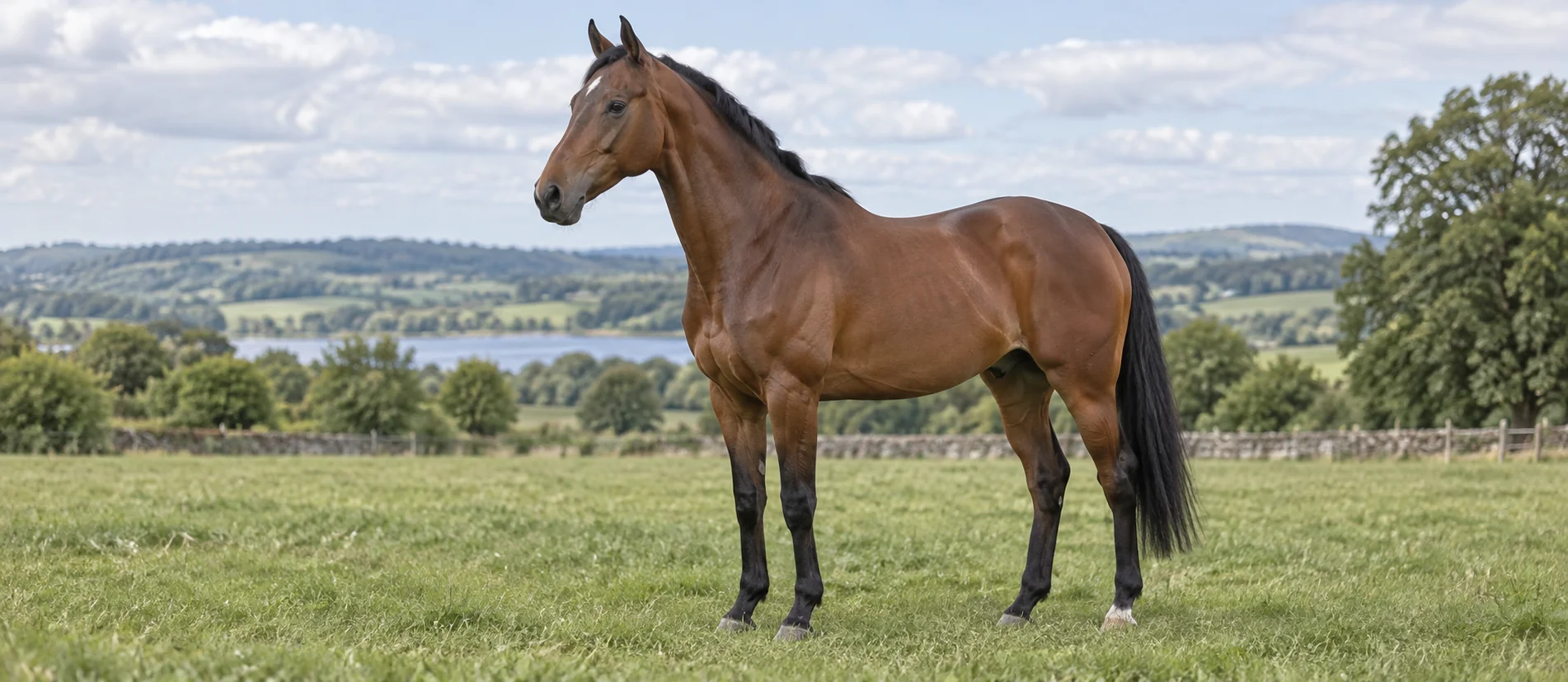
Today the Hanoverian is one of the leading sport horse breeds in the world, and it has a strong record in dressage, showjumping and eventing. Sales and stallion licensing in Verden, in Lower Saxony, remain a big moment in the breed's calendar. The horse you meet now, tall, well proportioned, with a good walk and a trainable head, is the outcome of nearly three centuries of a single question: what do people need from a horse, and can we breed it?
The breed has travelled well. In Britain the link is natural, given the shared royal history, and there is a British society for the breed that registers and promotes Hanoverians. In the United States the American Hanoverian Society, founded in the late 1970s, has done the same for American breeders and riders, and horses from both countries can go back to the same German stud book lines. That is one of the quiet strengths of the warmblood system: the paperwork lets a breeder in Yorkshire or Kentucky follow a pedigree back to the same roots.
What does the history mean for you if you ride or simply admire horses? It means the Hanoverian's reputation for sense is not marketing. It was built into the breed by farmers who needed a horse they could trust, and it was kept when the breed moved from the field to the arena. The elegance is real too, and it came from the army and carriage horse ancestors and from a deliberate move towards sport.
We draw horses because the history behind them is worth looking at properly. A breed is a long conversation between people and animals about what is useful and what is beautiful, and the Hanoverian is a very good example of that conversation going well. If you would like to take a little of it home, the Hanoverian pieces from our engraving-style horse artwork are linked below.
See it in the collection: The Hanoverian collection