
Breed Histories · 26 September 2026
The History of the Haflinger, Tyrol's Golden Mountain Horse
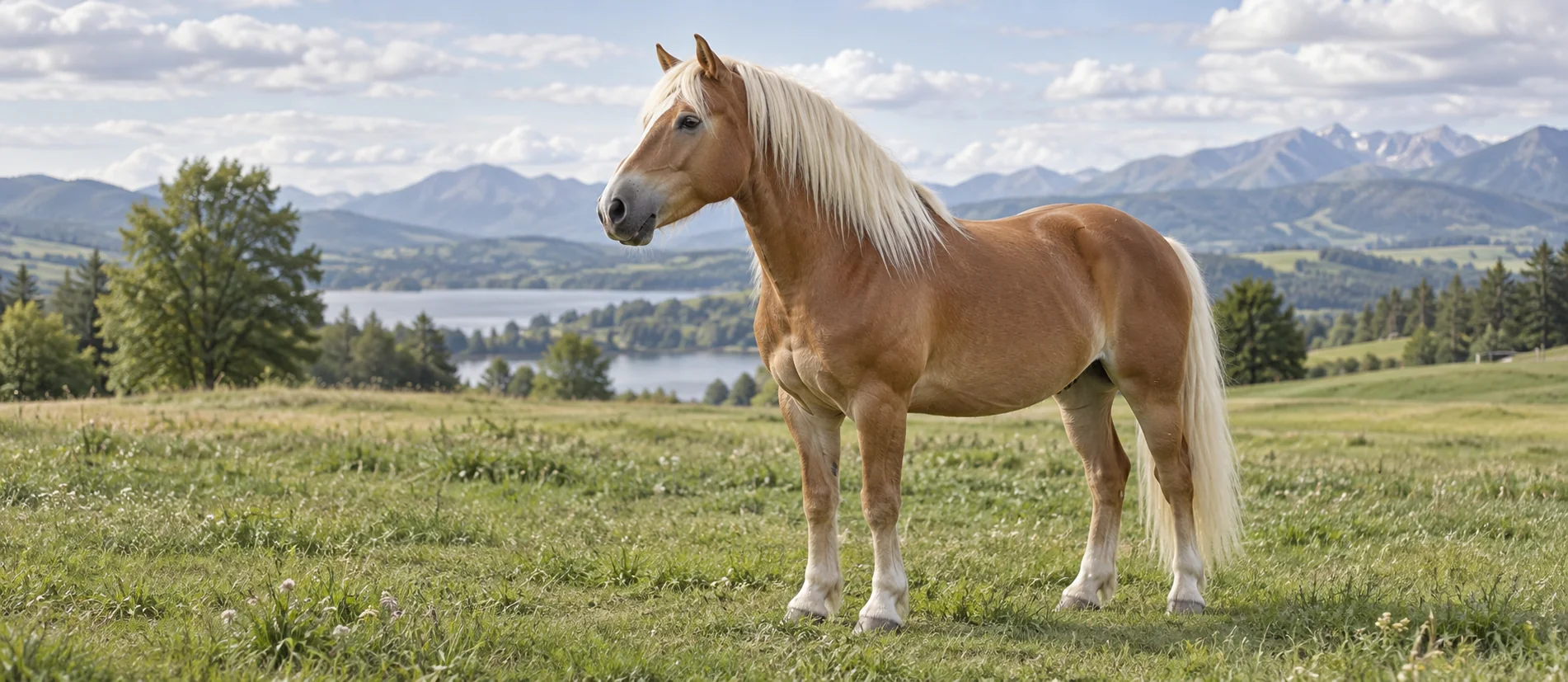
Ask someone to picture a Haflinger and most will describe the same horse: a compact chestnut with a flaxen mane, broad through the chest, looking as though it would carry you up a mountain and think nothing of it. That is not a coincidence. The picture was built by generations of farmers who needed one particular kind of horse, and they kept choosing it.
We draw horses for a living, so we like to know why a horse looks the way it does before we put a line on the page. With the Haflinger, the answer is a steep hillside.
A horse from the Tyrol
The Haflinger comes from the Tyrol, in the Alps, in the region that is now South Tyrol in northern Italy. The name comes from Hafling, a village in the hills above Merano. In Italian the village is Avelengo, and the breed is still known in Italy as the Avelignese. The name tells you where the horse was gathered and shown rather than where every one of them was bred, but the mountain home is not in doubt.
The work here was not the work of a broad, flat farm. Tyrolean holdings were small and steep. A horse had to carry loads on a pack saddle along narrow tracks, pull a plough on a slope, haul timber out of woodland, and bring in hay from ground where a heavier animal would struggle to keep its footing. It also had to live on mountain forage and get through hard winters without fuss.
Those demands go a long way towards explaining the build. The Haflinger is compact and deep in the body, with strong, short legs, a sturdy back and good, hard feet. It is a horse made for balance and stamina rather than for speed. The usual height range quoted for the breed is roughly 13.2 to 15 hands, small enough to be handy on a path and big enough to do real work.
The temperament followed the work as well. On a small mountain farm a horse lived close to the family and was handled every day, and one that was difficult or nervous was a danger on a narrow track. Kind, willing and steady was not a marketing line. It was a practical requirement, and the horses that met it were the ones farmers bred from.
The stallion behind the breed
The turning point in the story is a single foal. In 1874 a colt was born in the Vinschgau valley, in the south of the Tyrol. He was called Folie, and he carries the number 249 in the breed's records. His sire was 133 El Bedavi XXII, a half-Arab stallion, and his dam was a native Tyrolean mare. Folie is regarded as the foundation sire of the Haflinger, and every registered Haflinger today traces back to him through the male line.
That includes the well known seven stallion lines of the breed. All of them descend from Folie. If you have ever heard a breeder talk about a horse's line, this is what they are describing: a family tree that, on the sire's side, all runs back to one horse in one Tyrolean valley.
So the Arab influence is a documented part of the story, not a romantic add-on. What it did for the local mountain type is a matter of the horse's refinement and its chestnut colour, alongside the strength the local mares already carried. We would rather say that plainly than dress it up.
The organisation came a little later. Around the turn of the twentieth century, Tyrolean breeders began to work together to fix the type, and an official stud book for the breed followed in the early 1900s in Austria. That is the moment a regional farm horse became a recognised breed, with records, breeding rules and a standard people could point to. From then on, a horse was a Haflinger because its pedigree said so, not just because it looked the part.
Two world wars, then the tractor
A mountain horse was useful to armies as well as farmers. In the twentieth century Haflingers were used by military forces for pack work in mountain country, where vehicles could not follow. It is the same job the breed was already doing on the farm, just under much worse conditions.
The years after the Second World War, and the arrival of the tractor across European farming, were a real test. The reason for the breed to exist, the small hill farm that needed a strong, sure-footed all-rounder, was fading. Plenty of working horse breeds were lost or reduced to a handful of animals in those years, and it is fair to say the Haflinger's numbers were under pressure too.
What saved the breed was that it could do a different job. The same qualities that made it good on a slope made it good for people who simply wanted a horse: gentle, sturdy, reliable and easy on the eye. Haflingers moved into riding and driving, into leisure and family use, and into sport, and breeders in several countries took an interest. A body now known as the World Haflinger Federation later brought the national societies together, so that the breed's standards and records could be shared across borders.
This is the shape of many good breed stories. The original work disappears, and the breed survives because it turns out to be good at something else too. The Haflinger kept its willing nature and its strong build, and found a new place in the world.
What is true, and what is only a tale
Breed histories collect stories, and the Haflinger has its share. One that turns up often is that the breed descends from horses brought into the Tyrol in the early Middle Ages, with the Goths sometimes named. We have not found that supported by the breed's own records, so we treat it as a legend and not as history. The documented story starts with Folie in 1874 and the stud book that followed. Anything earlier is the sort of tale that is pleasant at a show and unreliable in an article.
The same care applies to the colour. Haflingers are chestnut, in shades from a light gold to a deep liver, with a flaxen mane and tail. That combination is what defines the breed's look. But the colour is a matter of what breeders chose to keep, and it should not be taken as proof of any grand ancestry.
The Haflinger in the UK and the US
The Haflinger came to the English-speaking world in the second half of the twentieth century, once the breed had recovered in central Europe. In the United States the first imports arrived in the late 1950s, and the breed has since built a substantial following among riders and drivers, especially those who want a strong, forgiving horse that can do a bit of everything. Registries and associations grew up there to keep the pedigrees in order.
In the UK the picture is a similar one, with a national society looking after the breed and its records. Here the Haflinger is mostly a family horse, a driving horse, a trekking horse and a first-rate partner for riders who do not want a fuss. If you have met one at a local show, you will know the type: sensible, stocky, and rather pleased with itself.
Its history shows in its character. A horse bred for generations to work close to people on difficult ground tends to be steady and sociable, and the Haflinger is exactly that. A breed that began on a Tyrolean hillside now lives on lawns, bridleways and driving courses on the other side of the world, still doing what it was bred for: being useful, calm and hard to unsettle.
Why we draw it
The Haflinger is a lovely horse to draw. The shape is generous, the mane is a gift, and the gold of the coat means a good deal of tonal work, which is exactly what our plates are for. Our plates are digital artwork in an engraving style. They are not antique and they are not hand engraved, and we say so every time, because a breed with a history this well documented deserves an honest description of the art as well.
If this history has sent you looking for a Haflinger of your own, we have gathered our Haflinger artwork below.
See it in the collection: The Haflinger collection