Breed Histories · 26 September 2026
The History of the Hackney Horse and Pony
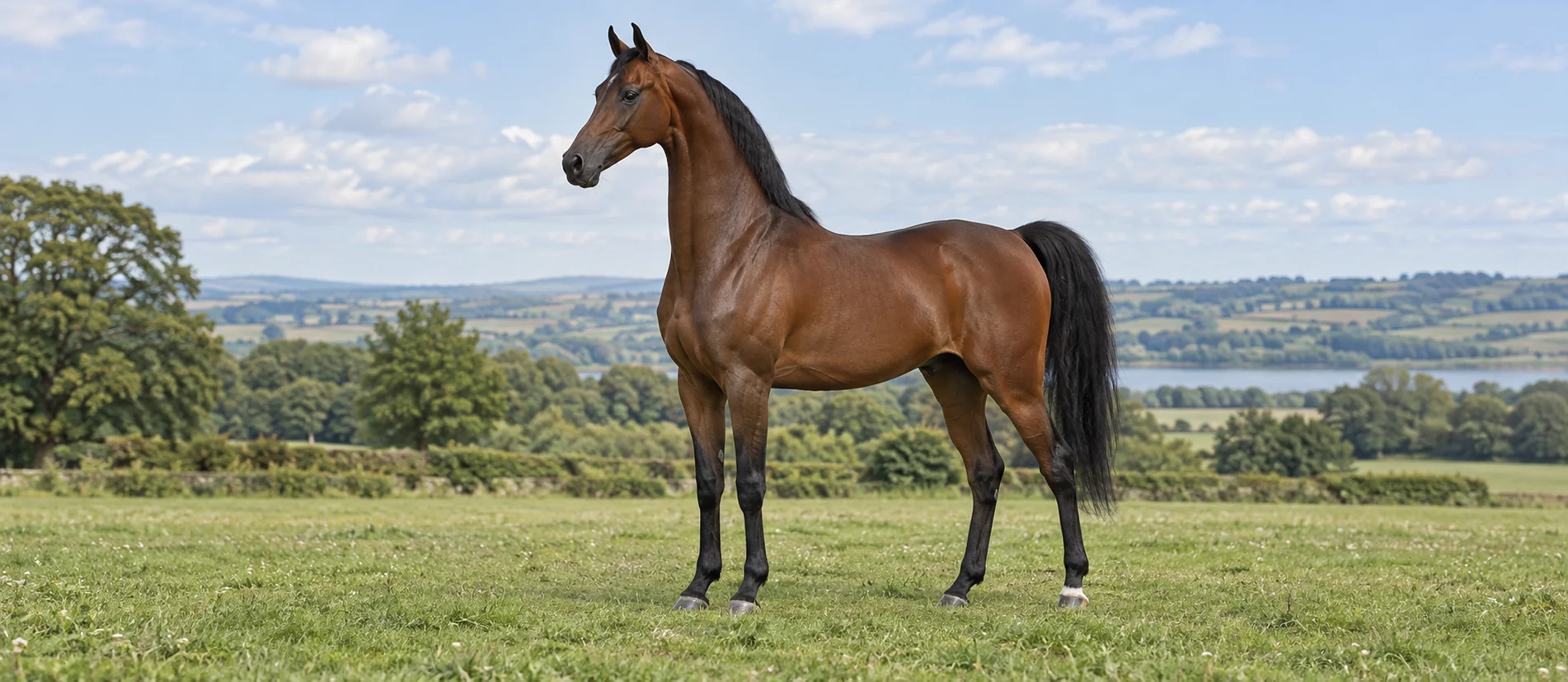
Watch a Hackney trot and you may think you are looking at a show-ring flourish. The knee snaps up, the foot hangs for a beat, the whole horse seems to float above the ground. It looks like pure display. It began as something far more practical: a way to cover a great many miles at speed, pulling a load, on the roads of eastern England.
We are Stirrup and Oak, and we make engraving-style horse artwork. Each of our plates is digital artwork drawn in that tradition. It is not an antique, and it is not hand-engraved, and we would rather say so plainly. Before we draw a breed, we read its history. This is what we found for the Hackney, and where the record is thin, we say that too.
A riding word, a road horse
The name comes first, because it is tangled. "Hackney" appears in medieval English for an ordinary riding horse, and the word is generally traced to the Old French haquenée, a horse with an easy, ambling gait. Such horses were kept for hire, which is why we still speak of a hackney carriage for a taxi, and why a phrase used too often becomes "hackneyed". Whether the London district of Hackney has anything to do with the horses is something etymologists have long debated, and we will not pretend to settle it here.
What we can say is that the Hackney breed as we know it was made later, and mostly in two places. In Norfolk and the wider East Anglian country, breeders developed the Norfolk Trotter. In Yorkshire, they developed the Yorkshire Roadster. Both were horses for the road in the years before railways and tarmac, when a man who needed to get somewhere quickly, whether to a market, a meeting or a sale, either rode or drove a horse that could trot for hours without tiring.
The trot matters. A horse that trots well can keep going long after a galloper is spent, and it is a far smoother pace behind a vehicle. Breeders selected for a horse that lifted its legs boldly, tracked straight, and kept its energy through a long day. The high, showy knee action we now associate with the breed is that same selection pushed further, and made more graceful, once the road horse became a carriage horse for people who wanted to be seen.
Blaze, Shales and the founding lines
Breed histories love a foundation stallion, and the Hackney has a well-known one. Blaze, foaled in 1733, was a Thoroughbred, a son of Flying Childers, who himself is remembered as one of the great early racehorses. Blaze stood in eastern England and his blood ran strongly through the trotting horses of the region. His son is recorded as Original Shales, foaled about 1755, and the trotting lines of Norfolk are traced back to that pair again and again in the old pedigrees.
It is worth being careful here. Eighteenth century pedigrees were kept by memory and by word of mouth, and some of the tidy family trees printed later are tidier than the evidence allows. What is safe to say is that Thoroughbred blood, added to the sturdy trotting mares of Norfolk and Yorkshire, gave the breed its refinement and its courage. Neither the local mares nor the imported speed would have made the Hackney on their own. It took both.
The people who did this were breeders and dealers, farmers and coach proprietors, working for their own reasons. A good trotting horse could win a match against the clock, pull a gig to market, or carry a doctor through a bad winter night. Money moved toward the horses that could do those things, and the horses that could not were quietly not bred from. That is how most working breeds were made. No one designed it. Thousands of small decisions did.
The stud book and the society
The turning point for the Hackney came in the 1880s. By then the trotters of Norfolk and Yorkshire had become a recognisable type, and people wanted them properly recorded. The Hackney Horse Society was formed in 1883 and the first volume of the Hackney Stud Book followed in 1884. From that point, a horse could be registered and traced, and the breed had a written definition instead of a reputation.
The timing was good. This was the great age of the carriage in Britain and abroad. Well-off households kept a pair or a team, and a matched pair of Hackneys, bright and biddable and moving in step, was a statement about the people behind them. Dealers sold them at home and shipped them overseas. In the United States, a Hackney society was founded in the early 1890s, and American breeders imported British stock to build their own lines. Hackney blood also went into other harness breeds abroad, and the Dutch Harness Horse is among those often named as carrying it.
A second strand of the story belongs to the ponies. In the later nineteenth century, Christopher Wilson of Cumbria bred a smaller Hackney type, using Fell pony blood alongside Hackney lines, and the Hackney pony was the result. It has the same action and the same carriage, but in a compact and often startlingly quick package. The pony has its own stud book record and its own following, and to this day it is one of the most striking sights at a driving class, a small animal moving as if it were twice the size.
What changed the work
Every breed built for a job has a bad moment when the job ends. For the Hackney, the motor car and the lorry did the damage. As engines took over from horses on the road, the reason for producing a fast, stylish carriage trotter faded. The First World War, which drew large numbers of horses into military service across Britain, and then the years between the wars, thinned out the breeding. The Second World War and the years of mechanisation that followed left the breed far smaller than it had been at its height.
We would not claim exact figures for those low points, and the sources we trust do not offer round numbers we can stand behind. What the breed society and later conservation bodies do record is that the Hackney survived because a small number of people kept showing and breeding it. The showing is the important part. When a horse is no longer needed for work, the ring can keep it alive, and the Hackney was one of the breeds the ring kept.
That is why the modern Hackney looks the way it does. The trot that once ate up the miles has become the whole point. Judges in the ring are looking for the lift, the reach, and the way the horse carries itself with pride, and the animals that best do so are the ones bred from. It is a real change of purpose, and it has shaped the animal further than any single stallion did. Some people find the action extravagant. We think it is a rare thing to see a working gait preserved so faithfully long after the work has gone.
The Hackney today, in the UK and the US
In Britain, the Hackney Horse Society still maintains the stud book that its founders began in 1884, and the Hackney is regarded as a rare breed. Conservation bodies in the UK have kept it on their watch lists, though the exact category changes over time and is worth checking with them directly rather than taking from us. You can still see the horses and ponies at county shows and driving events, harnessed to light vehicles and moving with that unmistakable action.
In the United States, the Hackney is the same breed with the same origin, kept alive by the American society and by owners who show and drive. American breeders have long valued the pony, in particular, for its brilliance and boldness in the harness ring. The horses on either side of the Atlantic share ancestors that go back to those Victorian exports, and a British and an American Hackney will still look like cousins.
As for temperament, the breed's reputation is for being alert, forward and proud. That is what you would expect from an animal selected to trot fast and keep its head up in traffic. A Hackney is not a horse for the nervous beginner in the ring, but people who know the breed describe it as intelligent and willing, and in good hands it is a generous partner. We would be wary of sweeping claims about any breed's character, and we are careful to say that individuals vary.
What stays with us, when we draw a Hackney, is how much of its history is visible in one image. The Thoroughbred refinement is in the head and the neck. The old road-horse strength is in the hindquarters. The carriage-era showmanship is in that lifted knee. Three centuries of decisions by breeders, dealers, society founders and ring judges are all there in one moving line, and that is exactly what we try to catch in the plate.
If you love the Hackney, or if you simply love a horse that seems to move to its own music, we hope this gives you a little more to look for next time you see one trot past.
See it in the collection: The Hackney collection