Breed Histories · 26 September 2026
The History of the Friesian Horse
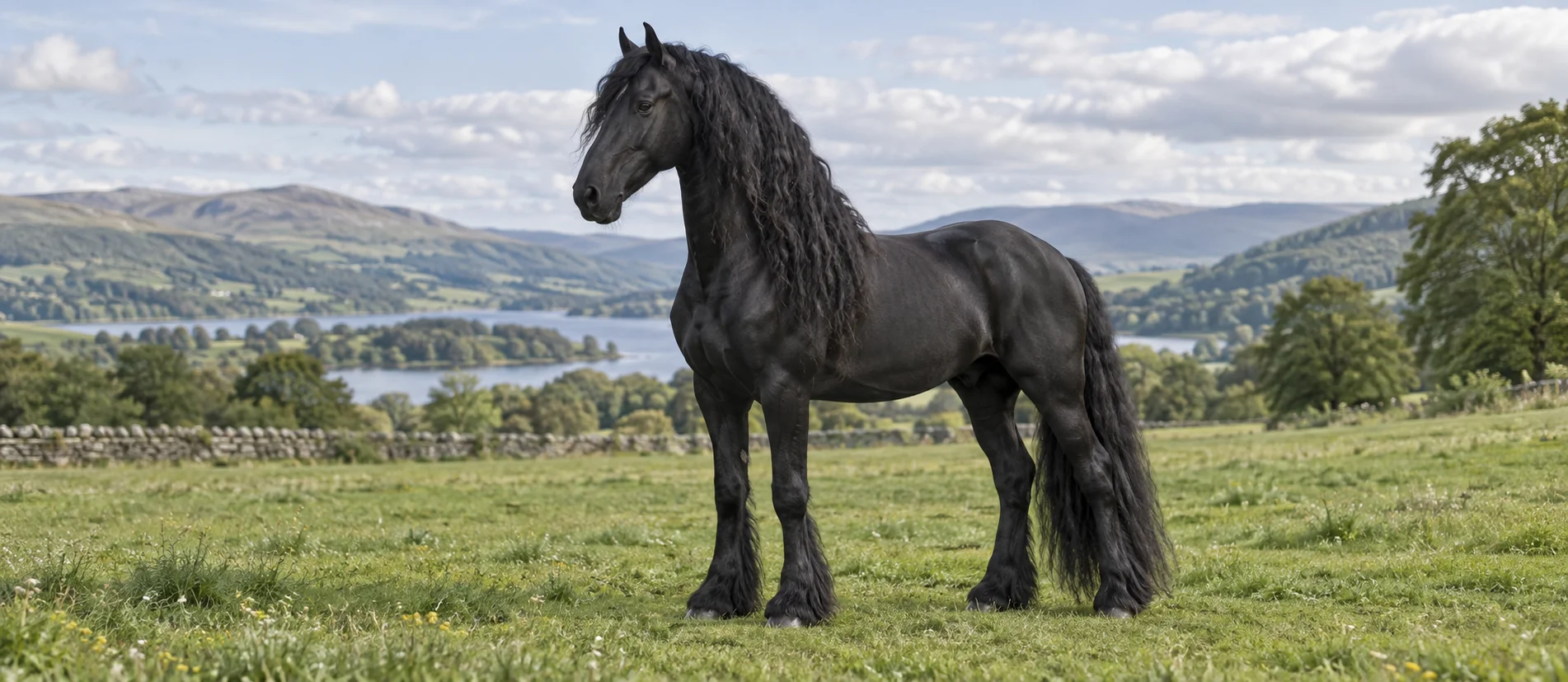
Why does a horse from one of the flattest, dampest corners of Europe look like something out of a legend? The Friesian has the arched neck, the heavy mane and the feathered legs of a horse that belongs on a tapestry. It also has a real history, and the real history is more interesting than the legend, mostly because it is about work.
We draw horse breeds for a living, and the Friesian is one that people ask for by name. So here is its story, told as carefully as we can manage. Where a tale is widely repeated but hard to pin down, we say so.
A horse from Friesland
The breed takes its name from Friesland, a province in the north of the Netherlands. It is low, wet country, cut by water and open to the wind. For a very long time people there have lived by farming and by moving themselves and their goods across ground that could be soft underfoot. A horse in that setting has to be strong, steady and willing to work close to people.
That is the first thing worth holding on to. The Friesian was not shaped for show. It was shaped by a landscape and by the jobs that landscape asked for: pulling, carrying, ploughing, and getting a family to market or church along a poor road.
You will often read that the Friesian is one of the oldest breeds in Europe, and that its ancestors carried armoured knights into battle in the Middle Ages. Horses have certainly been kept in the region for a very long time, and a strong, compact horse that could carry weight is a fair description of what a heavy war horse needed to be. The exact line from those early animals to the horse we know now is not something we can draw with confidence, and anyone who tells you it is a neat, unbroken family tree is telling a nicer story than the evidence allows.
The same caution applies to a favourite tale about the Eighty Years' War. The story goes that Spanish occupation brought Andalusian blood into the local horses, which is often offered as the reason for the Friesian's elegance and its high, rounded movement. It is repeated a great deal. It is also debated, so we would rather name it as a story people tell than build the breed's history on it.
Bred to work, and to be seen doing it
What is much better documented is how the Friesian was used. Over the centuries it was a working horse in the plainest sense: in harness, on farms, and on the road. It was also a horse that people liked to show off. A striking black horse with a proud head carrying a carriage said something about the family behind it.
Trotting in harness became a serious pastime in the region, and a horse that could trot well, and would keep its head up while doing it, was valued. You can see how that shaped the build. A neck that rises and arches, a body that is strong without being clumsy, and a knee action that lifts and gathers rather than skims the ground. Those are the features that make a Friesian look the way it does, and they came from asking one horse to do heavy work and to look good in front of people.
The temperament follows from the same life. A horse that spends its days close to a farmer or a driver needs to be calm around people and ready to listen. Friesians have a name for being willing and gentle, and for forming a bond with their handlers. That is a general reputation, not a guarantee for any one horse, but it makes sense of a breed developed for household work rather than for war alone.
The colour, too, has a history of being kept. The breed is black, and the breed society has long treated that as part of what a Friesian is. Long, thick mane and tail and the feathering around the lower legs complete the picture. Those are the features we spend the most time on when we draw one, because they are what make the outline unmistakable even in a simple black and white plate.
The stud book, and a close call
A breed survives when someone writes it down. The Friesian's stud book, kept by the breed society in the Netherlands, dates from 1879. It gave breeders a way to record parentage and to decide which horses would carry the breed forward. Today the society is known as the KFPS, and it remains the body most Friesian owners look to for registration and standards.
The years that followed were not easy. Fashions in horses changed. Lighter, faster trotting horses were wanted, and some breeders crossed their Friesians with other types to get them. Farm work also changed. As machines and other kinds of horse took over jobs the Friesian had done, the demand for a heavy black harness horse fell.
The result was a real threat to the breed. Early in the twentieth century the numbers of good breeding stock, and of stallions in particular, dropped very low. Sources describe this as a near loss, and it is the turning point of the whole story. We are not going to give you a stallion count here, because figures for this period vary between accounts and we would rather send you to the society's own published history than pick one and hope. What is not in doubt is that dedicated breeders and the society worked to gather what remained and rebuild from it.
Mechanisation, which had helped push the breed to the edge, came around again a second time after the Second World War, as tractors replaced horses on farms. This time the breed did not fade. The Friesian found a new life in driving, in riding and in dressage, where its presence and its trainability were an advantage rather than an oddity.
The Friesian today, in the UK and the US
The modern Friesian is a different kind of working horse. It pulls a carriage in the ring, carries a rider in the arena, and turns up wherever someone wants a horse that looks as if it has stepped out of an old painting. Breeders still talk about types within the breed, from the heavier, more traditional build to a lighter, more athletic one suited to sport, and the stud book keeps a system of inspection and approval to guide which horses are bred from.
The breed has followers well beyond the Netherlands. There are Friesian owners and breed groups in the UK and in North America, and each has its own association for registration, shows and advice. If you are thinking of owning one, or just want to see them properly, those groups and the KFPS are the best places to start. They can tell you far more than we can about care, health and current rules.
One practical point worth knowing is that the breed's beauty comes with maintenance. That long feathering and thick mane need attention, and the breed's history of heavy work means a good Friesian is a horse with real substance. The people who love them tend to say so.
What we take from the history is simple. The Friesian looks the way it does because of what it was asked to do, in a particular place, for people who needed a horse that could work and be admired at the same time. It nearly disappeared because that work changed, and it came back because people cared enough to write it down and keep it going.
Our plate of the Friesian is digital engraving-style artwork, made by us to echo the look of old natural-history plates. It is not an antique and it was not hand-engraved. We drew it because the horse rewards close looking: the curve of the neck, the fall of the mane and the shape of the feathering are all a record of the jobs it once did.
See it in the collection: The Friesian collection