Breed Histories · 26 September 2026
The History of the Fjord Horse
Have you ever looked at a Fjord and wondered how a horse that size manages to look so certain of itself?
We are Stirrup & Oak, and we draw horses. Digital engraving-style plates, made by us, in the manner of the old natural-history and stud-book illustrators. They are not antiques and they are not hand-engraved, and we would never dress them up as either. But drawing a breed properly means learning what it was for, and the Fjord is one of the easiest horses to draw once you understand that. Everything about it makes sense the moment you picture a small farm on a very steep hillside.
Before we start, a word on how we have written this. Breed history is full of stories that get repeated because they are good, not because anyone can show they are true. Where the breed societies, the stud books and the published histories agree, we say so plainly. Where they do not, we say that too.
A horse from the west of Norway
The Fjord takes its name from the country it comes from: the deep, narrow sea inlets of western Norway, where farms sit on ledges between water and mountain. Land there is scarce, steep and stony. A horse that was going to earn its keep had to be strong, sure on its feet, sensible in tight spaces and cheap to feed. It also had to be small enough that a family could look after it without a great deal of fuss.
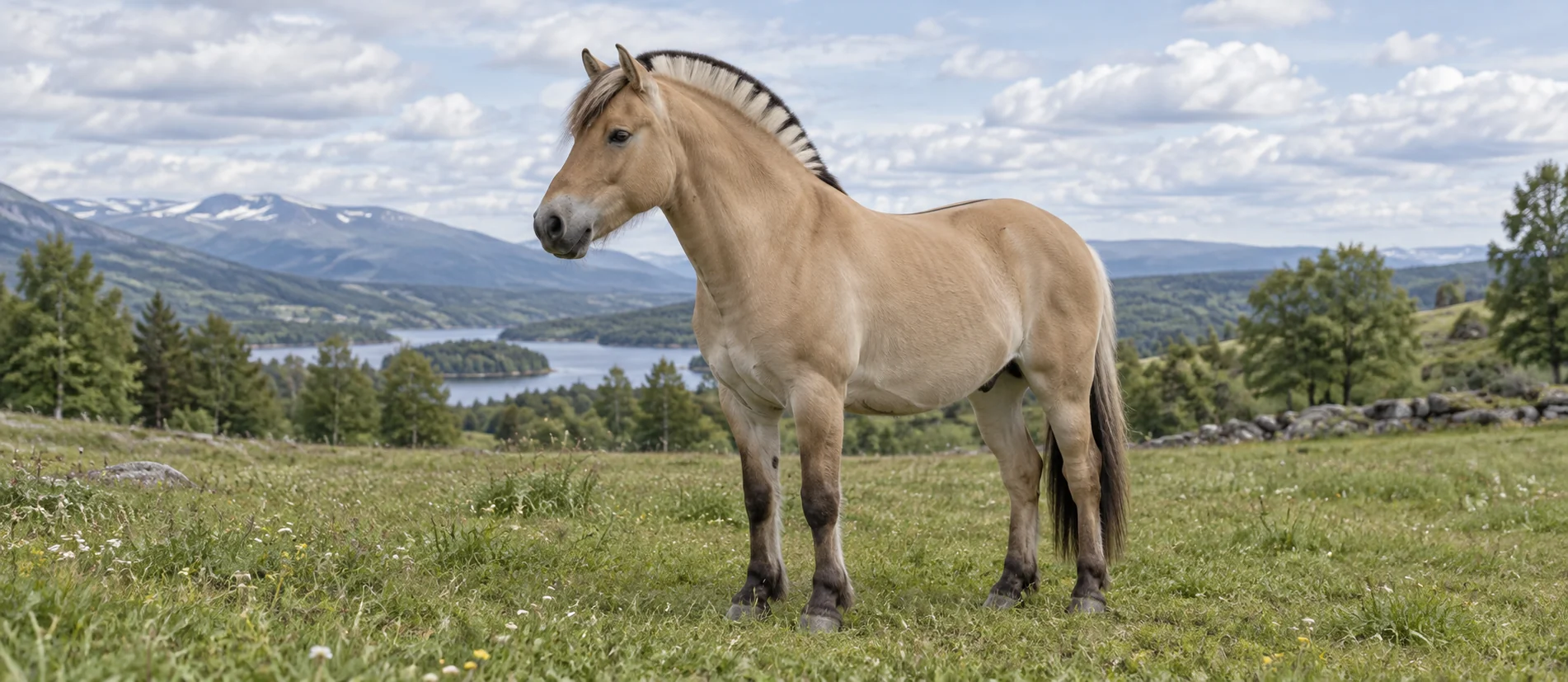
The result is a compact horse, generally somewhere around 14 hands, with a deep body, short strong legs, dense bone and a well-muscled, arched neck. The head is neat, the eye is kind, and the whole animal looks as though it was assembled for pulling and carrying rather than for show. Then there is the colour. Every Fjord is a dun, and the breed recognises several shades of it, from a warm brown dun through red and yellow to grey and a pale, creamy white dun. Nearly all carry a dark stripe down the back, and the mane is pale with a dark line through the middle.
That mane is worth a moment. In Norway it has long been clipped so that it stands upright in a smooth crescent, which shows off the dark stripe running through the centre. It is partly tradition and partly a very practical bit of tidiness. It is also the single detail that makes a Fjord recognisable from across a field, and we spend more time on it in our plates than on almost anything else.
Vikings, and the things we cannot prove
Most articles about the Fjord get to the Vikings within a paragraph. You will read that the horse was their mount, that it is the direct descendant of horses that crossed the North Sea, and that it looks like the wild horses of the steppe. It makes a good story.
Here is what we are happy to say. Horses have lived in Norway for a very long time, and the Fjord is regarded as one of the oldest and purest of the European breeds, kept in a fairly closed population by farmers in a landscape that did not invite much outside blood. The dun colour and the dorsal stripe are primitive markings, and they fit the picture of an old, hardy type. That much is well supported.
What we will not tell you as fact is that Vikings rode this exact horse, or that the breed can be traced in an unbroken line to any particular raid or ship. Comparisons with the wild Przewalski horse turn up in a great many popular accounts, but resemblance is not descent, and the science on horse origins has not settled the question in the tidy way those accounts imply. If we cannot support it, we would rather draw the horse and let you enjoy it.
What we can say is simpler and, we think, more interesting. For most of its history the Fjord was not bred by a society or judged in a ring. It was bred by farmers, for the work in front of them, and the horse we see today is the product of generations of practical choices.
Bred for the farm, and the road that led to it
The Fjord's working life was on the land. It ploughed and harrowed small, awkward fields. It hauled timber down slopes that a heavier horse would have struggled on. It carried loads on narrow tracks and pulled carts along roads that hugged the water. It also carried people, because on a small farm a horse that does everything is worth far more than one that does a single job very well.
You can read that history straight off the animal. The short back and strong quarters are for pulling. The good, hard feet are for rough ground. The economical build is for a farm where feed was never plentiful. And the temperament, which is the part people who own them talk about most, is calm, willing and patient. A horse that shared a small farm with children, livestock and the family's daily routine could not afford to be difficult, and over many generations the difficult ones simply were not kept for breeding.
By the nineteenth century the Fjord was being bred more deliberately, and it also travelled. Horses went to neighbouring countries and were valued as working animals there too. In time, Norway organised the breed formally, with a breed society and a stud book, and set out what a correct Fjord should look like. If you want the exact founding dates and the names of the early stallions listed in that stud book, the best sources are the Norwegian breed society and the national stud books themselves, and we would point you there rather than repeat a date we have not checked against the register.
The pattern matters more than any single date. A working type, shaped for two centuries or more by the same demands, was written down and given a standard, so that what farmers had been doing by instinct could be kept going deliberately.
When the tractor came
The threat to the breed was not a war or a disease. It was the same thing that changed every working horse in Europe in the twentieth century: mechanisation. When the tractor became affordable, the reason for keeping a farm horse began to disappear, and numbers of working horses fell across the continent. The Fjord, which had spent its whole history being useful on small farms, was exposed to exactly that change.
It came through, and the reason is fairly plain. It was already a horse that people liked. It was easy to keep, easy to handle and good with children, so it moved from the field to the riding school and the family stable. Its strength and steady manner suited it to driving, and its size suited it to riders of all ages, including adults who wanted a horse that did not tower over them. A breed that had been asked to do everything on the farm turned out to be well suited to doing a lot of different things off it.
Today the Fjord is used for riding, for driving in harness, for leisure and trekking, and for therapeutic and beginner work, where a quiet, dependable horse matters far more than a flashy one. It is also still a working horse where working horses are wanted, including forestry work and small-scale farming. That mix of jobs is the modern echo of its original one.
In the UK and the US
In Britain, the Fjord is not a common sight, which is part of its appeal. It tends to be found with people who have discovered it for themselves: riders who want a sturdy, sensible all rounder, drivers who like a horse with real presence between the shafts, and families looking for something with substance that will still suit a child. It copes well with a British climate, being a hardy, good-doing horse, though as with any native-type, that easy-keeper nature means owners need to watch its weight.
In the United States, the Fjord has its own registry and a community of owners who ride, drive and show. They are valued there for the same reasons they were valued in Norway: they are strong for their size, steady in the head and versatile. Wherever a Fjord turns up, the story is much the same. Someone meets one, is surprised by how calm and capable it is, and ends up telling everyone.
That, to us, is the real history of the breed. Not a grand legend, but a very long conversation between a small horse and a hard landscape, and a lot of people who noticed it was worth keeping.
If you have a Fjord, or you simply cannot resist that crescent mane and the stripe running down the middle, this is the horse we drew our plate for.
See it in the collection: The Fjord collection