Breed Histories · 26 September 2026
The History of the Fell Pony
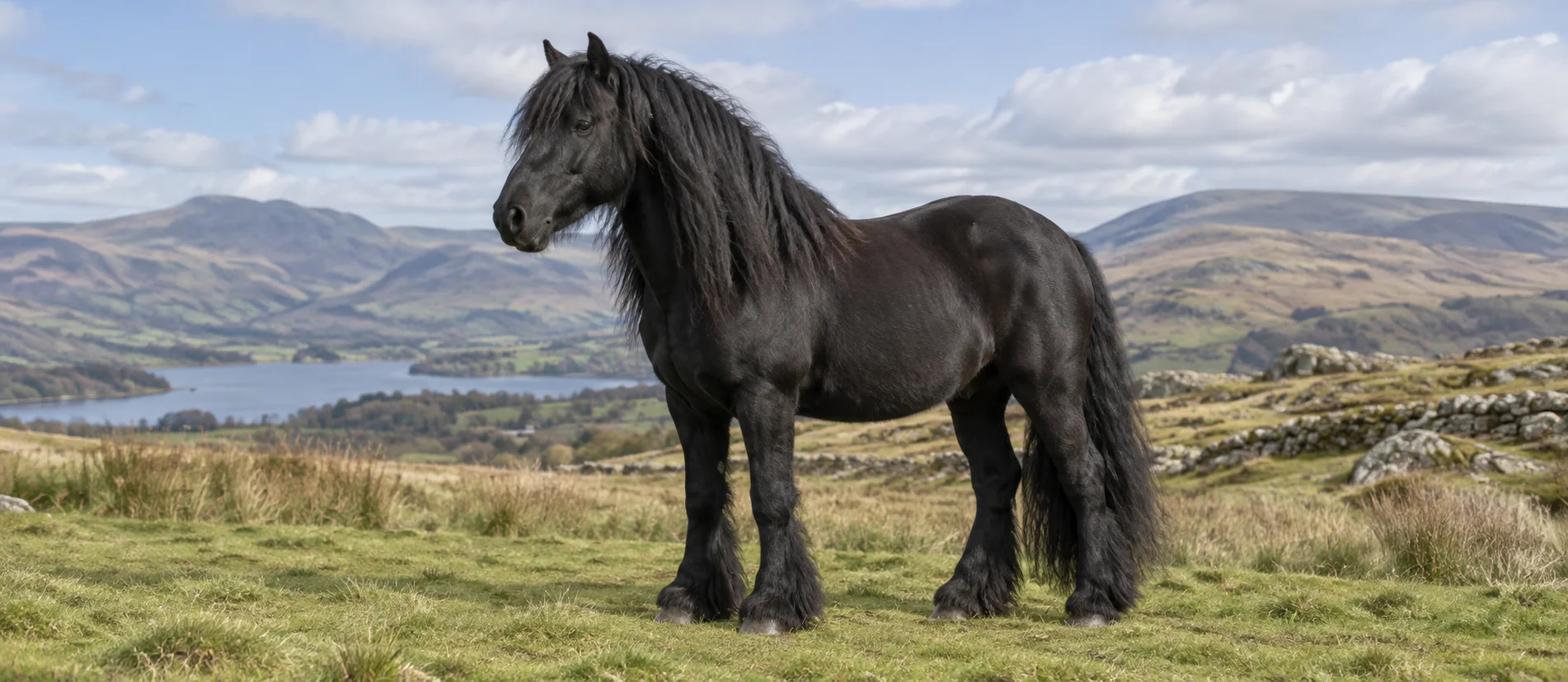
Why does a pony under fourteen hands carry so much reputation? Ask anyone who knows the Fell and you will hear the same few words: sure-footed, sensible, tough. None of those qualities was bred for show. They were bred for the fells of Cumbria and the country around them, where a pony that could not look after itself did not last long.
At Stirrup & Oak we like to start a breed history with the work, because the work explains the animal. With the Fell, it explains almost everything.
Where the Fell Pony came from
The Fell Pony belongs to the north-west of England: the high ground of Cumbria, Westmorland and the neighbouring Pennine country. Its home is open fell, cold, wet and steep, with poor grazing for much of the year. Ponies that lived there had to be small enough to live on little, and strong enough to work.
Its exact ancestry is not fully documented, and it is worth saying so plainly. Breed writers usually describe a mix of northern native pony types, and they often name the old Galloway, a now vanished pony of the Scottish borders and northern England that was prized for stamina. Other influences are mentioned in the older accounts too, and the Fell is closely related to its neighbour, the Dales Pony. What is well supported is the general picture: a hardy native type, kept for generations in a particular landscape, selected by the demands of that landscape.
You will also hear that Roman cavalry left their mark, usually with Frisian horses brought to garrisons along Hadrian's Wall. It makes a lovely story and it is repeated often. We would call it a tradition rather than a proven fact, and we would not build a breed history on it. The fells shaped this pony far more than any single introduction did.
The work that made its build
The Fell was a working pony before it was anything else. Historically it did the jobs a small upland farm needed. It carried loads on pack saddles across ground no cart could cross. It was used on the farm and on the hill, for shepherding and gathering, and for getting a family to market. It was ridden and driven, and it was known for a fast, ground-covering trot.
The best known chapter is the pack work of the northern Pennines, where ponies moved goods such as lead ore in strings along upland tracks. Loads were heavy for an animal of this size, which is the point of the breed: a compact, deep-bodied pony with a strong back, good bone and very hard feet. The traditional description of Fell feet, hard, well shaped and dark, is not decoration. A pony walking rough stone for a living needs them.
The other features people love follow the same logic:
- A thick mane and tail, and a dense coat that grows heavy in winter, for weather that turns quickly.
- Feather at the heels, and a deep, sloping shoulder and short, strong legs for steep going.
- Good sense. A pony that panics on a narrow track with a load on its back is a danger to itself and everyone else, so calm heads were kept and nervous ones were not.
Colour tells a similar story of selection. The breed society standard favours black, brown, bay and grey, with only a small amount of white allowed, and the classic Fell is a dark, plain pony. Height is kept below fourteen hands. That limit is part of the breed's identity, not a technicality.
Temperament came from the same place. Many Fells lived out on the fell for much of the year, with breeding stock running on open grazing and coming down to the farm when they were needed. A pony raised on its own wits, that then works closely with people, tends to be both independent and willing. Owners today describe just that mix, and it is fair to say the history is where it comes from.
Turning points: recognition, wars and near-loss
The breed's real story in the twentieth century is one of organisation. Fell ponies had long been bred by farmers who knew their lines by memory. In the early decades of the century, breeders began to record them formally, first alongside the Dales in the wider mountain and moorland pony movement, and then under a society of their own. The Fell Pony Society, established in the early 1920s, and its stud book gave the breed a written standard and pedigree records. That is the point at which a local type became a defined breed with a documented future.
The wars mattered as well. Native ponies were needed for pack and draught work, and northern breeds were affected by wartime demand, and then by the loss of stock and the disruption that came with it. After the Second World War, tractors and lorries replaced the working pony on most farms and tracks. For a breed whose whole purpose was work, mechanisation was a serious threat. Numbers fell, and the Fell became a breed to be watched. It is still listed by conservation bodies among the native breeds that need care, which tells you the danger has not entirely gone.
What saved it was people who valued the pony for more than its job. Breeders kept their bloodlines going, the society kept the register honest, and a new role opened up: riding, driving, showing and family ponies. The Fell proved itself as a strong, kind pony for riders, a capable driving pony, and a good all rounder for those who want something more real than a fashion breed. Its reputation for driving has been helped by well known enthusiasts over the years, including members of the British royal family who have kept and driven Fells.
We have been careful here. Some of the popular tales about named ponies and individual stallions from this period are hard to trace to a proper source, and we would rather leave a name out than repeat an unverified one. If you know a particular pony of the twentieth century from a stud book or the society's own history, that is the kind of detail we would like to include in future.
What that history means today
The Fell is now a breed defined by the work it used to do. Its strength, its hardiness and its steady manner are the fossil record of the fells, and the society standard exists to protect them. People still use Fells for trekking, driving, general riding and light farm and conservation work, and many are kept simply because they are good company.
In the UK the breed still centres on its home county and the society that looks after it. Outside the UK, the Fell has followers in North America, where breeders and owners value the same things: a hardy, sound, sensible small horse that does not need pampering. American keepers often talk about how well the breed copes with hard weather and rough country, which is exactly what it was made for. The distance has changed; the reasons for choosing a Fell have not.
There is a lesson in it for anyone who loves horses. A breed that is judged by its usefulness, and protected by people who care about that usefulness, tends to survive. The Fell Pony survived because someone always wanted a pony that could do a day's work on the hill and still be the calm one in the yard.
Our own plates of the Fell are digital artwork in an engraving style. They are new pictures, made for us, not antique prints, and we would never dress them up as anything else. What we try to do is give the pony the same plain, careful attention that its breeders always gave it: the deep body, the short strong legs, the dark coat and the level, watchful eye.
If you are learning about the Fell, the best sources are the breed society, its stud book and the museums and local histories of Cumbria. We have leaned on the same kinds of source for this history and left out anything we could not stand behind. When something is only a tradition, we have said so.
See it in the collection: The Fell Pony collection