Breed Histories · 26 September 2026
The History of the Exmoor Pony
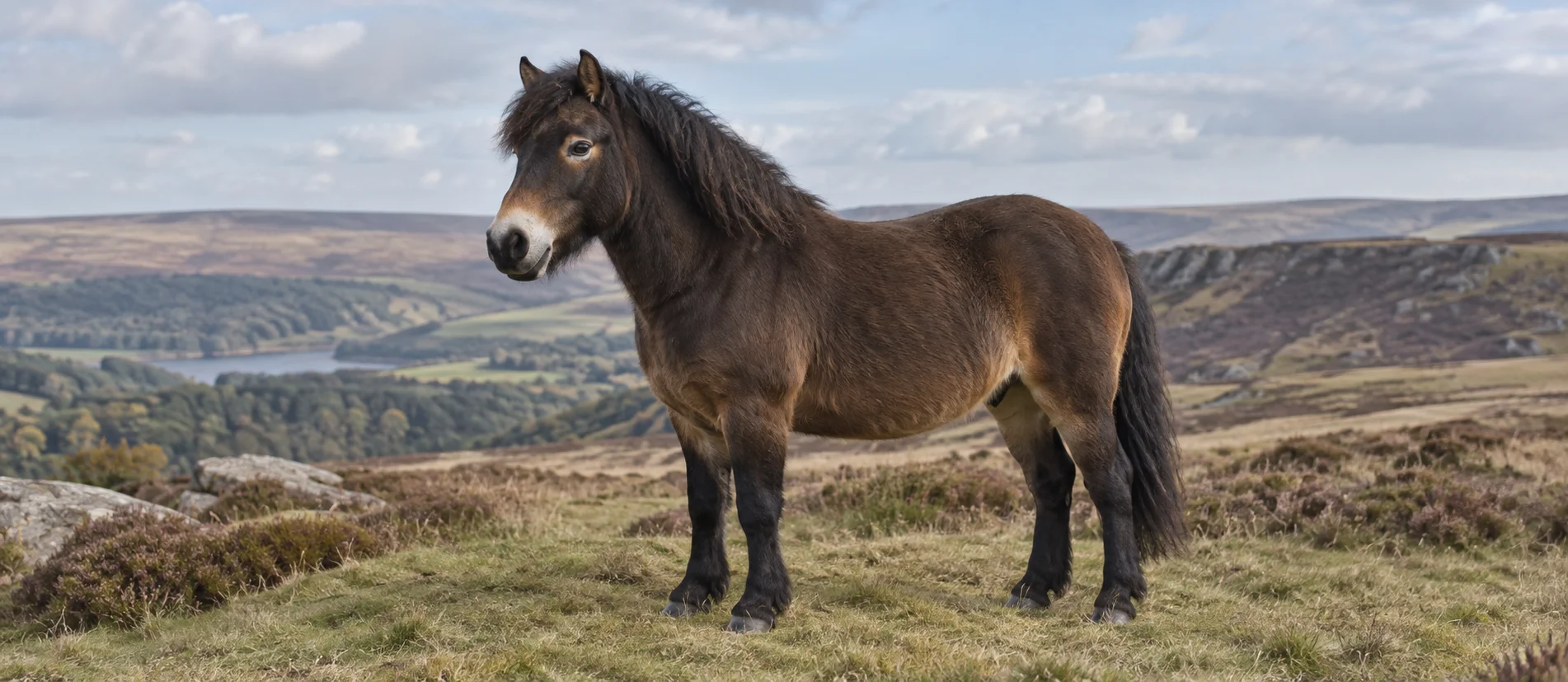
Have you ever looked at a pony and thought it was built by the weather rather than by a breeder? That is how I feel about the Exmoor. When we drew our Exmoor plate, the hardest part was resisting the urge to tidy it up. Every feature that looks a little odd is there for a reason, and the reasons are the story.
A note before we start. Our plates are digital engraving-style artwork, drawn by us in the manner of old natural-history and sporting prints. They are not antiques and not hand-engraved. The history below is a different matter: I have kept to what the breed society, the stud book and published breed histories support, and where a popular story cannot be backed up, I say so.
A moorland pony older than the records
Exmoor is a high, wet, exposed stretch of moorland in the south-west of England, straddling Somerset and Devon. Ponies have lived on it for a very long time. The usual starting point for the written record is the Domesday survey of 1086, which is generally cited as mentioning ponies in the Exmoor area. It is a thin reference, and it tells us that horses were there, not that they looked like the ponies we know now.
That is worth saying plainly, because the Exmoor is often introduced as a direct survivor of the wild horses of the Ice Age. It is a lovely idea, and you will see it repeated confidently. But the evidence for an unbroken line from prehistoric wild horses to today's ponies is argued over by researchers, and I would call it a hopeful claim rather than a settled fact. What we can say honestly is that the Exmoor is among the oldest and most primitive-looking of Britain's native pony types, and that it developed over centuries on one hard landscape.
For much of its history the moor was a Royal Forest, a hunting ground held by the Crown, and the ponies ran on it in semi-wild herds. Local farmers also turned their own animals out onto the commons, and those herds were gathered for marking and sale. That mix of open moor, seasonal gatherings and very little interference is the setting the breed grew up in.
Built by the moor
Nobody designed the Exmoor's look, and that is why it is so distinctive. Consider what the moor demands: driving rain, wind with nothing to stop it, snow, and forage that is coarse and thin for much of the year. A pony that cannot cope simply does not last.
So the pony that came out of it has a double coat, a springy, water-shedding outer layer over a dense woolly one. It has the "ice tail", a fan of hair that grows thick at the top of the dock and sends rain away from the body. It has what the breed society calls "toad eyes", heavy hooded lids that shelter the eye from the weather. And it has the mealy colouring, a pale, oatmeal shade on the muzzle, around the eyes and under the belly, which is the breed's signature. Bay, brown or dun are the accepted colours, and white markings are not wanted.
Its build tells the same story. The Exmoor is compact, deep through the body and strong in the bone, with a sensible, short-coupled frame. It is small, around twelve hands, but it has always been asked to carry more than its size suggests. Temperament follows the landscape too. A pony that lives half wild has to be self-reliant, quick to judge a situation and sure-footed, and Exmoors have a reputation for being clever, independent and sometimes stubborn. Anyone who has handled one will tell you they do not do things simply because they have been told to. They do them once they understand why.
Because of that strength and stamina, Exmoors were used for practical work well beyond the moor: carrying loads and shepherds, helping on farms, and as children's riding ponies. They have also been recorded as working underground in the pits, as many small hardy British ponies were. I would not claim a precise number for any of it, only that the breed's usefulness came from exactly the traits the moor had already selected for.
The Knight family and the herds that survived
The most important turning point in the modern story is a change of ownership. In the early nineteenth century the Crown sold off the Royal Forest of Exmoor, and the largest part was bought by Frederic Knight, an industrialist from the Midlands. He set about improving the land, and he also took an interest in the ponies. The Knight family herd, kept on the moor for generations, became one of the great foundations of the breed. The family also carried out experiments in crossing, with mixed results, and kept a herd of pure ponies apart. Pure herds of this sort, along with those kept by other moorland farmers, are what everything later rests on.
The next step was organisation. The Exmoor Pony Society was founded in 1921, an association of breeders who wanted to record the ponies and protect their type. Registration followed, and with it the practice of inspecting ponies and documenting their pedigrees in a stud book. That was the moment the Exmoor stopped being just the ponies on the moor and became a defined, recorded breed, with a written standard to say what an Exmoor is and is not.
The Second World War and near loss
The greatest crisis came with the Second World War. Exmoor was a training area, and the moor was used by the military. Breeders lost their working staff, herds were left unattended, and the ponies suffered. Accounts of the period describe ponies being taken for meat and used for target practice, and the numbers fell to a shockingly low level. The figure often given is that fewer than fifty ponies were left when the war ended, and even the breed's supporters treat that number as approximate. What is beyond doubt is that the breed came close to disappearing altogether.
What saved it was a small group of people who refused to let it go. Breeders gathered the surviving ponies, and dedicated herds were built up from them, bred on the moor and in carefully managed groups. Chief among the names in this recovery is Mary Etherington, remembered for her commitment to the breed and the herd she built. The society's work in these years, keeping the stud book, sorting out the true type and making sure that the remaining bloodlines were not lost, is a big part of why any Exmoor stands here today.
Mechanisation cut in from the other side. As tractors and lorries took over the jobs that small hardy ponies once did on farms, the economic reason for keeping them faded, which is the same trap that caught many British native breeds. For the Exmoor, survival became a matter of conservation and enthusiasm rather than plain usefulness.
The Exmoor today, in the UK and the US
The modern Exmoor is still rare. It appears on the conservation watchlists of British breed organisations, and every registered foal matters to the breed's numbers and genetic diversity. Some ponies still live on the moor itself in semi-wild herds, gathered each year for inspection and registration. Others are kept in herds elsewhere in Britain, valued as riding ponies, driving ponies and as conservation grazers. Because they thrive on rough, low-quality vegetation, they are used to graze nature reserves, where they help to keep scrub down and let wildflowers and insects flourish. It is hard to think of a better second career for a pony designed by the moor.
The breed has a smaller but committed following in the United States. American enthusiasts have imported Exmoors from Britain and formed their own association to register and promote them, and the ponies there are kept by people who value the same qualities: toughness, brains and a very old type. Numbers are small, so each pony is precious, and the transatlantic link between breeders has become part of how the breed's future is being protected.
What does this history mean for someone who simply loves horses? To me it is a reminder that the animals we admire were shaped by place. The Exmoor is not elegant in the way a show horse is, and it does not need to be. Its hooded eyes, its mealy muzzle and its thick winter coat are a record of a landscape, and a few devoted people kept that record from being lost.
That is the spirit we tried to catch in our engraving-style plate of the Exmoor: a sturdy, quietly stubborn pony that looks as though it has just come in out of the rain, and does not mind at all. If it appeals to you as it does to us, the Exmoor products in our shop carry that plate.
See it in the collection: The Exmoor collection