Breed Histories · 26 September 2026
The History of the Eriskay Pony
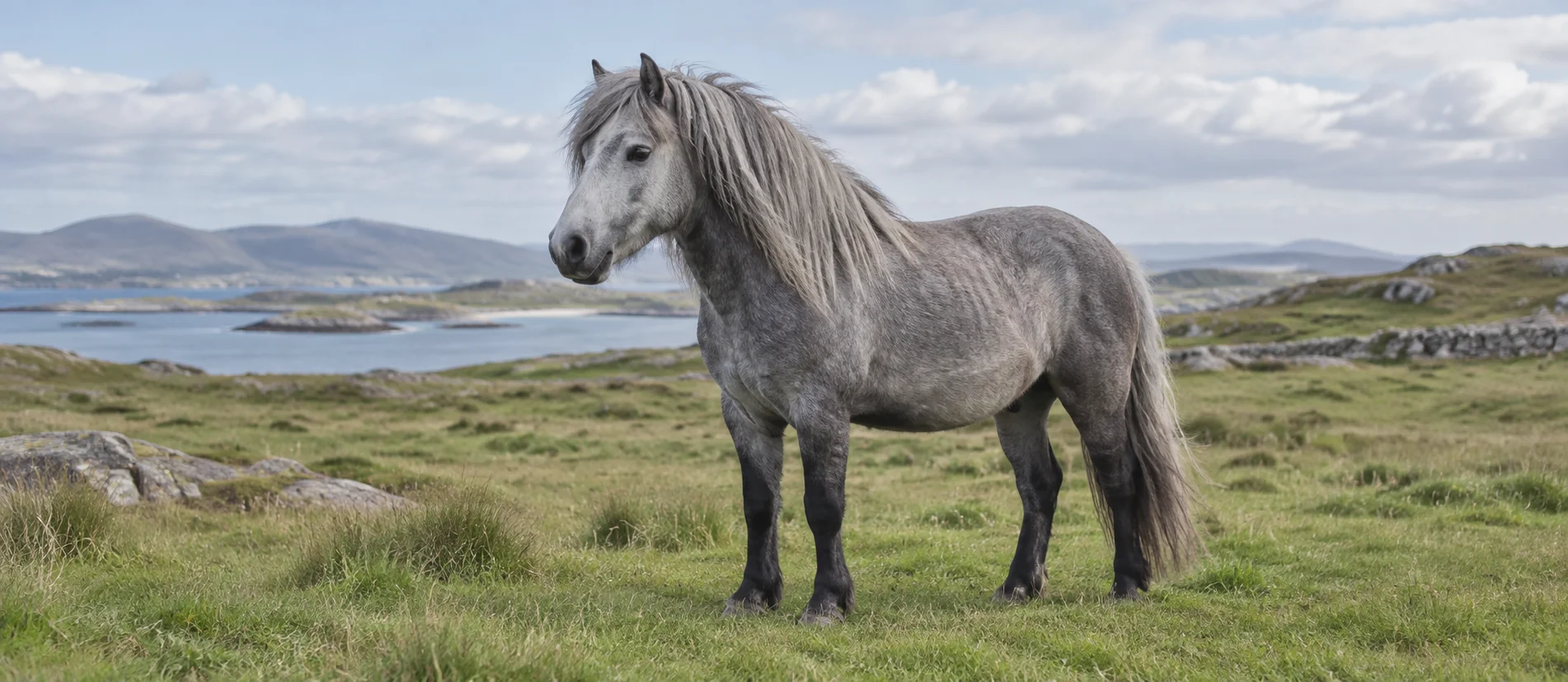
How much pony do you need to carry a creel of peat home across wet ground, all day, on very little feed? Ask a Hebridean crofter a century or two ago and the answer would have been a small one. That is the whole story of the Eriskay pony in a sentence, and it is why I find it one of the most quietly convincing breeds we have written about.
Here at Stirrup & Oak we draw horses in an engraving style, digital artwork made to look at home beside old natural-history plates. The plates are not antiques and we never pretend they are. But the horses in them earned their shapes the honest way, by doing a job. The Eriskay is a very clear case of that.
An island pony from the far edge of Scotland
Eriskay is a small island in the Outer Hebrides, between South Uist and Barra. The pony takes its name from it, though the breed was never confined to that one island. Ponies of the same type were kept across the Western Isles, on crofts where every animal had to earn its keep and where there was very little to spare for one that could not.
Where the type first came from is the part I want to be careful with. You will often read that the Eriskay descends from the ancient ponies of the Celtic fringe, and that Norse settlers brought ponies to the islands and left their mark. It is a lovely idea and it may well hold some truth, since these islands were settled and traded across for centuries. But a good story is not the same as a documented pedigree. What can be said is that the island ponies were a hardy, local type, shaped over a very long time by the climate and by the crofting life around them. Beyond that, I would rather say we do not know than dress a guess up as history.
What the ponies looked like is easier to describe. The Eriskay is small, generally somewhere around 12 to 13.2 hands. It is stocky without being coarse, with a deep body, a broad chest, strong quarters and short, sound legs. The head is neat, with a straight or slightly concave profile and a kind eye. The coat is thick and weatherproof, and grey is the colour most people associate with the breed, though bay and black are also seen. A grey Eriskay in winter coat, with mane and tail blowing sideways off the Atlantic, is a proper picture.
The work that made it
The Eriskay was a working pony first and everything else much later. On a Hebridean croft there was no room for a specialist animal. One pony did the lot.
The classic job was carrying. Peat was the fuel of the islands, cut on the moor and needing to be brought home, and a pony fitted with panniers or creels could get it there over ground that would have swallowed a cart. Seaweed was another load. Crofters gathered it from the shore to spread on the land as fertiliser, and again the pony was the means of moving it. Ponies were also used for light work on the land and for pulling small carts where the tracks allowed. In the accounts I have read of croft life, the ponies were often led by women and children, which tells you something about the temperament. A pony that will stand quietly while a child fills its creels, and then walk home behind them without fuss, has to be steady and sensible.
That work explains the build. A deep, compact body with good bone carries weight well without needing a great deal of height, and a small frame does well on thin island grazing. Sure feet matter on wet, uneven moorland and stony shore. The thick coat and hardy constitution mean the animal can live outside through Hebridean weather. And the willing, calm nature is not an accident of the show ring. It is what you get when generations of ponies that were awkward or flighty were simply not the ones a family wanted to keep working.
If you have met Shetlands, Highlands or Exmoors, you will recognise the family resemblance in the practical sense. These are all northern and western native types where the landscape did the selecting. The Eriskay is smaller than a Highland and lighter than one too, and it fills a niche of its own: the pony for carrying, for the child to lead and for the croft with hardly any room to spare.
Near-loss and a rescue
The twentieth century was hard on the working pony everywhere, and the Hebrides were no exception. Crofting changed. Tractors and other machinery arrived, roads improved and vehicles took over the jobs the pony had done. When an animal's work disappears, the reason for keeping it disappears with it. On top of that, other breeds had been used over the island mares at various times, and the old type became diluted. By the early 1970s the pure island pony had fallen to a very small number, only a few dozen animals at most according to the accounts I know, and the breed was in real danger of vanishing without anyone quite noticing.
What saved it was people who noticed. In the early 1970s, enthusiasts set out to find the surviving ponies that still showed the old type and to bring them together as a breeding group. A breed society was formed in 1972, and with it came a stud book to record which animals counted as Eriskay ponies and where they came from. That is the step that turns a scattering of local ponies into a recognised breed. Without a register you cannot say what is pure and what is not, and you cannot plan matings sensibly when the whole population could sit in a couple of paddocks.
The breed remained tiny for a long time after that. It is listed by the Rare Breeds Survival Trust among Britain's native breeds at risk, and it has sat in the most serious category. I would encourage you to check the Trust's current watchlist rather than trust any figure I might quote, since the numbers move from year to year. What is safe to say is that it has never stopped being rare, and that the work of the society and its breeders has kept it going.
One small thing I will name as a myth rather than let it drift into the story. Eriskay is also the island near where a cargo ship ran aground during the Second World War, an event that became the basis of a famous book and film. People sometimes weave the pony into that tale. There is no reason to think the pony had a part in it, and I would not want you to leave here believing it did. The island's fame and the pony's history are separate threads.
What that history means today
These days the Eriskay is no longer a pony that anyone needs for peat. Its work has changed, and the breed's future depends on people finding new uses for it. Because it is small, strong and willing, it makes an excellent children's riding pony and does well in harness. Its calm head suits pupils who are still learning, and its stamina and sure-footedness make it a pleasant partner for gentle hacking. Some owners also value it simply for conservation, keeping a living piece of Hebridean history going.
In the UK you can find the breed through its society and through the native pony community more generally, and it is worth going to see them in person if you get the chance. Outside Britain the picture is thinner. It is a very rare breed anywhere beyond the islands and the mainland UK, and I would not want to give you a number for the United States that I cannot support. If you are in the US and keen on the breed, the sensible route is to contact the breed society directly and ask what is known about ponies in North America and how registration is handled.
The bigger lesson, for me, is that a breed's survival is decided far from the show ring. The Eriskay did not lose its old job because it was any less good at it. The world simply stopped asking for it. It came back because a handful of people decided a small grey pony from a small island was worth the trouble of writing down. Every breed with a stud book has someone like that somewhere in its past, and the Eriskay is a reminder of how close the alternative sometimes runs.
Next time you see a photograph of one, look at the depth through the body, the short strong legs and the calm, level expression. That is a pony designed by peat, seaweed and weather, and by the children who led it home. It is a lot to carry for a pony that stands little higher than a big dog's shoulder, and it has carried it well.
See it in the collection: The Eriskay collection