Breed Histories · 26 September 2026
The History of the Dartmoor Pony, Told Plainly
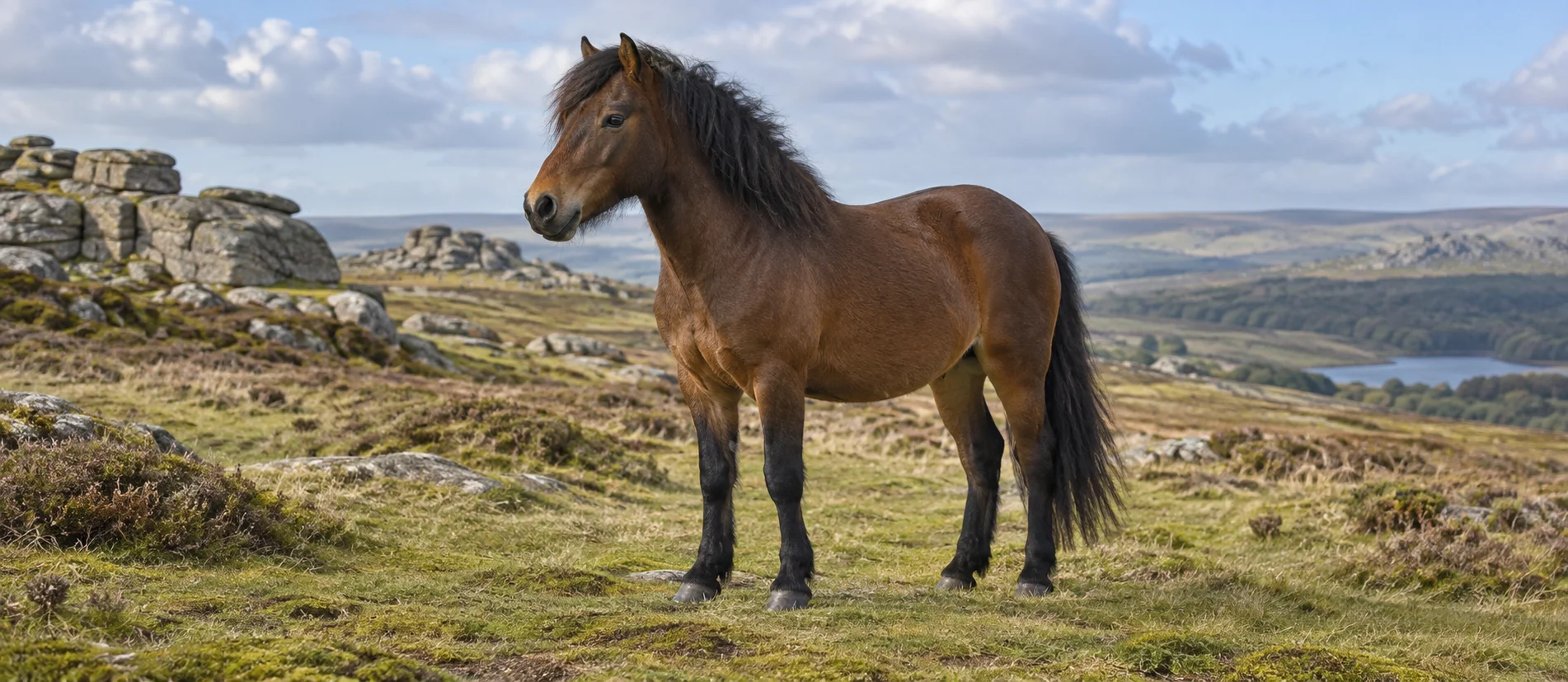
What makes a pony fit for one of the wettest, windiest and most exposed places in southern England?
Ask anyone who has stood on Dartmoor in November and they will tell you it is not size or polish. It is sense. It is a thick coat, a steady eye, a body that wastes nothing and feet that know where the bog is. That is the Dartmoor pony, and its history is really the history of a place teaching an animal what it needs to survive.
We are Stirrup & Oak, and we make horse artwork in a digital engraving style. It is our own artwork, made for us, not an antique or a hand-engraved original, and we like to be clear about that. When we set out to tell a breed's story, we hold ourselves to the same standard: say what can be supported, and say plainly where the records run thin.
A pony of the moor, long before anyone wrote it down
Dartmoor is a high granite upland in Devon, in the south-west of England. It is open, boggy and often wet through, with little shelter and poor grazing for much of the year. Ponies have lived on it for a very long time. Exactly how long is harder to say than you might expect, and this is where a lot of breed writing gets carried away.
You will often read that the Dartmoor pony is the direct descendant of prehistoric wild horses, or that its blood has run unchanged for thousands of years. We would not put that in writing as fact. What can be said is that ponies have been grazing the moor for centuries, that the earliest written mention commonly cited by breed writers is an eleventh century Saxon will, and that the ponies were valued enough by then to be worth leaving to someone. Beyond that, the story is one of local people, local land and local horses, with outside blood arriving from time to time.
That last point matters. The Dartmoor as we know it today is a recognised breed, but the moorland population has never been sealed off from the world. Over the centuries, other stock was turned out on the moor, and some of it left its mark. Anyone who tells you the breed is untouched by history is telling a tidier story than the true one.
The work it was bred for
Dartmoor's working past is not the field or the racetrack. It is the moor itself, and the people who made a living on it.
The moor has a long history of tin working, and ponies were a natural fit for the job of moving loads across ground that no cart could cross. A small, sure-footed animal with a strong back and good sense could carry what was needed over rough, wet country. Farmers and commoners, meaning people who held rights to graze animals on the moor, also kept ponies as part of a mixed working life, using them for hauling, for shepherding and for getting about a landscape where roads were poor and weather was worse.
That kind of work shapes a body. A pony that had to be sound, willing and economical on thin grazing did not need to be tall or showy. It needed:
- a compact, strong frame that carries weight without wasting feed;
- a deep body and a thick winter coat that shrugs off rain;
- hard feet and good limbs for rock, bog and slope;
- a calm, sensible temperament, because a bolting pony on a moor is a danger to everyone.
Those are still the qualities people praise in the breed. The modern description of a Dartmoor talks about a small, neat head, small alert ears, a good sloping shoulder and free, low movement. Height is capped in the breed standard at a little over twelve hands. The colours accepted are bay, brown, black, grey and chestnut, and the standard excludes piebald and skewbald. If you have ever wondered why a Dartmoor looks so plain and so right, that is a large part of the answer. The moor did not reward decoration.
Temperament deserves its own mention. Breed societies and owners describe the Dartmoor as intelligent, kind and level-headed, and it is often recommended as a first pony for a child. We would gently add that any pony is an individual, and a well-mannered breed is not a guarantee of a well-mannered animal. But there is a plausible line between a working life that punished nerves and a breed that is known for keeping its head.
Records, societies and a breed on paper
For much of its history the Dartmoor was simply what lived on Dartmoor. Turning that into a named, recorded breed was a job for the late nineteenth and early twentieth centuries, when native pony breeds across Britain were being described, judged and entered into stud books.
The Polo Pony Society, which later became the National Pony Society, opened a stud book at the end of the nineteenth century that took in several native types, and Dartmoor ponies were among those recorded. In 1925 the Dartmoor Pony Society was formed to look after the breed on its own terms. That gave the breed something it had not properly had before: a written standard, a register, a body that could say what a Dartmoor was and what it was not.
We have not been given a verified list of individual named stallions and mares to write about here, so we will not pretend to one. Stud books and breed histories do name influential animals, and if you are researching pedigrees, the breed society and its registers are the place to look. What we can say is that recording changed the way people bred. Once a standard existed, breeders could aim at it, and the moorland ponies and the studs that kept registered stock began to be talked about as two related strands of one breed.
The breed also had an important life beyond the moor. Dartmoor blood has been used in the making of riding ponies, and the breed's neat build and good manners made it a natural choice for children. It is the sort of pony that turns up in a childhood story: the first one, the kind one, the one that did not mind a wet afternoon.
The hard years, and how near it came to being lost
Mechanisation reduced the need for working ponies across Britain, and the moorland breeds felt it as much as any. Ponies that had once been useful were, in many places, simply less needed.
The Second World War was harder still. Breed societies and moorland accounts describe the free-living ponies of Dartmoor falling to very low numbers in and after the war years. Neglect, hard winters, shortages and the disruption of ordinary farming all played a part, and the moor was also used for military training. You will find stories that put a very precise figure on the low point, and you will find stories about ponies being deliberately shot at. Accounts differ, and we would rather tell you that the numbers fell sharply and leave the exact count to the breed society and its records than repeat a figure we cannot back.
What is clear is that the breed was rescued by people, not by luck. Breeders kept registered stock going. Commoners kept turning ponies out. Over the following decades, the breed's position steadied. The ponies that graze the moor today are managed under the commoning system, with owners, rounding up of herds at set times of year and rules about who may turn out what. In the twenty-first century, the Dartmoor Pony Heritage Trust was set up to look after the welfare and future of the moorland ponies. It is a reminder that the breed's survival is an ongoing job and not a finished one.
One thing worth clearing up: there is a difference between the Dartmoor pony, which is a registered breed with a standard, and the Dartmoor hill pony, a term used for the wider moorland population, which includes many ponies that are not eligible for the breed register. They share a place and a history, but they are not always the same animal on paper. If you meet a pony on the moor, you cannot know from looking whether it is registered.
What it means today, in the UK and the US
In the UK, the Dartmoor is still a working pony in every sense that matters. It is ridden, driven, shown and loved. It is also a landscape animal: the ponies grazing on the open moor are part of how the moor looks, part of how it is grazed and part of the way people feel about the place. Visitors are asked, sensibly and repeatedly, not to feed them, because a pony that learns to beg near a road is a pony in danger.
In the US, the breed is far less common. Dartmoors have been imported over the years and there are American breeders and enthusiasts who keep the breed going, but it is a rare pony there, and we would not want to guess at numbers. If you are in the US and thinking of buying a Dartmoor, the sensible thing is to speak to a breed society and to look carefully at pedigrees and registration, because a small population means every breeding decision counts.
The common thread across both countries is that a small breed lives or dies on the attention of people who care. The Dartmoor was shaped by a place, kept alive by a few determined breeders and commoners, and is now looked after by societies, trusts and owners who understand how easily it could have gone the other way.
That is why we like drawing it. A Dartmoor is not a dramatic subject. It has no flowing show mane to make a fuss over. It is a small, practical, weatherproof animal that turned a hard landscape into a home, and the line of its neck and the set of its ears say most of what needs saying. Our plate of the breed is digital artwork in an engraving style, made by us, and it is offered as a tribute to a pony that earned every bit of its reputation the hard way.
If the Dartmoor is a favourite of yours, or you simply admire a horse that has never pretended to be anything else, you are in good company. It is a breed that rewards the people who look closely.
See it in the collection: The Dartmoor collection