Breed Histories · 26 September 2026
The History of the Dales Pony
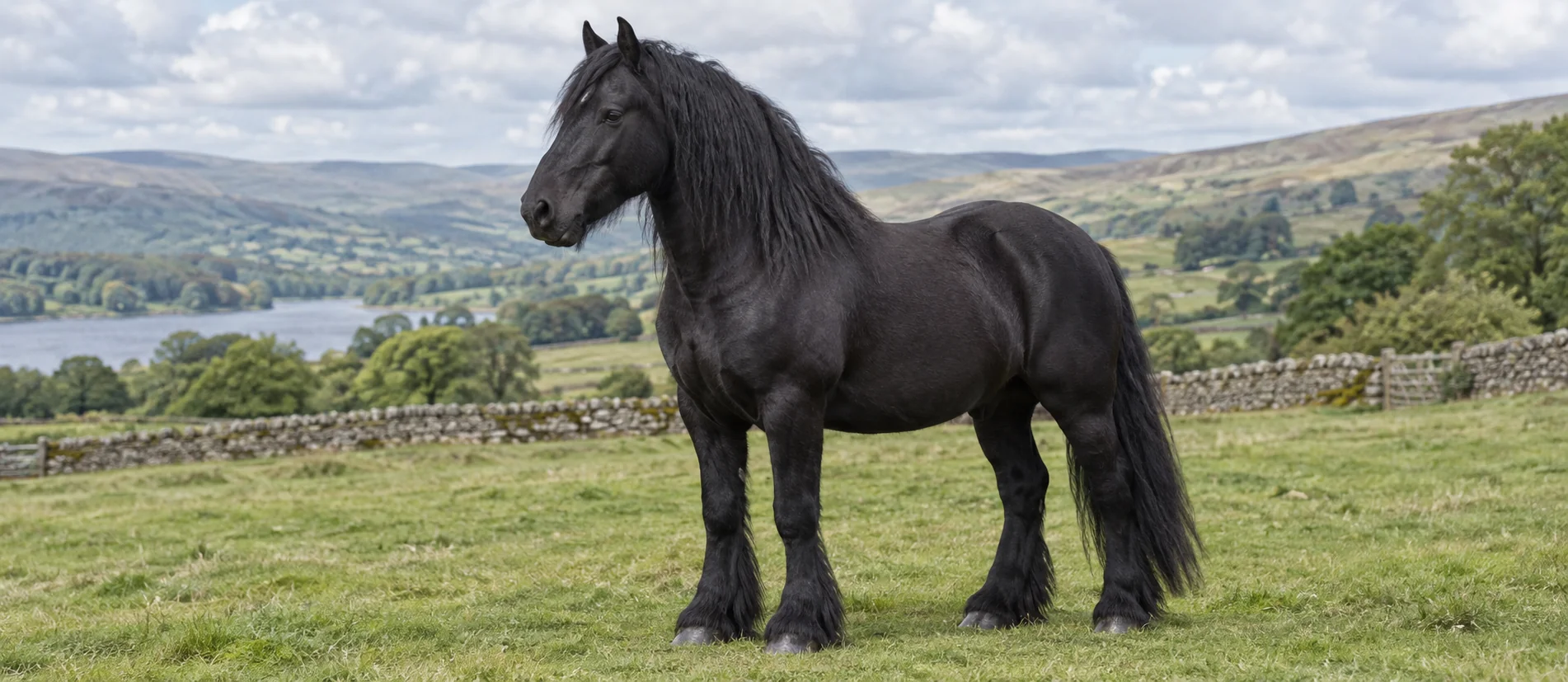
Why does a pony from the north of England look the way it does? Once you know what it was asked to do, the answer is written all over it. The broad chest, the short strong back, the feathered heels and the sensible head all began as answers to a job. When we drew our Dales Pony plate, we kept thinking about the work, not just the outline.
We should say one thing plainly before we begin. Our plates are digital artwork in an engraving style. They are not antique prints and they are not hand engraved. What follows is history, and we have tried to keep to what breed societies, stud books and published breed histories support. Where a tale is told a hundred times but nobody can properly source it, we either leave it out or tell you it is a tale.
Where the Dales Pony came from
The Dales Pony belongs to the eastern side of the Pennines, the long spine of hills running down northern England. Its home is the upper dales of the rivers that drain that side of the hills, in what is now North Yorkshire, County Durham and Northumberland. Its close cousin the Fell Pony belongs to the western side, in Cumbria. The two are related and often confused, but they grew up on different sides of the same hills, and the breed societies keep them apart.
The ancestors of the Dales are usually traced to the native hill ponies of the north, mixed over the centuries with other stock. The old Galloway, a tough riding and pack pony from the Scottish borders that no longer exists as a breed, is often named as an influence. So are the trotting horses that were popular in the north. In the nineteenth century, Clydesdale blood was brought in, and it added weight and bone to the Dales type. This is one reason the breed is stouter than many other British hill ponies.
Nobody drew up a plan. The Dales Pony was not designed at a desk. It was shaped by farmers and miners who needed animals that would earn their keep on poor grazing, in a hard climate, and who kept back the ones that did the job best.
The work that shaped it
The heart of the story is lead. The northern Pennines were one of the great lead mining districts of Britain. The ore had to be carried from remote mines to smelting mills and on to the ports and the wider market, over steep, boggy and often trackless ground. Roads for wheeled carts were poor or non existent in many places, so the job went to pack ponies, walking in strings with loads slung either side of them.
Think about what that job demands. A pony has to carry a heavy weight over long distances and over rough ground. It needs to be sure footed, because a stumble with a load can be a disaster. It must be able to live on hill forage. It needs strong, hard feet, and it needs to stay calm when it is tied into a line of other ponies in bad weather. Those are exactly the qualities the breed is still praised for. The compact, powerful body, the good hard hooves and the steady manner were not decoration. They were the reasons a pony got to breed on.
The Dales did other work too. On the hill farms the same pony could be ridden to check sheep, put in harness for a cart, or used to draw a light plough or a harrow. Ponies of this type were also used to carry coal and other goods. A dales farmer could not afford a different animal for every task, so the pony that would turn its hoof to anything was the one worth keeping. Its thick mane and tail, dense coat and good feathering at the heels all helped it cope with wet and cold.
The breed also became known as a fast trotter. The northern love of trotting horses is well recorded, and a Dales that could cover the ground briskly, in harness or under a rider, was valued for it. That may sound at odds with a pony that carried heavy loads, but it fits. A strong hindquarter that can push a load uphill also gives good, driving action on the flat.
Temperament came from the same place. A pony that shared the farm with people, worked alongside them daily and had to be handled by anyone from a shepherd to a child could not afford to be flighty. Dales owners today still describe the breed as sensible, willing and bold, and it is easy to see where that reputation came from. Generations of unreliable ponies simply did not stay in the breeding pool.
Wars, machines and the near loss
Two changes in the story explain the fall in numbers. The first was the end of the lead trade. Cheaper imported lead made many Pennine mines uneconomic in the later nineteenth century, and the great strings of pack ponies faded with them. The second was mechanisation, which slowly took over the work on farms and roads. Railways, then lorries and tractors, took over the tasks that ponies had done for centuries.
Enthusiasts did not want to see the type lost. In 1916, in the middle of the First World War, the Dales Pony Improvement Society was formed, and a stud book was begun to record the breed's ancestry. That date matters. A stud book turns a local type into a breed, because it fixes who is a Dales and who is not, and it lets breeders plan. It gave the pony a place on paper as well as in the dales.
War then pulled the other way. Dales ponies were wanted by the army, which used strong, sound ponies for pack and gun work. Sturdy ponies were taken from the dales in both world wars. That kind of demand is hard on a breed with a small population, because it draws off the best animals at exactly the point when farms are also mechanising and fewer are needed at home.
By the middle of the twentieth century the breed was in real danger. Breed histories describe very low numbers in the 1950s and after, with the pony a rarity on the dales that had made it. In the decades that followed, breeders and the society worked to bring numbers back, and the breed has been watched by conservation bodies since. The Rare Breeds Survival Trust has listed the Dales on its watchlist, so it is a breed that still needs people to keep breeding it.
We have not repeated the round number stories that circulate about the very lowest point, because they vary from source to source. What is safe to say is this: the breed came very close to being lost, and it survived because a small number of committed people kept breeding the right animals.
The Dales Pony today, in the UK and the US
The modern Dales is a strong, upstanding native pony, standing at no more than 14.2 hands, which is a little under 1.5 metres at the withers. The usual colours are black, brown, bay and grey, and occasionally roan, with only limited white markings. The breed society sets the standard, and the type today is recognisably the same working pony, with its short back, powerful quarters and good bone.
Its jobs have changed. The Dales is now ridden and driven for pleasure, used for trekking and riding for the disabled, and shown in the ring. It has proved suitable for driving competitions, and the old capacity to carry weight makes it a good ride for adults as well as children. Many owners will tell you it is one of the more comfortable breeds to spend a long day with, and that is the sort of claim you can only judge by owning one. What the history does tell us is that this is a pony bred for sense and stamina, not for showing off.
Outside Britain the breed is much smaller in number. There is a registry for the Dales in North America, and a small population of ponies there, many of them descended from imports. For American owners and admirers, the Dales is a rare and interesting alternative to the more familiar native breeds. Because numbers are small everywhere, each pony bred still matters to the breed's future.
That is the part of the story we find most affecting. The Dales Pony did not become rare because it failed. It became rare because the world stopped needing the exact work it did, and it has survived because people decided it was worth keeping anyway. A pony built to carry lead over a moor is now kept for its character and its history, and we think that is a fair reward for a breed that gave so much.
If you love the Dales as we do, we hope this gives you a little more to look at next time you see one on a hillside, in a show ring or on a page.
See it in the collection: The Dales Pony collection