Breed Histories · 26 September 2026
The History of the Connemara Pony
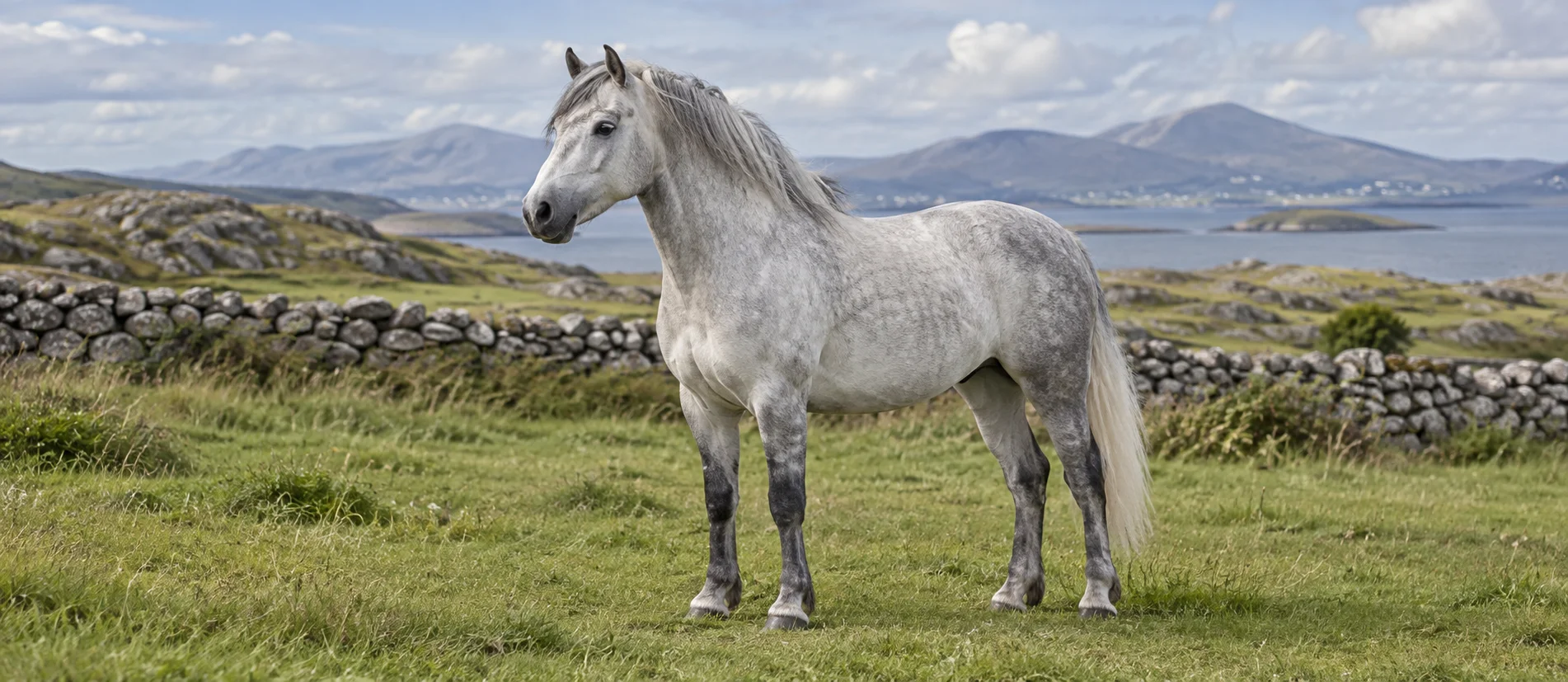
Have you ever watched a Connemara pony pick its way across wet, broken ground and wondered where that calm, careful confidence comes from? We have, more than once. It is not an accident of breeding fashion. It comes from the country the breed was made in, and from the jobs it was asked to do there.
This is our account of the Connemara's history, written the way we write all of these: we have kept to what the breed society, the stud book records, the Olympic record and published breed histories can support, and we have named the stories that cannot be supported as stories. Where a point is a matter of debate, we say so.
A pony made by the west of Ireland
Connemara is the wild, rocky, boggy stretch of County Galway on Ireland's Atlantic coast. Thin soil, small fields divided by stone walls, heavy rain and a great deal of open bog. Nobody farming there could afford an animal that needed pampering. A horse had to live on poor grazing, stay sound on rough ground and turn its hand to whatever the household needed that week.
That is the working life the Connemara was shaped by. The ponies carried loads in baskets slung either side of the saddle, including seaweed from the shore for the land and turf cut from the bog for the fire. They pulled small carts, worked light land and were ridden to market and to church. Ask most breed histories what the Connemara was bred for and you get the same plain answer: everything, and cheaply. In our view that is exactly why the breed has such a level head. A pony that panicked on a cliff path did not stay in the breeding pool for long.
Where the ponies came from in the first place is less certain, and it is worth being straight about that. The commonly told version is that the west of Ireland's native ponies descend from the small, hardy horses of the early Celtic peoples. That is a reasonable account, and it is the one the breed's own histories give, but there is no tidy documentary trail back that far. You will also hear that Spanish horses swam ashore from wrecked Armada ships and founded the breed. That is a story, and a well loved one, but we have found nothing solid to support it, so we leave it as a myth. What is documented is that, over the nineteenth century, outside stallions were brought to the region, among them Arab, Thoroughbred, Welsh cob and Hackney blood, in the hope of improving the local stock. The results were mixed. Some crosses added quality and some added faults, and by the early twentieth century breeders were arguing about which of these influences had helped and which had not.
The society, the show and the stud book
The turning point came in the 1920s, when the people who kept these ponies decided the type was worth protecting and defining. The Connemara Pony Breeders' Society was formed in 1923. The following year, in 1924, the first Connemara Pony Show was held at Clifden, the small town on the Galway coast that has hosted the show ever since, and which the society's own history gives as the breed's home event.
Those two dates matter more than they might look. Before them, a Connemara was largely whatever a local family said it was. After them, there was a body to agree what the breed should look like, inspectors to look at stallions and a show where breeders could put their ponies side by side and be judged against one another. A stud book followed, so that pedigrees could be written down and checked rather than remembered. If you want a single moment when a regional working pony became a recognised breed, it is this run of years in the 1920s.
The type the society set out to protect is one people still recognise. A compact, strong pony, up to around 148 centimetres, with a deep body, good bone, a kind eye and a free, ground covering stride. Grey is the colour most people picture, but the breed also comes in dun, bay, black and brown. Ask any owner what they value most and they will rarely say looks. They will say sense. The ponies think for themselves, they look after their riders, and they do not need to be asked twice to cope with something awkward.
Lean years and the pull of the wider world
None of this made the breed safe. The same forces that changed farming across Britain and Ireland in the twentieth century reached Connemara too. As tractors and better roads arrived, the everyday need for a small all round working pony fell away. A breed that had been kept because it earned its keep on the land now had to find a new reason to be kept.
What saved it was that the qualities bred in by hard work turned out to suit a different kind of life. A pony that is sound, sensible, athletic and economical to keep is exactly what riders want for children's ponies, for hunting, for eventing, for jumping and for general riding. The society and its breeders kept the stud book going and the type consistent, and the ponies moved from the bog to the show ring and the arena. Connemara ponies today are found across Ireland and Britain and well beyond, and the breed is bred and ridden in many countries.
We should add that pure Connemara breeding and Connemara crosses are not the same thing, and the difference matters when you read the sporting record. Crossing a Connemara with a Thoroughbred has long been a popular way to add speed and scope, and a good many of the best known sporting successes have come from those crosses. It is a compliment to the breed that people so often want a Connemara on one side of the pedigree.
Stroller, and the breed in the United States
The most famous name in the breed's sporting story is a pony called Stroller. At the 1968 Olympic Games in Mexico City, Marion Coakes rode Stroller, a Connemara cross pony, to the individual show jumping silver medal. It was silver, not gold, and not bronze, and the Olympic record has it plainly. What made it remarkable was the size of the partnership. Stroller was a small pony jumping courses built for full size horses, and he was not overawed by any of it. We think most people who love ponies remember that result, and it did a great deal to make people outside Ireland look twice at the Connemara.
The breed had also crossed the Atlantic. The American Connemara Pony Society was founded in 1956, and it has kept its own registry and promoted the breed there ever since. As in Britain, the American story is largely one of sport and family riding: a pony that can do a little of everything, jump a good course and still be trusted with a child. The pattern is much the same wherever the breed has settled. It is a pony people keep because it is willing, honest and easy to live with, and that is a fair description of the ponies that once carried seaweed and turf on the Galway coast.
If we had to sum up what the breed's history means today, it would be this. The Connemara is a working animal that stopped having to do one particular job and did not lose what that job gave it. Every quality riders praise, the sense, the stamina, the sure feet and the willingness, was formed by hard country and hard use long before anyone wrote a stud book.
For sources, we have leaned on the Connemara Pony Breeders' Society's own account of its founding and its Clifden show, the American Connemara Pony Society's account of its 1956 founding, and the Olympic record for the 1968 individual show jumping result. If you spot anything you can support with a better source, we would like to hear it.
Our Connemara plate is digital artwork in an engraving style, drawn by us in tribute to this breed. It is not an antique or a hand engraved original, and we would never pass it off as one. It is simply our way of putting a pony we admire on a shirt, a sweatshirt or a print.
See it in the collection: The Connemara collection