Breed Histories · 26 September 2026
The History of the Clydesdale
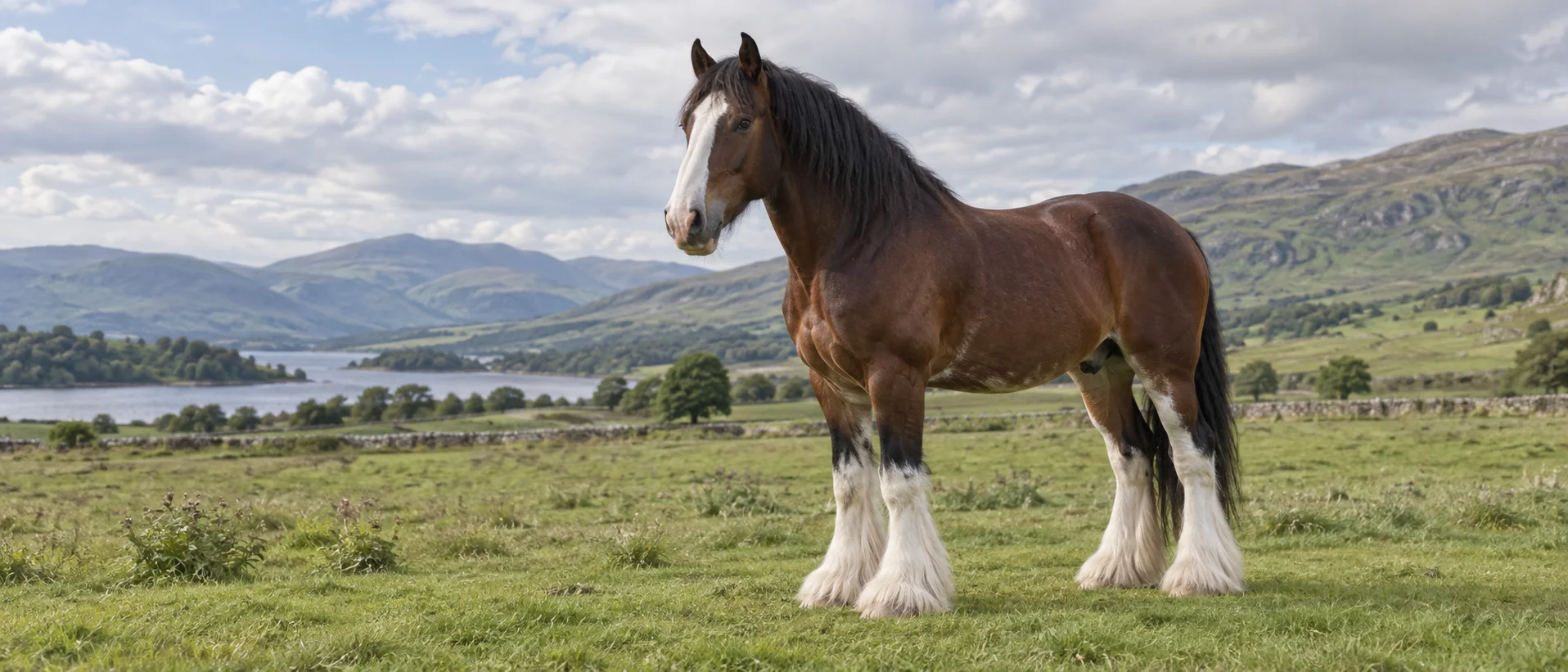
Ask most people to picture a heavy horse and you will get a Clydesdale. Tall, bay or brown, four white socks and a blaze, feathering swinging around the hooves as the legs lift high. It is an image that has sold a great deal over the years, and it started somewhere far less glamorous: with a farmer in Lanarkshire who needed a horse that could pull a load and keep walking.
We are Stirrup & Oak, and we draw horses for a living. When we sat down to write about the Clydesdale we wanted to keep to what the breed society and the published breed histories can support. Where a well-loved story is hard to pin down, we say so.
A horse named for a valley
The name is the first clue. Clydesdale is an old name for the area around the River Clyde, in what is now Lanarkshire, in the south of Scotland. The breed takes its name from that district and grew up there, on farms that needed strong horses for ploughing, hauling and carting.
The usual account of how it began goes back to the eighteenth century. Local mares, sturdy but fairly modest, were put to imported Flemish stallions, and the cross gave larger, more powerful horses. Breed histories often credit landowners in the area, the Dukes of Hamilton among them, with bringing those stallions in. It is a tidy story, and the broad outline is well accepted. What is harder to say is exactly which horse, on which farm, in which year. Early records were mostly memory and reputation, so be wary of anyone who gives you a precise date and a single founding sire with complete confidence.
What we can say is that by the early nineteenth century Lanarkshire had a recognisable type of horse, and that people beyond the county were starting to want it.
Bred for the road as much as the field
It helps to understand the job. A Clydesdale was not just a plough horse. Scotland was building roads, mines, railways and docks, and all of it needed goods moved. Around Glasgow especially, the horse that could haul a heavy load through city streets, and do it at a decent pace, was worth a great deal.
That work left its mark on the build. Clydesdales are known for a clean, active stride, with the legs lifted and set down cleanly rather than shuffled. A horse that spent its days on hard road surfaces needed sound feet and good straight limbs, and breeders paid attention to both. The long, silky feathering on the lower legs and the flashy white markings became part of the breed's look, and they are the details people remember. But the working point was the movement and the soundness underneath.
Temperament came with the job as well. A horse working in a busy town, among carts and crowds and noise, could not afford to be flighty. The Clydesdale has a long reputation for being willing and level-headed, and it is easy to see how a breed shaped by that kind of daily work would end up that way. That is a fair reading of the history rather than a guarantee about any individual horse, of course. Every horse is different, and anyone who has worked with a stubborn one will tell you so.
Stud books, societies and famous names
The turning point for the Clydesdale as a proper breed came in the 1870s. The Clydesdale Horse Society was founded in 1877 and the first volume of its stud book followed in 1878. Recording pedigrees meant a stallion's offspring could be traced, a buyer could see what he was paying for, and breeders could plan matings on evidence instead of local talk. Across the Atlantic, the American Clydesdale Association was founded in 1879, so the breed was being organised in North America almost as soon as it was in Scotland.
Two stallions come up again and again in breed histories of this period: Prince of Wales and Darnley. Both are described as hugely influential in the make-up of the modern Clydesdale, and their names turn up in the pedigrees behind a great many later horses. Another name you will meet is Baron's Pride, a stallion foaled in 1890 who became a sire of real importance and whose descendants shaped the breed in the early twentieth century. Once you start reading old pedigrees, these names keep returning, which tells you how far a handful of stallions could reach in a stud book.
There was money in it too. Clydesdales were exported in large numbers to Canada, Australia, New Zealand and the United States, wherever new farmland was being opened up and needed strong horses to work it. Scotland had, in effect, developed one of its most successful agricultural exports, and it walked on four legs.
War, engines and a close call
Then the work changed. Horses were called up in large numbers for the First World War, and many did not return. At the same time the tractor was arriving on farms and the motor lorry on the roads. Between the wars, and then again after the Second World War, demand for working heavy horses fell away sharply. It was not a sudden crash but a steady loss, farm by farm, as engines took over jobs that horses had done for centuries.
The Clydesdale came through it, but not comfortably. In the UK the breed fell to numbers low enough that it was placed on the Rare Breeds Survival Trust's watchlist, and it has spent time in the category for breeds that need watching. That is a striking thing for a horse that was once so common in the streets of Glasgow. If you want a reminder of how quickly a breed's fortunes can change once its work disappears, this is one.
What kept it going was a mixture of enthusiasts, breeders who refused to let the bloodlines lapse, and a public that simply liked seeing these horses in the ring and on the road. Ploughing matches, county shows and heavy horse events gave people a reason to keep them.
The Clydesdale today, in the UK and the US
Today the Clydesdale is a horse of shows, parades, driving and, in some places, still a little real work. In the UK you will find them at county shows and heavy horse events, and the breed society continues to keep the stud book and support breeders. The Household Cavalry's drum horses are a familiar sight at state occasions, and while they are often described as a mix of heavy breeds, the Clydesdale's presence and build is part of why that job suits them.
In the United States the picture is different in one very visible way. Since 1933, the Budweiser Clydesdales have been one of the most recognised teams in advertising. The story goes that August Busch Jr. presented a hitch of Clydesdales to his father to celebrate the end of Prohibition, and the team has been a fixture ever since. Whatever you think of the beer, it has kept the shape of the breed in front of millions of people who might never otherwise have seen a heavy horse up close. Alongside the famous hitch, there are private breeders and owners on both sides of the Atlantic who keep the breed going quietly, for showing, driving and the pleasure of it.
There is a lesson in the Clydesdale's story for anyone who loves horses. A breed is a set of choices made over generations: which mare, which stallion, which qualities to keep. The Clydesdale was shaped by Lanarkshire farms, city roads and the ambition of a few careful breeders, then pushed to the edge by a world that no longer needed its labour, and pulled back by people who cared. That is why we find it such a good subject to draw. The powerful shoulder, the lifted foot, the feathering and the calm eye all mean something. They are the record of what the horse was for.
Our Clydesdale plate is digital engraving-style artwork. We are not claiming it is antique or hand engraved, only that we borrowed the discipline of the engraver's line to give this horse the attention its history deserves. If the Clydesdale is your breed, or the one you keep meaning to learn about, we hope this has been a useful place to start.
See it in the collection: The Clydesdale collection