Breed Histories · 26 September 2026
The History of the Cleveland Bay Horse
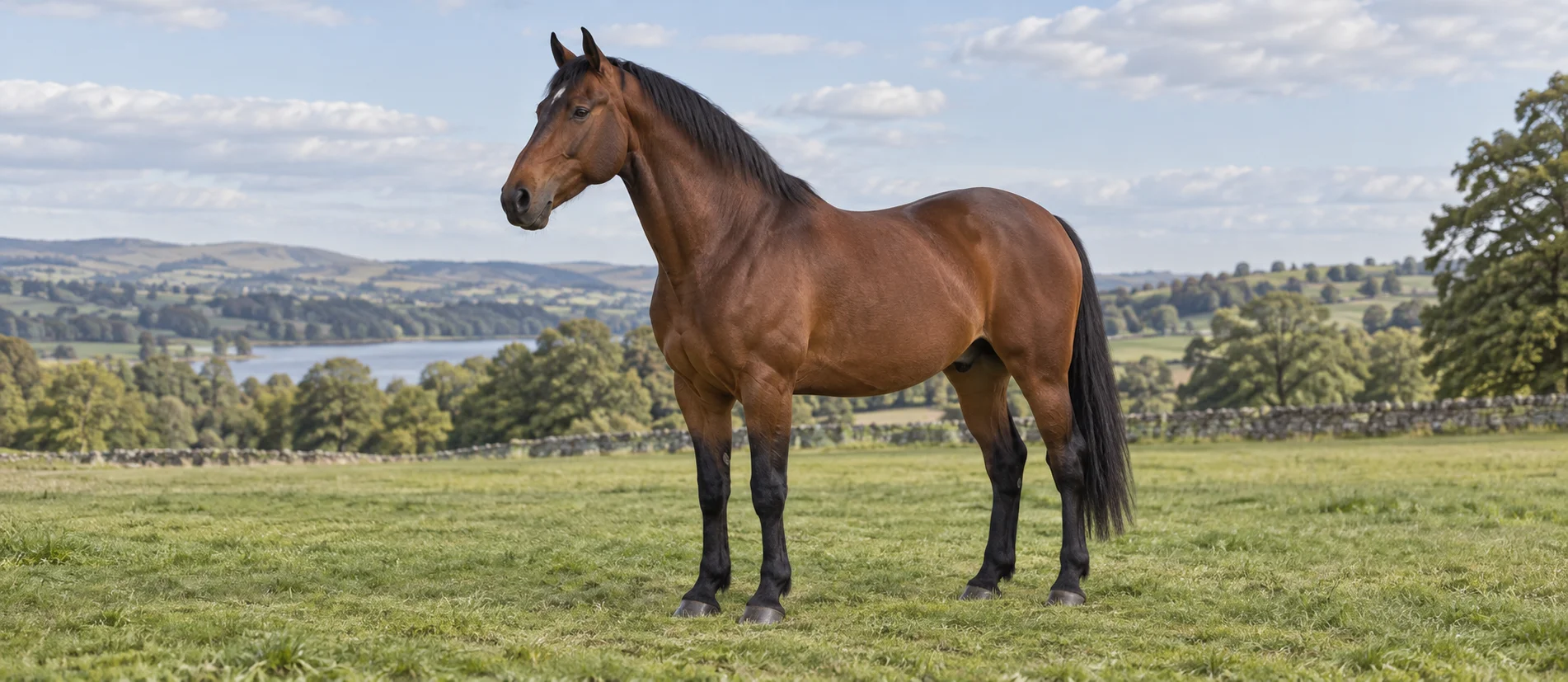
Ever noticed that a Cleveland Bay never looks in a hurry? Deep bodied, clean legged, bay all over with black points, it stands like a horse that has already done the day's work and is wondering what you are going to suggest next. That calm has a history behind it, and it is worth telling properly.
We are Stirrup & Oak, and we draw horses. Before we draw a breed, we read up on where it came from. What follows is what we found, kept to what the breed society and the published breed histories support. Where the record is thin, or a story is more legend than evidence, we say so.
Where it came from: the Vale of Cleveland
The Cleveland Bay takes its name from the Cleveland district of North Yorkshire, an area of farmland, moor and coast. Breed histories generally describe it as the oldest established English breed of horse, and that claim rests on the long, continuous breeding of one recognisable type in one part of the country.
The usual account of its ancestry begins with the so-called Chapman horse. A chapman was a travelling trader, and in the medieval period, before good roads, goods moved on the backs of pack animals. A horse for that job needed strength, sound legs, a steady head and enough stamina to keep going over rough ground. The breed's early ancestors are said to have been just such horses, and monastic estates in the north of England are often credited with breeding them. We would treat the finer details of that story with care. It is a well-repeated origin, but not one we can pin to a single document, so we offer it as the accepted account rather than a proven chain.
What is better supported is the next step. Breed histories describe how, in the seventeenth century, eastern blood was brought in through Barb and Arab stallions, which lightened the old packhorse type and gave it more quality and more freedom of movement. The result was a horse that could still pull and carry, but could also trot on. Roads were improving, and a horse that could do both was suddenly very useful.
The work that made the build
Ask what the Cleveland Bay was bred for and the honest answer is: nearly everything a farm and a road could want. On the land it ploughed, hauled and worked as a general farm horse. On the road it was a coach and carriage horse. Under saddle, crossed with the Thoroughbred, it produced hunters and other riding horses. It was not a specialist. It was the horse that could turn its hand to whatever the week required.
You can read that history in the animal itself.
- Bay only. The breed standard asks for a bay body with black legs, mane and tail. White markings are not wanted, with at most a small star allowed in the standard as the society describes it.
- Height and frame. A tall, deep horse, typically around 16 to 16.2 hands, with a good depth of body and short, strong, flat-boned legs, made to pull without wearing itself out.
- Temperament. Sensible and willing. A farm horse that panicked would have been dangerous, and a carriage horse that shied at every gate would not have kept its place. Generations of selection for work you could trust left a horse that tends to be level headed.
It is a good example of function shaping form. Nobody set out to make a handsome horse for its own sake. They set out to make a useful one, and the handsomeness followed. When we draw a Cleveland Bay we find that the lines do half the work already: the long back of a carriage horse, the strong quarters, the calm eye.
Turning points: the stud book and the carriage trade
By the nineteenth century the Cleveland Bay was well established as the carriage horse of choice in much of the country, and a breed that valuable needed protecting. The Cleveland Bay Horse Society was founded in 1884, and its stud book followed, recording the breeding of the horses so that the type could be kept true. A stud book is a dull-sounding thing that turns out to be the whole reason a breed survives. Without written pedigrees, a breed is just a fashion.
The breed also spread beyond Yorkshire in this period. Cleveland Bays were exported, including to North America, where an American society for the breed was formed in the 1880s. Breeders elsewhere valued the same things Yorkshire farmers did: a strong, sound, sensible horse that could do more than one job. Some of the breed's influence also went into crossbreeding programmes, where Cleveland Bay blood was used to add substance and soundness to other horses. Related to this, a Yorkshire Coach Horse was developed from Cleveland Bay and Thoroughbred crosses and had its own stud book, but it did not last as a separate breed, while the Cleveland Bay itself carried on.
The Cleveland Bay also came to be associated with the royal household. Cleveland Bays have been kept at the Royal Mews to draw carriages on state and ceremonial occasions, a link that has helped keep the breed in public view. Like any tradition of that kind, it is worth checking the current position with the Royal Household rather than assuming it, but the association is long established and often cited by the breed society.
Near loss, and what it means now
Then the work went away. The twentieth century brought the motor car, the tractor and the end of the carriage trade, and a breed built for exactly those jobs found there was suddenly very little for it to do. Numbers fell, and they fell hard. The commonly repeated figure is that by the early 1960s only a handful of purebred breeding stallions were left in Britain, with the often-quoted number being four. We would call that the widely reported figure rather than a count we have checked ourselves, but nobody disputes that the breed came very close to disappearing.
The story often told from that period is that a stallion was bought for the Crown in order to keep him in the country when an export sale threatened to take another of the few remaining sires abroad. The horse usually named is Mulgrave Supreme. Accounts differ a little on the detail, so we will only say that it is a well-known part of the breed's rescue, and that it is a good illustration of how thin the margin was. One export more and the story might have ended differently.
The breed did not vanish. It was kept going by a small number of committed breeders and the breed society, and it has since been recognised by conservation bodies as a rare breed. In the UK it appears on the Rare Breeds Survival Trust's watchlist, and in the US the Livestock Conservancy also lists it as a heritage breed at risk. Both listings change from year to year, so if you want the current category, ask them directly rather than trusting a blog post, including this one.
What has kept the Cleveland Bay useful is that the qualities it was bred for turn out to be exactly the ones modern riders and drivers still want. It is a breed that does carriage driving well, which is where the old work lives on. It also makes a strong, sound riding horse, and crossed with the Thoroughbred it has been used to produce sport horses, adding bone and sense to speed. The old farm and road horse has become, in a quiet way, a breed for people who like a horse with a level head and a long history.
There is also a lesson in it that we find hard to shake. A breed does not need to be fashionable to matter. The Cleveland Bay survived because a few people cared about a type of horse for its own sake, kept the records, and refused to let the line end. Every native breed has a version of that story, and this one is a very close-run example.
If you are lucky enough to see one, at a show, on a driving course or pulling a carriage, take a moment. You are looking at something that started on a Yorkshire packhorse track centuries ago and very nearly was not here to be looked at. Our plate of the Cleveland Bay is digital artwork in the engraving style, made by us, and not an antique or a hand-engraved original. It is our way of saying that a horse like this deserves to be looked at closely.
See it in the collection: The Cleveland Bay collection