
Breed Histories · 26 September 2026
The History of the Camargue Horse of the Rhône Delta
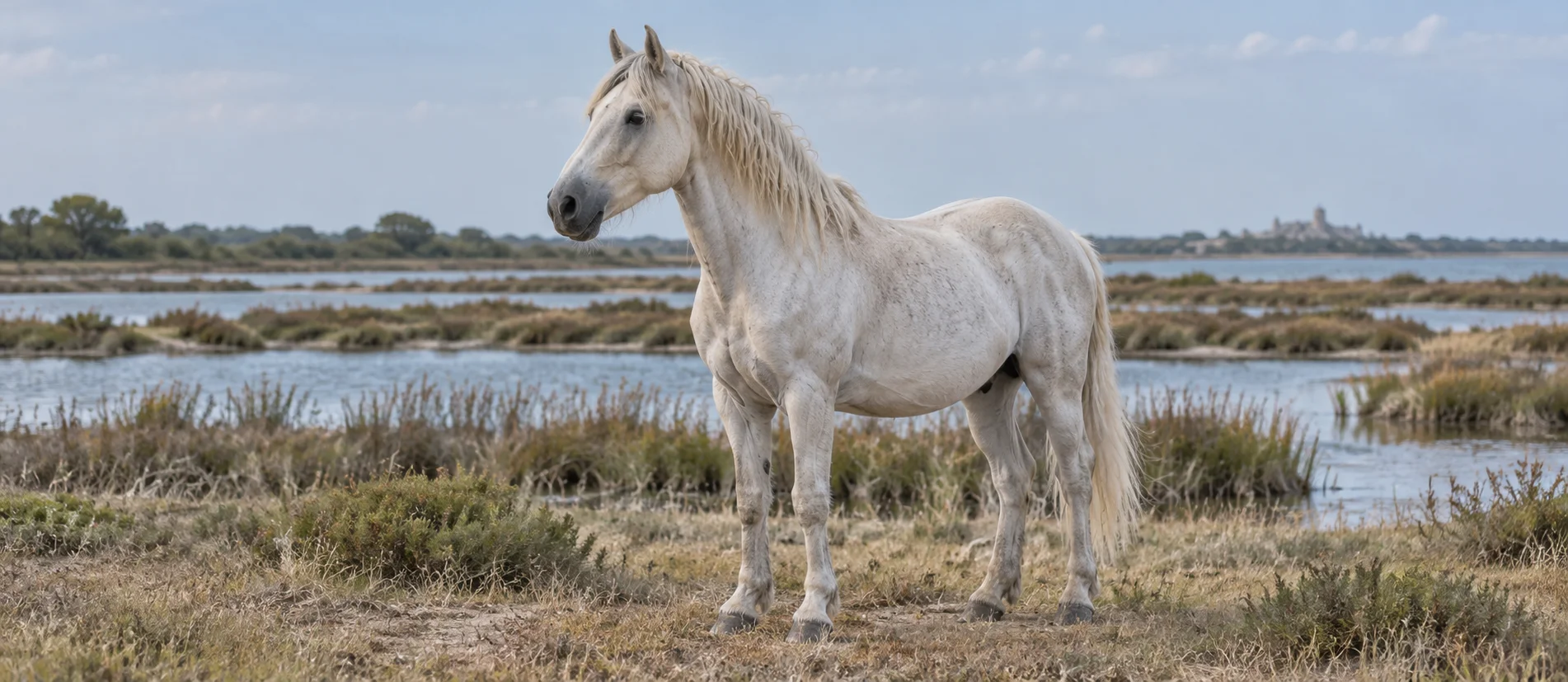
Have you ever seen a herd of pale horses splashing through shallow water, with a marsh bird lifting off behind them? If you have, there is a good chance it was the Camargue. It is one of those breeds that seems to belong to its landscape so completely that you cannot picture it anywhere else.
We draw horses at Stirrup & Oak, and we try to write about them the way we would talk about them over a gate: fondly, but without dressing things up. The Camargue is a breed where the romance is very loud and the paperwork is fairly quiet, so we have kept to what can be supported and named the rest as legend.
A horse of the delta
The Camargue is the wide, flat delta where the Rhône splits before it reaches the Mediterranean, in the south of France. It is a place of lagoons, salt flats, reed beds and rough grazing, hot and dry in summer and battered by the mistral wind, with water lying about for much of the year. Mosquitoes are a fact of life. It is not gentle country, and the horse that came out of it is not a gentle-country horse.
What we can say plainly is this. Small, hardy, grey horses have lived and worked in that delta for a very long time, kept in herds that spend most of the year outdoors on marsh and pasture. They are usually a little over 13 hands up to about 14.3 hands, so on the small side, with a broad head, a straight or slightly convex profile, a short strong back and dense, low-set manes and tails. The hooves are hard and the feet are wide, which suits soft, wet ground. That is a description of a working animal shaped by a place, and it is the best starting point for any history of the breed.
There is one more thing that surprises people who meet the breed for the first time. Camargue foals are born dark, usually a brown or black, and turn grey over several years, becoming the near-white we know somewhere around the age of four to six. The white horse of the postcards is a grown horse. The foal is a different colour altogether.
What is myth, and what is not
Almost every account of the Camargue starts with a very old origin. You will read that these horses are direct descendants of prehistoric horses, sometimes linked to the horse remains found at Solutré in eastern France. You will read that Roman writers described them, that Caesar was impressed by them, or that horses left behind by Saracen invaders in the early medieval period gave the breed its blood. It is a wonderful set of stories.
The trouble is that none of it can be pinned to a firm record that we are able to point to. A pale, sturdy horse living in a marsh for centuries tells you that it is old in type, and it tells you very little about a single line of descent. Breeds like this were shaped by the environment and by whoever kept them, and horses were moved around Mediterranean Europe for thousands of years. So we treat the direct prehistoric descent, and the tidy story of a specific Roman or Saracen origin, as myths. They may contain something true, but no one has shown us what. We would rather say "unproven" than pass it on as fact.
What is well supported is the work. For a long time the horses of the delta were used in the practical business of the region, including working with cattle, and in the traditional harvest work of Provence, where horses were driven over cut grain on a threshing floor to separate it. Ridden horses were the ordinary way to get around in a country of water and soft ground. That practical, everyday life is the real foundation of the breed.
The gardians and their bulls
The work that defines the Camargue horse is herding. The Camargue has its own small, dark, rangy breed of bull, and it is looked after in herds called manades by mounted herdsmen known as gardians. A gardian rides out, sorts stock, moves them between pastures and tends the herd, and does it from the saddle, carrying a long trident-tipped pole used to handle the cattle. That is the picture behind the phrase "cowboys of France", which is a fair shorthand as long as you do not take it too literally.
This is the work that shaped the horse we see. A gardian needs a mount that is calm around cattle, quick when it has to be, and steady in water and mud. He needs an animal that is tough enough to live outdoors, that can get by on rough grazing, and that will keep going through a long day in the heat. A horse that panics in the marsh, or that needs a rug and a bucket feed every evening, is no use on a manade. So generations of selection, deliberate and otherwise, favoured a compact, sure-footed, sensible horse with a good deal of stamina and a level head. Most people who ride them say the temperament is calm and willing but clever, and that the breed likes to think for itself. That fits a horse bred to work at some distance from a rider's instructions.
Alongside the working herds there is the culture that grew around them. Bull games, known as the course camarguaise, are a local tradition in which athletes try to take small tokens from a bull's horns, and the horses and gardians of the region are woven into the festivals and parades of the delta. The best-known name in that story is the Marquis Folco de Baroncelli, a landowner and bull breeder who was a champion of the gardians' way of life and helped organise their traditions in the early twentieth century. The gardians' own brotherhood was formed in 1904, and people often connect that movement with the way the Camargue horse and its riders became a symbol of the region. We would not go further than that in crediting one man, but his name comes up in almost every serious account.
Recognition and the modern breed
For most of its history, the Camargue horse was a type rather than a registered breed. The horses were known by the herds they came from and by what they did. The move toward formal recognition came in the twentieth century, when French breeders and the national authorities began to define the Camargue as a breed in its own right. A breed society was formed, and a stud book was set up in the 1970s, so that the horses could be registered and their breeding recorded. We are being careful with exact years here, because different sources give slightly different dates for the steps of recognition, and we would rather hedge than get one wrong. What matters is the direction: a working type became a documented breed, and that gave the horses a shape that could be protected.
That protection matters because the breed has a real relationship with its home. The delta was declared a regional natural park in 1970, and it is still a working landscape for the manades as well as an important wetland for birds. The horse is part of what keeps the pastures grazed in the traditional way. If you have ever seen photographs of pale horses standing in still water with flamingos behind them, you have seen the working landscape the breed was made for, and not a staged one.
Camargue horses have also had a life in front of the camera. The 1953 short film White Mane, by Albert Lamorisse, follows a wild white stallion in the marshes of the delta and won a prize at Cannes. It is a made-up story about a made-up horse, so we do not count it as history, but it did a great deal to fix the picture of the wild white horse of the Camargue in people's minds far beyond France. Some of the romance you feel about the breed probably starts there.
In practice today, the Camargue is still used for herding on the manades, and it is also ridden for pleasure, trekking and light work. Riders like its surefooted nature and its hardiness. It is a small horse, but many adults ride it comfortably, and it can be a good choice for a rider who wants a sensible companion with a bit of spirit. It is also seen in equestrian sports such as working equitation, where handiness and a calm head count for a lot, and in displays showing the gardians' traditional skills.
In the UK and the US
Outside France the Camargue is a rare breed. You will find small numbers of them in the UK and in North America, owned by people who love the type and take the trouble to keep it going. We have not got firm figures for either country that we can stand behind, so we will not quote any, and if you want an up-to-date picture we would suggest asking the breed society directly or a national stud book.
What we can say is that a horse from a marsh in the south of France is not an obvious fit for a wet field in Devon or a paddock in Virginia, but it is more adaptable than it looks. A breed shaped by heat, wet ground, poor grazing and cold winter winds copes with a lot. The trade-off is that a hardy native-type horse is easy to overfeed. Anyone who has kept a good doer in the UK will recognise the problem: grass that would once have been scarce in the delta can be too rich in a British spring. The breed's toughness is a strength, and it is also something a careful owner has to manage.
Why it still matters
The Camargue is a breed whose whole story is about doing a job in a particular place. It was not made for the show ring, and it was not the result of a single famous stallion or a grand plan. It was shaped by mud, salt, bulls and the people who worked with them, and then written down late, after it had already become what it is. That makes it a good reminder that a breed is really a working relationship between horse, land and people.
We have drawn the Camargue as one of our plates, in the same digital engraving-style artwork as the rest of the collection. It is new artwork made to look engraved, and we would never pass it off as an antique. The horse is the old part. We hope the plate does justice to the way it looks when it stands in the water with its head up.
See it in the collection: The Camargue collection