Breed Histories · 26 September 2026
The History of the Arab Horse
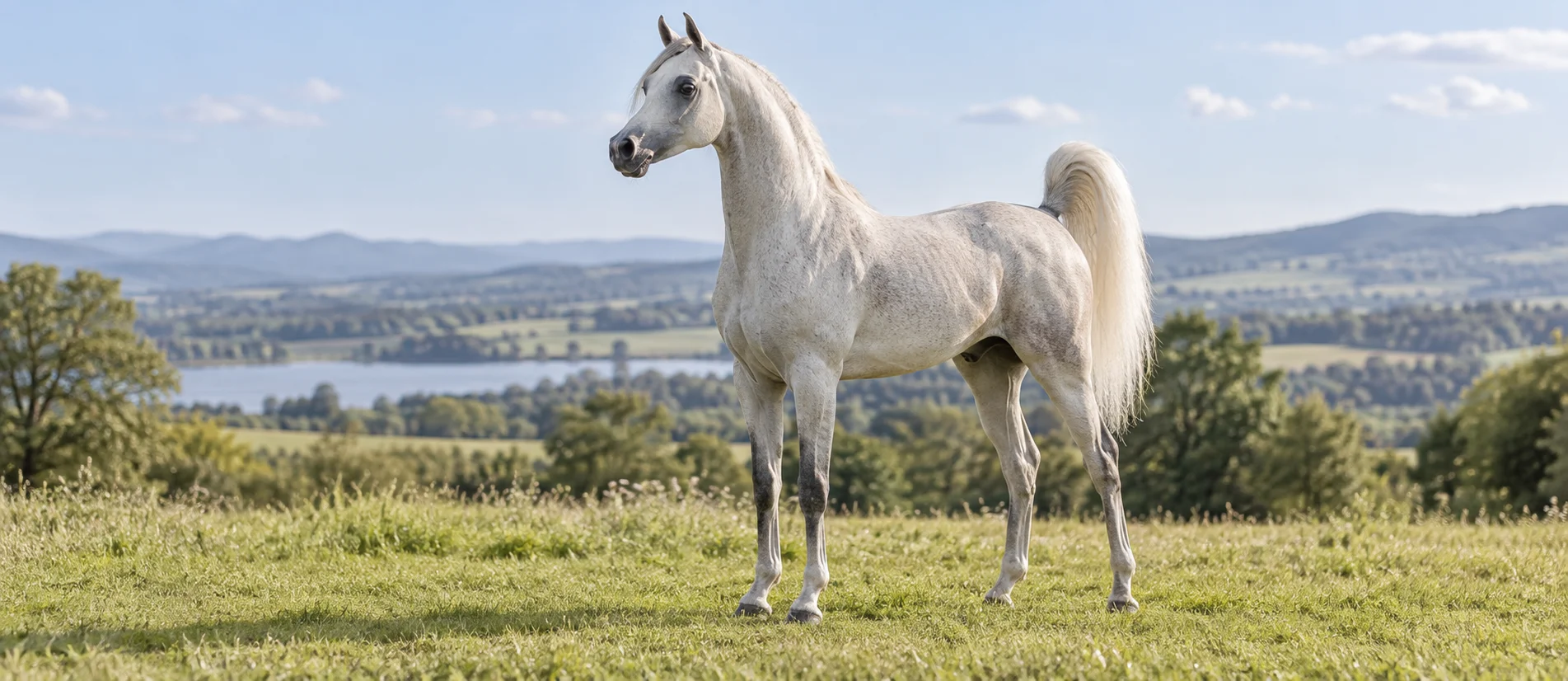
Ask a room of horse people which breed is the most recognisable, and someone will draw a dished face and a high, flagged tail in the air with one hand. That is the Arab. We have drawn it more than once at Stirrup & Oak, and every time we do, we find ourselves asking the same question: why does it look like that, and why has it mattered so much?
The answer starts in a hard place, with people who had good reasons to be particular about their horses. It runs through English racing, a couple of stubborn Victorian travellers, a President's stables and a near-loss in the twentieth century. Here is the story as well as we can tell it, with the myths marked as myths.
Bred in the desert, and bred for it
The Arab comes from the Arabian Peninsula, and its early history is thinner on paper than people like to admit. Rock carvings and later written sources show that horses were kept in the region for a very long time, but the exact moment the breed became the breed cannot be dated. Anyone who gives you a neat year is guessing.
What is better documented is how the Bedouin kept them. Horses were valuable and scarce in a land of little grazing and less water. A mare might live close to the family, and the tradition was that she was a companion as well as a mount. She carried her people on raids and on long journeys, and she was expected to cope on sparse feed and short water. A horse that could not do that did not stay in the breeding herd for long.
That is the work behind the build. The Arab is typically a lightly built, compact horse, often a little over fourteen hands, with dense bone, a short back and a naturally high carriage of the tail. Breed descriptions commonly point to fewer vertebrae in the back and tail than most other horses have. The large nostrils, the wide, dished forehead and the fine skin are usually linked to life in heat and dry air, though we would say that is an accepted explanation rather than something anyone can prove for the earliest horses. Stamina is the point that is beyond argument. Arabs are still the breed people reach for when the job is a very long day.
Temperament follows the same logic. A horse that lived beside a tent and was handled from birth learned to read people. Arabs are often described as quick, sensitive and bonded to their person. Anyone who has ridden one will tell you that is a gift and a responsibility in about equal parts. It is a horse that pays attention, so you had better give it something worth attending to.
Strains, mares and a legend we keep at arm's length
The Bedouin kept pedigrees in memory, and they traced them through the dam. The great families were called strains, with names such as Kuhaylan, Saqlawi and Hamdani that still appear in Arab pedigrees today. A horse belonged to its strain through its mother, and a well-known mare's line carried real prestige.
You will often hear the story of the five foundation mares, sometimes tied to the Prophet Muhammad and a test of thirst and loyalty on a long march. It is a lovely tale and it is widely repeated. It is a tradition, though, not a documented event, and we would rather say so than dress it up as history. What the tradition does capture accurately is the value the Bedouin placed on the mare and on the purity of her line.
That habit of careful, dam-led selection is why the Arab is called a pure breed in a sense that matters. When Europeans began collecting these horses, they were buying into centuries of deliberate choices, even if the record of those choices lived in people's heads rather than in a book.
How the Arab reached Britain, and built the Thoroughbred
You cannot tell the story of English racing without the Arab. The Thoroughbred descends from three famous imported stallions of the late seventeenth and early eighteenth centuries: the Byerley Turk, the Darley Arabian and the Godolphin Arabian. The Darley Arabian was bought in Aleppo by Thomas Darley and sent to the family's estate in Yorkshire in the early 1700s. The Godolphin Arabian stood at stud in England around the 1730s. Some sources have long called him a Barb, from North Africa, and the argument has never been fully settled, which is a good reason to be careful with the label.
The Darley Arabian's male line is the one that dominates the modern Thoroughbred, running down to the unbeaten eighteenth century racehorse Eclipse and on through most of today's racing pedigrees. So when you watch a Derby, you are watching, at some distance, the descendants of a horse that came out of Syria on a merchant's ship.
The nineteenth century added a different kind of interest. Travellers and diplomats began bringing desert horses home not to race them but to keep them as they were. In 1877 and 1878, General Ulysses S. Grant, on his tour after leaving the presidency, was given Arabian horses by the Sultan of Turkey, named Leopard and Linden Tree, which went to the United States. They are among the best known early Arabian imports there, and although few in number they helped plant the idea.
The Blunts, Crabbet and the stud book
The single most important British name is Crabbet. In the late 1870s Lady Anne Blunt and her husband Wilfrid Scawen Blunt travelled in the Middle East, met Bedouin breeders and bought horses directly from them. In 1878 they began the Crabbet Arabian Stud in Sussex. They kept records of what they had bought and where it came from, and they bred with a clear aim: to hold on to the desert type in an English field.
After the couple separated, their daughter Lady Wentworth, Judith Blunt-Lytton, took over the stud in the early twentieth century and ran it with great determination for decades. Among the horses that came to Crabbet was a stallion called Skowronek, imported from Poland in the first decade of the century, whose descendants were very influential. Crabbet stock was exported widely, so a good many Arabs in Britain, the United States, Australia and elsewhere trace back to that Sussex stud somewhere in their pedigrees.
Organisation followed enthusiasm. The Arab Horse Society was founded in Britain in 1918, and it keeps the breed's stud book. Across the Atlantic, the Arabian Horse Club of America was founded in 1908. It matters because a stud book turns a fashionable horse into a defined population: it says what counts as the breed, and it protects that answer over time.
In the United States, a further chapter came in 1906, when the writer and cartoonist Homer Davenport brought back a group of Arabian horses, commonly given as twenty-seven, bought from the Bedouin. That importation carried the support of Theodore Roosevelt, and it is remembered by American breeders as a significant moment. The horses' descendants are still traced by breeders who value those direct desert lines.
Wars, machines and what the Arab is now
The twentieth century nearly undid some of this. Two world wars and the coming of the engine took away many of the reasons to keep large studs. In Europe, historic studs suffered badly in wartime. Poland's state studs, among them Janów Podlaski, which has origins in the early nineteenth century, lost horses and staff in the Second World War and then had to rebuild. Elsewhere, the old Bedouin way of life was changing, and the desert herds that had produced the foundation lines were no longer sustained as they had been. That is why the studs, the stud books and the careful private breeders matter so much. They kept the record when the tradition that made it began to fade.
What the Arab does today is more varied than the desert image suggests. It is the breed of endurance riding, and it turns up at the top of long-distance events on both sides of the Atlantic. The Tevis Cup, the hundred mile ride across the Sierra Nevada in California, first run in the 1950s, has a long record of Arabians and part Arabians. The Arab also appears in showing, in driving, in dressage and in the family field, and it has been crossed with other breeds to give lightness and stamina to many others, the Thoroughbred being the most famous example of all.
In the UK, the Arab Horse Society sits at the centre of the breed, keeping the stud book and organising shows and rides. In the US, the Arabian community is large and varied, split by preference between show horses, sport horses and those who prize the old desert bloodlines. Those groups do not always agree about what an Arab ought to be, and that argument is part of the breed's story. It is a healthy sign, in a way: people only fight this hard over something they love.
When we draw the Arab, we try to keep hold of the three things the history keeps returning to. The head, dished and wide at the brow. The tail, carried like a banner. And the eye, which is large, dark and looks straight at you. Our plates are digital artwork in an engraving style, made by us. They are not antiques and we would never pass them off as such. What they can do is honour an animal whose long history was written by people who watched it carefully, day after day, for their own survival.
If you have ever stood beside an Arab and felt it take your measure, you already understand why so many people, across so many centuries, have taken such trouble over this one horse.
See it in the collection: The Arab collection