Breed Histories · 26 September 2026
The History of the Appaloosa
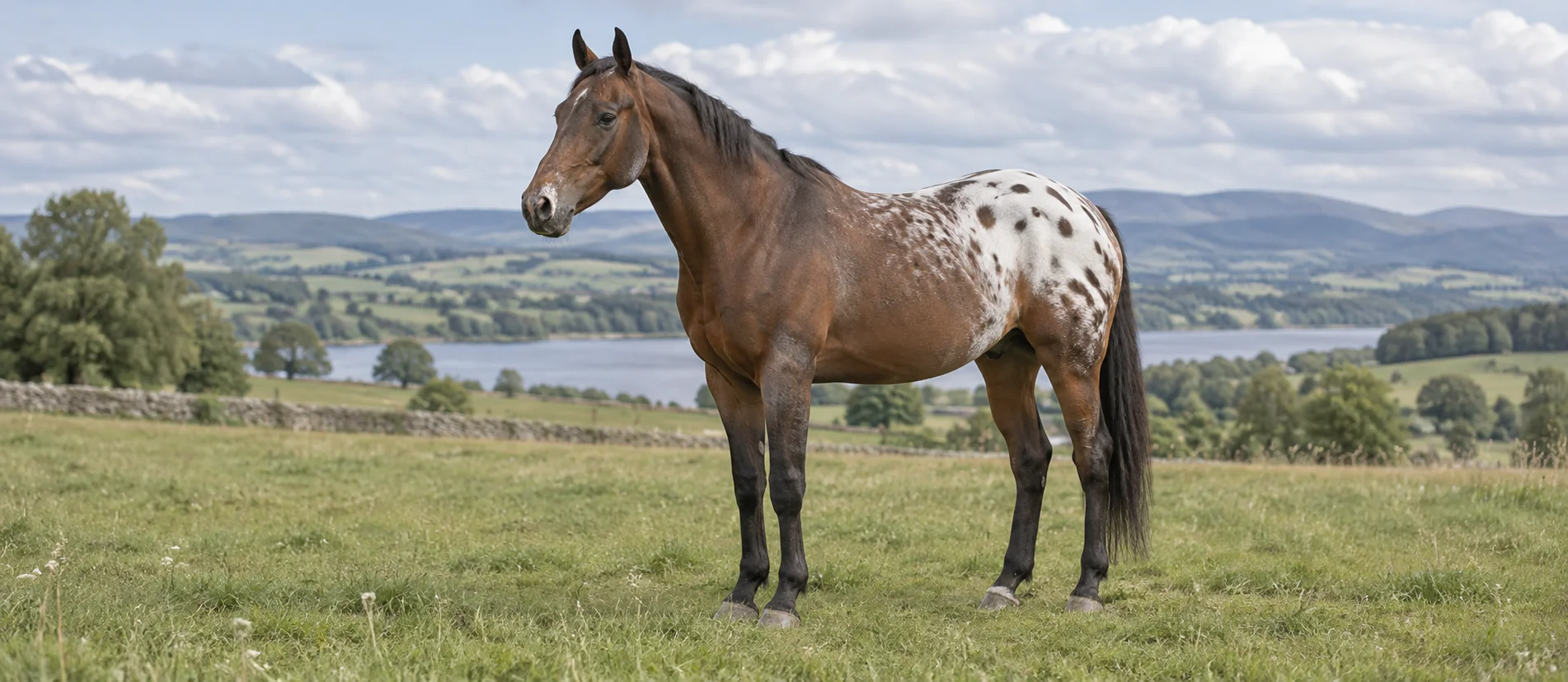
Would you know an Appaloosa if it walked past you in a field? Most people would, and that is half the trouble. The spots are so striking that we tend to stop at the coat and never ask where the horse came from. We think the story is worth more than that, so here it is, as plainly as we can tell it.
We should say at the start what we are and are not doing. We are telling the history that breed societies, museums and published breed histories support. Where a popular tale cannot be backed up, we leave it out or call it a myth. And when you look at the engraving-style plate of this breed in our archive, remember that it is digital artwork made in the spirit of old engraving. It is not an antique, and it is not hand-engraved.
Spots are older than the breed
The first thing to clear up is the idea that spotted horses began with the Appaloosa. They did not. Spotted horses are painted on cave walls in Europe, and the famous panel at Pech Merle in France shows spotted horses that people have long argued over. For a while it was fashionable to say the artists were simply being imaginative. Then ancient DNA from wild horse remains in Europe showed that a spotted coat pattern really did exist in horses of that age. The painters, it seems, were drawing what they saw.
Spotted horses turn up again and again in art from very different places and times, including Asian and European painting, and European portraiture of horses kept for show and ceremony. Several European breeds still carry spotting today, among them the Knabstrupper of Denmark and some spotted lines of the Noriker in the Alps. So the spotted coat is an old and widely shared thing. What the Appaloosa has is something narrower and more interesting: a particular history of people, land and work.
The Palouse and the Nez Perce
That history belongs to the Nez Perce, the people of the inland north west of America, whose country runs across what are now eastern Washington, north eastern Oregon and central Idaho. The name of the breed comes from that country. It is generally explained as a corruption of the Palouse, the name of a river and its rolling grassland, so that settlers speaking of "a Palouse horse" ended up saying "Appaloosa". It is a good example of a breed named by outsiders after a place, not by the people who made it.
Horses reached the Americas with the Spanish in the sixteenth century and spread north through trade, gift and raiding, reaching the peoples of the northern plateau in the course of the eighteenth century. The Nez Perce took to them with real skill. What sets them apart in the record is that they bred with intent. They kept the stallions they valued, gelded those they did not, and paid attention to which mares and which lines gave them the horse they wanted. Their country helped them. The plateau grazing was good, and the terrain was steep, broken and demanding, so a horse that could not carry itself over rough ground did not stay in the herd for long.
What was that work? It was travel, first of all, over high mountain country and long distances, including journeys to hunt and to trade across the ranges. It was also racing, which the Nez Perce prized, and it was riding in war and in the defence of their own land. A horse for that life needed sound feet, stamina, a steady head and the sense to look after itself. Those qualities are what people have long said about the Appaloosa since: a hardy, sensible, sure footed horse that will work all day. We would gently add that "temperament" in a whole breed is always a generalisation, and individual horses vary as they always do.
The explorers noticed. When the Lewis and Clark expedition passed through Nez Perce country in 1805, their journals record the horses the Nez Perce kept and speak well of them. It is worth being careful here, because it is easy to inflate this into a tale of the expedition praising "Appaloosas" by name. The journals do not use that word, and the breed as we know it was not yet named. What they show is a people already known for their horses.
1877 and the near loss
The turning point, and the saddest one, came in 1877. Conflict over land led to what is called the Nez Perce War. A large group of Nez Perce, with Chief Joseph among their leaders, set out on a long retreat of more than a thousand miles across the mountains, hoping to reach safety in Canada. They were stopped in October 1877 in the Bear Paw Mountains of Montana, a short distance from the border, and surrendered.
The people were removed from their homeland, and their horses were taken from them. Many were sold or scattered, and the careful breeding that had produced them came to an end. The breed was not wiped out, because spotted horses stayed in the hands of some ranchers and families in the region, but for decades there was no organised effort to keep the type together. Horses were bred with little record, and they were used as ranch and general working horses. The loss was real, and we would rather say so than tell only the cheerful half.
Two more forces worked against any spotted horse in that era. Mechanisation steadily reduced the demand for working horses of every kind across the twentieth century. And a flashy coat did not always suit the taste of the day, when many ranchers wanted plain, uniform colours. It is one of the reasons that so few people were actually breeding the spotted horse on purpose.
A stud book, and the horse comes back
The recovery starts in the 1930s with a small number of enthusiasts. A Western Horseman article in 1937 by Francis Haines, who studied the history of the Nez Perce and their horses, drew attention to the breed and to the fact that it was disappearing. In 1938 the Appaloosa Horse Club was founded in Oregon, led by Claude Thompson, to register the horses and set out what the breed was. It later moved to Moscow, Idaho, where the club is still based.
A stud book is what turns a scatter of spotted horses into a breed. The early registry recognised the foundation horses that could be found, and Old Joe is recorded as the first name on that list. To rebuild the type it also allowed outcrossing to other stock, notably the Quarter Horse and the Arabian, which is why many Appaloosas you see today have a more muscular, compact build than the lighter horses of the Nez Perce herds. Over time the registry tightened its rules about which breeds could be used, but the principle stayed: spots alone are not enough, the horse must be bred to a standard.
The Appaloosa has since become one of the best known Western breeds. Idaho named it the state horse in 1975. It is seen in Western riding, trail work, endurance, ranch work and racing, and it is a familiar sight in general riding as well. Its patterns have a whole vocabulary of their own, with blankets, leopard, snowflake, marble and frost among the terms, and its other markers are just as characteristic. The skin is often mottled, the hooves are commonly striped, and the white of the eye, the sclera, is easy to see.
What it means for the breed today
Because the spotting comes from a particular gene, breeders and vets today understand a good deal about the Appaloosa's health. Horses carrying two copies of the leopard complex gene can be affected by congenital stationary night blindness, and the breed has a higher recorded risk of equine recurrent uveitis, an eye condition. This is not a reason to look away from the horse. It is one of the things a responsible owner or breeder learns, and modern registries and vets do take it seriously.
The Nez Perce themselves have continued the story. In the 1990s the Nez Perce Tribe began a breeding programme, crossing Appaloosas with the Akhal-Teke to produce what is now called the Nez Perce Horse, and it was set up to honour the tribe's long connection with the horse. It is a reminder that this is not a closed chapter of history. The people the breed is named for are still working with horses.
In the United Kingdom, the Appaloosa is a smaller but well loved breed, looked after by the British Appaloosa Society, with owners who ride and show it across a range of disciplines. Here the horse sits alongside our own long history of native and spotted horses in art and in the show ring, so it feels both familiar and a little exotic. In the United States it is a breed with deep roots and a large registry. In both places, the people who love it tend to say much the same thing: that it is a horse with character, and a coat you never get tired of looking at.
That is what we find when we look past the spots. A breed shaped by mountain country and by the people who bred for what the work asked of it, nearly lost after 1877, and rebuilt on paper by a stud book and a few determined people. Every Appaloosa you see is a small piece of that story walking about in the daylight, and we think it deserves to be told properly.
See it in the collection: The Appaloosa collection