Breed Histories · 26 September 2026
The History of the Andalusian Horse
Have you ever watched an Andalusian come into a canter and wondered why it looks as though it has been taught to dance since birth? It has, in a sense. Not the individual horse, but the breed. Centuries of asking the same kind of horse to do the same kind of work left a shape and a temperament that riders still recognise across a field.
We draw horses for a living, so we spend a lot of time looking at how a body carries its history. The Andalusian carries more than most. This is our account of where it came from, what it was for, and how it survived the things that could have ended it.
An old horse from the Iberian Peninsula
The Andalusian belongs to Iberia, the peninsula that today holds Spain and Portugal. Horses have lived there for a very long time, and writers of the ancient world noticed them. Iberian horsemen and their mounts turn up in accounts of the wars between Carthage and Rome, and the cavalry tradition of the peninsula was already respected long before the Middle Ages.
A second layer arrived in 711, when Muslim armies crossed from North Africa and began a rule in southern Iberia that lasted, in some form, for centuries. The south of Spain, the region of Andalusia that gave the horse its name, became a meeting point of horse cultures. North African riding styles and horses met the Iberian stock already there.
Here we should be careful, because this is where a popular story gets tidier than the evidence. You will often read that the Andalusian is simply a Barb horse brought over from North Africa. The truth appears to be less one-directional. Horses moved both ways across the Strait of Gibraltar for a very long time, and the Iberian horse was already there and already valued. The Andalusian is best described as a native Iberian horse shaped by many hands, not a single import.
The name itself reflects the breed's home. In Spain the horse is officially known as the Pura Raza Española, the Pure Spanish Horse, and Andalusian remains the everyday name in English-speaking countries. The Portuguese cousin, the Lusitano, has its own stud book. The two share deep roots but are recorded separately.
What it was bred to do
An Andalusian was never bred for a single job. It was a working horse in a country that asked a great deal of its horses, and a few kinds of work did most of the shaping.
The first was war. The Spanish light cavalry tradition, known as riding a la gineta, needed a horse that could turn quickly, stop hard and change direction without being asked twice. Big, slow horses were no use in that style of fighting. A compact, agile, willing horse was. That preference is still visible in the breed's short, strong back, its powerful hindquarters and its ability to gather itself and sit down behind.
The second was the ranch. Andalusia has a long tradition of managing cattle from horseback, including the fighting bulls, and the riding style that grew out of it, doma vaquera, is still practised and competed in today. Working stock all day rewards a horse that is calm, intelligent and quick to read what a rider wants. It punishes a nervous one. Generations of breeders kept the horses that coped, and the breed's reputation for a cooperative temperament grew from that quiet selection.
The third was the manege. Schooling horses to perform collected, elevated movements began as serious military training, since a horse that could rear, pivot and leap was a horse that could protect its rider in close fighting. Over time those movements became an art in their own right. The Andalusian's natural tendency to carry weight on its hindquarters, its high, rounded action and its arched neck made it a natural for this work.
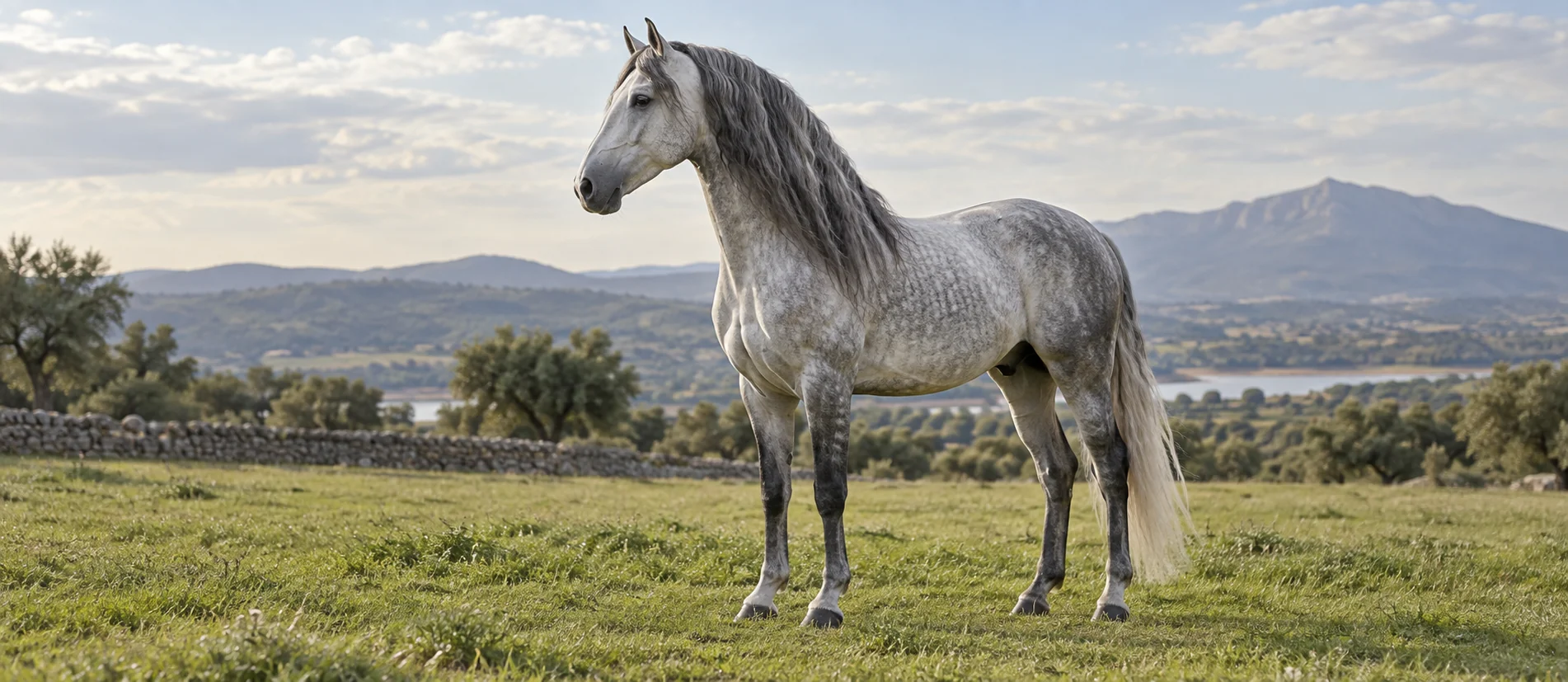
Put those three jobs together and you get the horse you would draw. Medium in height, deep through the body, a strongly crested neck, a full mane and tail, and an expressive head. Most Andalusians you see are grey, though bay and other colours are recognised. None of that is decoration. It is the outline of a working history.
The Carthusians, the crown and the stud book
Breeding horses on purpose in Spain was never a small affair. The crown took an interest, and in 1567 Philip II established a royal stud at Córdoba, a name that still carries weight in the breed's story. Spanish horses had by then become a prized export and a diplomatic gift, and buyers across Europe wanted them.
Their influence travelled a long way. In 1580 the Habsburg court founded a stud at Lipica, in what is now Slovenia, using Spanish horses. That stud gave rise to the Lipizzaner, and the Spanish Riding School in Vienna, which took its name from those same Spanish horses, is still known today for the airs above the ground. The Andalusian's fingerprints are all over classical riding.
English readers may like to know that the horse had admirers here too. In the seventeenth century William Cavendish, Duke of Newcastle, wrote a well known treatise on horsemanship in which he spoke very highly of the Spanish horse. It was, in his view, among the very best a rider could choose. That is one Englishman's opinion from a long time ago, but it shows how far the breed's name had spread.
Then there is the horse's overseas story. Horses of Spanish stock crossed the Atlantic in the years after Columbus, and they became foundation stock for horse populations across the Americas. Many of the American breeds that developed later carry some of that Iberian blood. When someone in the US tells you the Andalusian is an ancestor of the horses that shaped their country's riding heritage, they are on solid ground, although how much each breed owes to it is a matter historians still discuss.
The hardest period came later. Wars, disease and changing fashions all took their toll. The Napoleonic invasion of Spain in the early nineteenth century brought disruption to Spanish horse breeding, and the following decades saw many breeders cross their horses with heavier or different types, chasing whatever the market wanted at the time. The old type was diluted in many places.
What held on were a few careful breeders, and above all the Carthusian monks. The monastery of the Cartuja near Jerez de la Frontera kept a horse breeding programme for centuries and became known for the discipline with which it protected its lines, keeping records and refusing to chase fashion. Horses of Carthusian breeding are still spoken of with a certain reverence by Andalusian enthusiasts. Other private breeders also guarded old bloodlines through difficult years, but the monks are the name people remember.
Formal recording followed. The Spanish state, through its military horse breeding service, began keeping a stud book for the breed in the early twentieth century, and today the Spanish breeders' association, ANCCE, manages the stud book of the Pura Raza Española. Mechanisation cut the demand for horses everywhere, cavalry included, and the Spanish Civil War of the 1930s was another hard blow to livestock of every kind. A registered population, with an agreed standard and recorded parentage, was what turned a set of scattered bloodlines into a breed that could be counted, protected and rebuilt.
The Andalusian today, in the UK and the US
The modern Andalusian has moved from the battlefield and the bull pen into the arena. It is a familiar sight in dressage, where its natural collection and its willingness are an advantage, and in classical and working equitation. Doma vaquera and the mounted bullfighting tradition of Spain continue in their homeland. Outside Spain, many Andalusians are simply much loved riding horses and family companions.
Breed societies now exist in many countries, including the UK and the US, and the horse has its own following among people who might never have expected to own a Spanish horse. Owners speak most often about its temperament. Bred over so many centuries to work close to a rider, it tends to be attentive and people oriented. We would not claim every individual is the same, since horses are not that obliging. But the pattern is consistent with the work the breed was asked to do.
There is also a point worth making about what that history means. A breed with a long record is a kind of memory. The Andalusian nearly lost some of its old lines in the nineteenth century, and it was people with patience, monks, stud keepers and eventually a national stud book, who kept them. The horses you see now are, in a real sense, a piece of shared work that stretches back a very long way.
Our plates of the breed are digital engraving-style artwork. They are made now, not centuries ago, and we do not pretend otherwise. What we try to do is honour the shape itself: the crested neck, the deep body, the wide eye. If you would like the Andalusian on something you can wear or hang, the link below takes you to the breed's page in our shop.
See it in the collection: The Andalusian collection