Horse Habits · 23 November 2026
That Curled Lip Smile: Why Horses Pull The Face They Do
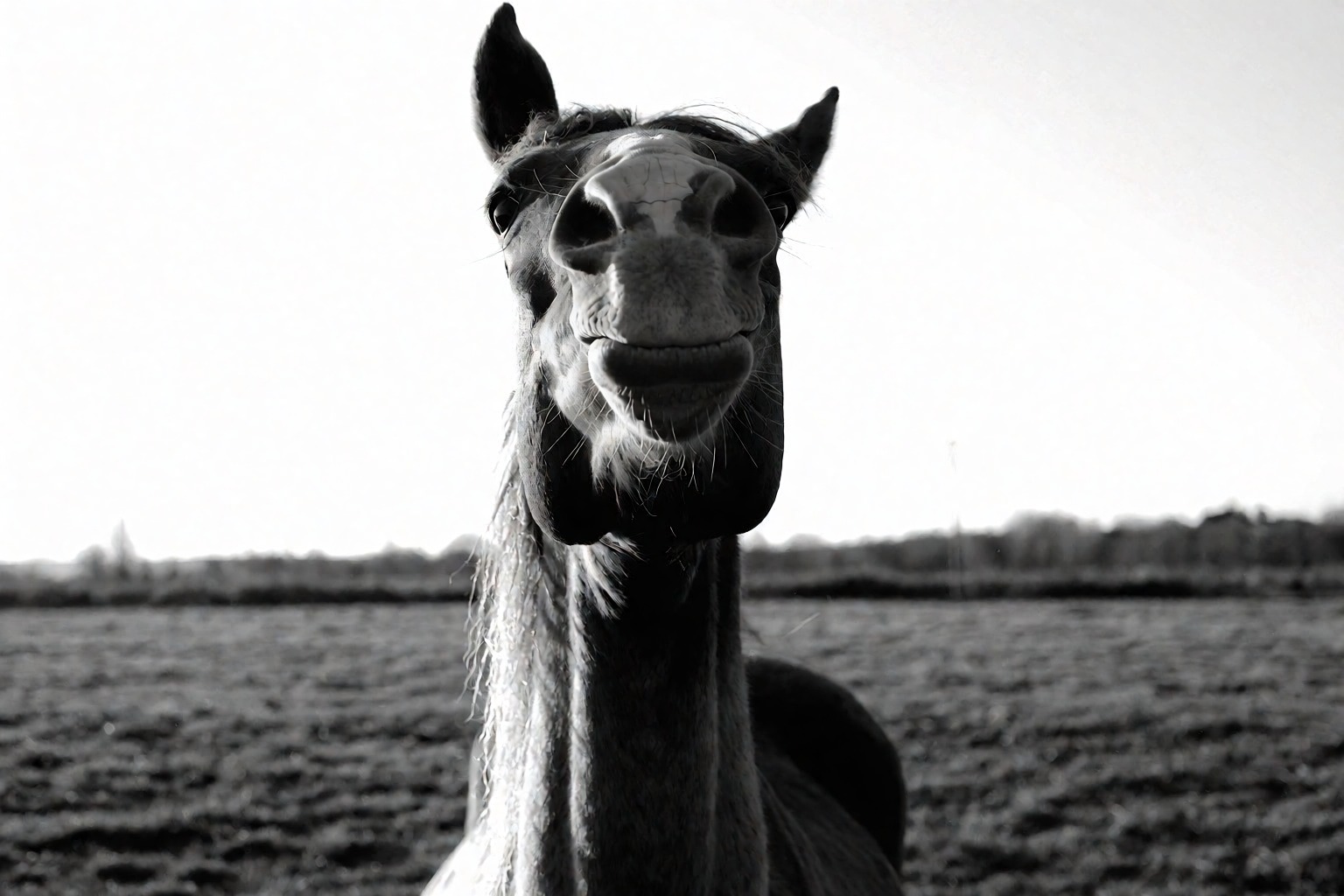
Why does a horse pull that curled lip, show its teeth and stretch its neck out as though it has heard the best joke of the week? It is called the flehmen response, and it has nothing to do with happiness. The horse is testing a smell, not smiling at you.
It is the natural reading. The lip curls back off the teeth, the head goes up, the neck goes long, and for a few seconds the horse looks like it is grinning at the sky. But that face is doing a job, and the job is smelling, not smiling.
What is the flehmen response?
The flehmen response is a horse's way of moving a scent to a special organ at the roof of its mouth so it can work out exactly what the smell is. Curling the top lip back closes off the nostrils to ordinary breathing and opens a small duct behind the front teeth, called the vomeronasal organ, or sometimes the Jacobson's organ. Air carrying the scent gets trapped there and held against sensitive tissue for longer than a normal sniff would allow, which gives the horse far more detail than its nose alone can gather.
The word itself comes from German and roughly means "to bare the upper lip", which is a fair description of what you are watching. The behaviour is not limited to horses either. Cats, goats, deer and plenty of other mammals do a version of the same thing, usually recognisable by the same stretched neck and curled lip. In cats it is subtler and often mistaken for a sour face; in horses it is unmistakable because the whole head goes up and the lip rolls right back.
Recognising this behaviour matters because a horse's face is not built on the same muscles or the same signals as ours, so the shapes it pulls mean something quite different from what they would mean on a person. Flehmen sits alongside other everyday behaviours, licking, chewing, the position of the ears, that together make up how a horse tells you what it is experiencing, once you know how to read them.
What makes the flehmen face so convincing as a smile is that it borrows the same shapes we use for one. Lifted lip, visible teeth, head tilted back: on a person, that is pure delight. On a horse, it is closer to the expression you might pull yourself while trying to place an odd smell in a room, head tipped, concentrating, mouth slightly open. The resemblance to joy is a coincidence of anatomy, not a shared feeling.
Why do horses pull this face?
Horses do it most often around strong or unfamiliar smells, and there are a few situations where you will see it come up again and again.
A stallion will flehmen in response to a mare's urine, particularly when she is in season, because the scent carries information about her reproductive state that he is built to read in detail. This is the context most people have seen without necessarily clocking what it was, since it is the one most often filmed and shared. It is also one reason the behaviour gets wrongly filed under "horse things" rather than understood for what it is: a working sense organ being put to use.
But it is not only about mares and stallions. Geldings and mares both do it, and foals do it too, sometimes within hours of being born, often directed at their own mother or at unfamiliar adults who approach the stable. A newborn foal testing its mother's scent this way is thought to be part of how it begins to recognise her specifically, among the general business of learning who is who in a new and confusing world.
Horses will also flehmen at new feed, at medication mixed into food, at an unfamiliar rug or blanket that has been somewhere else, at another horse's manure, and sometimes at a smell with no obvious source at all, simply because it is new and strong enough to be worth a proper look. Some horses will do it at a hand that has just handled something strongly scented, at a fence post marked by another animal, or even at a particular patch of grass. The common thread is not the type of smell so much as how unusual or concentrated it is. An ordinary, familiar smell rarely earns the full flehmen treatment; something sharp, new or loaded with information usually does.
Flehmen fits best among the ordinary investigative actions a horse uses to gather information about its surroundings, rather than anything emotional. It sits alongside sniffing, nudging and the slow, careful approach a horse makes toward something it has not met before. In that sense the flehmen face is the endpoint of a horse's curiosity rather than the start of it: first the ears prick, then the nose goes out, and only once the smell proves interesting enough does the lip curl back for a proper reading.
Is it ever a sign of pain or a problem?
Almost always, flehmen is nothing to worry about. It is brief, it passes within a few seconds to half a minute, and the horse goes back to whatever it was doing beforehand without any other change in behaviour. You might see it once at turnout, once over a feed bucket, and not again all day.
There is one situation where it is worth paying closer attention. If a horse is repeatedly curling its lip without an obvious smell to react to, especially alongside other signs such as flank watching, pawing, reluctance to eat, or general restlessness, that pattern can sometimes point toward abdominal discomfort or mouth pain rather than ordinary scent investigation. An occasional flehmen response on its own is not a symptom, but any unusual repeated grimacing or lip curling that comes with other signs of distress is worth a call to your vet rather than a guess. The flehmen face in isolation, done once or twice around a strong smell and then finished with, is completely normal and nothing to act on.
The easiest way to tell the two apart is context. A horse that lifts its head, curls its lip at a new bag of feed or a strange horse's droppings, and then carries on grazing is doing exactly what its nose and that little organ behind its teeth are designed for. A horse that keeps doing it out of nowhere, looking uncomfortable between times, is telling you something different, and that is the one to get checked. Owners who know their own horse's ordinary habits are usually the first to notice when a familiar behaviour starts turning up at the wrong times or for longer than usual, which is exactly the kind of change worth mentioning to a vet even if nothing else seems obviously wrong yet.
What this means for anyone watching their horse
Once you know what the flehmen response actually is, it is hard to see it as a smile again, though it is easy to see why people read it that way. The shape of the face does the trick: lifted lip, visible teeth, head tipped back. It looks for all the world like delight. What is actually happening is closer to a long, careful sniff than a laugh, a horse pulling every bit of information it can out of a smell that caught its attention.
It is one of those small pieces of behaviour that rewards a bit of knowing. Next time a horse in a field does that strange, toothy stretch at the fence line or over a feed bucket, you will know it is not being soppy. It is doing something closer to reading a label than cracking a smile, and there is something rather good about a creature built to find that much detail in a single breath of air. The next time someone tells you their horse is grinning at them, you will have the real story, and it is a better one than the smile: a whole organ built for nothing but working out exactly what it is smelling.